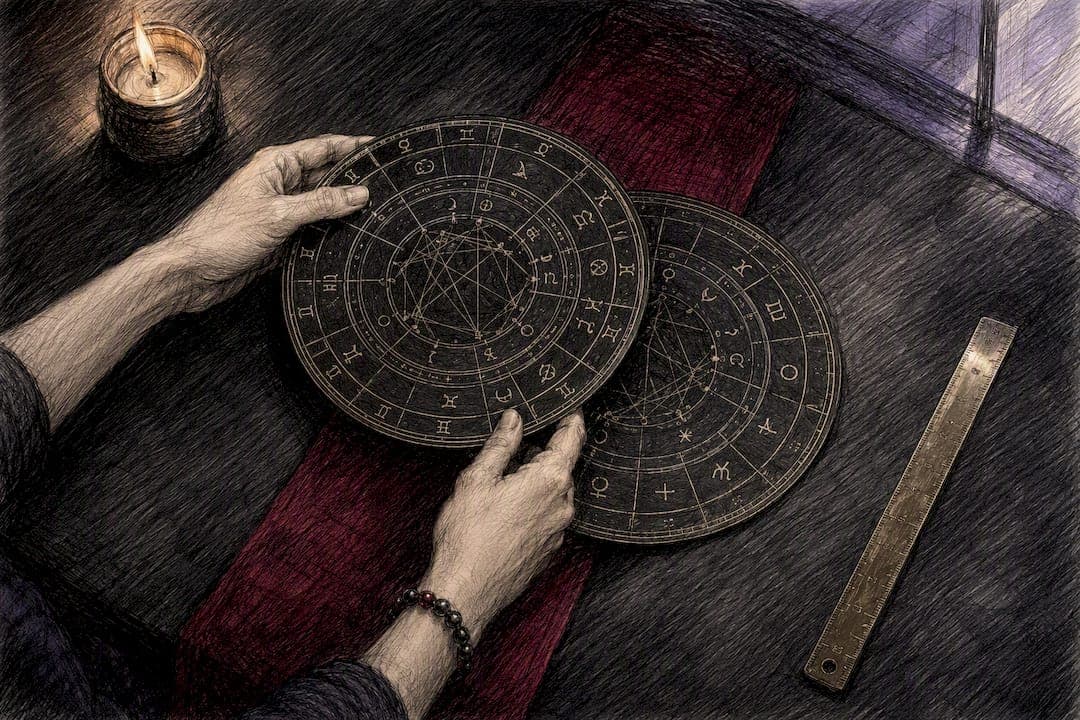
Comparing birth charts means running a synastry read to find the strongest planetary contacts between two people. That read shows tension and harmony points. Composite and Davison charts add a separate layer, describing the relationship itself and its timing. Birth-time accuracy affects how much you can trust the results. The next sections walk through the exact steps.
TL;DR:
- The most important aspect to analyze is the tightest, most weighted contact, typically between personal planets within a one to two-degree orb.
- Using a three-degree orb as a cutoff helps identify relevant aspects without including too much noise in the reading.
- Knowing the accuracy of birth times is crucial, especially for house overlays and Ascendant contacts, which can shift significantly with uncertain timing.
- Prioritizing the big three contacts—Sun to Sun, Sun to Moon, and Moon to Moon—guides you toward core relationship dynamics before considering less impactful aspects.
- Nodal and Chiron contacts add depth but should not override primary planetary aspects, especially when understanding the basic tone and potential challenges of the relationship.
Table of Contents
- What Synastry, Composite, and Davison Charts Actually Show
- Which Placements to Compare First in a Birth Chart Comparison
- How to Compare Two Birth Charts: A Step-by-Step Workflow
- Reading the Headline Contacts Without Losing the Thread
- Working With Missing or Uncertain Birth Times
- Accuracy Notes: Why Precision and Orb Choices Matter
- How Tarosyn's AI Synastry Readings Fit Into a Comparison
- The Role of Nodes and Chiron in a Relationship Comparison
- Using Synastry Insight Without Losing Sight of the People Involved
- Get an Interpreted Synastry Reading With Tarosyn
- Where to Verify the Numbers Yourself
- Sources
What Synastry, Composite, and Davison Charts Actually Show
Synastry overlays two natal charts and maps every contact between them. Practitioners build a 5×7 grid, one person's planets across the top, the other's down the side, and scan it for the tightest, highest-weight aspects. That grid is the raw material. It doesn't summarize the relationship on its own.
Composite and Davison charts do that summarizing job, but they answer different questions:
- Composite chart: an arithmetic midpoint between two charts. It never corresponds to a moment in the sky, but it describes the tone and texture of the relationship as a unit.
- Davison chart: a real chart cast for the exact midpoint in time and location between two birth moments. Because it reflects an actual sky, Davison charts are generally preferred for timing questions, like when a relationship might intensify or shift.
Run synastry first. It tells you how two people affect each other. Composite and Davison come next, once you want to know what the relationship looks like as its own entity.
Which Placements to Compare First in a Birth Chart Comparison
Not every planetary contact deserves equal attention. A prioritized checklist keeps you from drowning in dozens of aspects before you've found the ones that matter.
Start with the Big Three:
- Sun to Sun, Sun to Moon: core identity and emotional recognition. This is usually where attraction or friction first shows up.
- Moon to Moon: emotional rhythm. Mismatched Moons often explain why two otherwise compatible people feel out of sync at home.
- Ascendant contacts: first impressions and daily behavior style, but only reliable when both birth times are accurate.
Then move to the relationship planets:
- Venus and Mars: values, affection style, and attraction. Venus square Mars can create genuine chemistry and genuine friction in the same breath.
- Mercury: how you argue, joke, and explain yourself to each other.
Once times are confirmed, layer in Saturn (commitment and long-term pressure), outer planet contacts (Uranus, Neptune, Pluto for intensity and transformation), and the angles.
Pro Tip: Read in order, not by volume. Start with the single loudest contact, then the next five or six, then house overlays. Scanning the full grid before you've anchored on the headline aspect is the fastest way to lose the thread of what actually matters.
How to Compare Two Birth Charts: A Step-by-Step Workflow
You need three inputs for each person: birth date, birth time, and birth location. If the time is missing, most calculators let you substitute noon as a placeholder, though anything tied to the Ascendant or house cusps becomes provisional.
- Calculate both natal charts individually first. Confirm the birth data is entered correctly. A transposed digit in the birth time can shift a house cusp enough to change the whole read.
- Generate the synastry overlay. Most free tools produce a bi-wheel and a ranked list of inter-aspects automatically.
- Review the top six headline contacts. Astrolium's synastry tool ranks aspects by tightness times weight and reports orb to the arc minute, which is the level of detail you want before drawing conclusions.
- Cast the composite and, if timing questions matter, the Davison chart.
For calculator settings, filter aspects by orb (three degrees or tighter is a reasonable starting cutoff), display houses, and flag whether each aspect is applying or separating. Record the headline planet pair, the exact orb, the aspect type, and which house the contact activates. That short note is what you'll actually reference later.
Reading the Headline Contacts Without Losing the Thread
The headline aspect is whichever contact is tightest and carries the most weight, usually a major aspect between personal planets within a degree or two. That contact sets the tone for the whole reading, so it leads, not the total number of hits.
Harmony aspects (trine, sextile) show where energy flows without effort. Tension aspects (square, opposition) show friction, but friction isn't automatically bad. A tight Venus square Mars often produces real attraction alongside real disagreement. Context decides which way it leans, not the aspect name.
House overlays tell you where the relationship shows up in daily life:
- Planets landing in the 4th house point toward home and family themes.
- Contacts in the 7th house speak directly to partnership and commitment.
- Activity in the 10th house suggests the relationship intersects with career or public life.
A high compatibility score from any calculator is a description of terrain, not a verdict on the relationship's future. Two charts can show heavy tension and still work, and two charts full of trines can still end quietly.
Working With Missing or Uncertain Birth Times
Planet signs and most major aspects between personal planets hold up fine even without an exact birth time, since planets other than the Moon rarely change sign within a single day. The Moon is the exception. It moves quickly, so an uncertain time can put it in a different sign or degree entirely, which affects Moon-based aspects and lunar house placement.
Ascendant, house cusps, and any angle-dependent finding should be labeled tentative when the time is unconfirmed. If the relationship reading hinges on Ascendant compatibility or a house overlay, that's the point to consider professional rectification rather than guessing.
Accuracy Notes: Why Precision and Orb Choices Matter
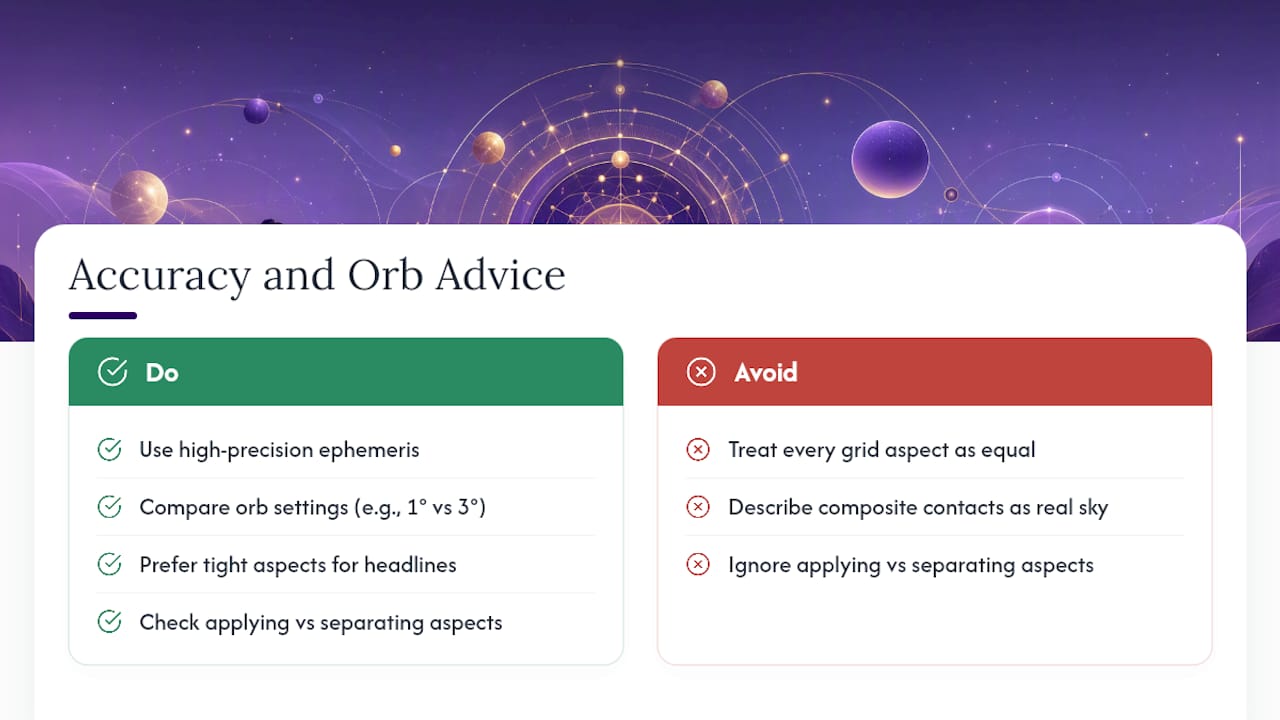
Calculation precision isn't a minor technical detail. Tools built on the Swiss Ephemeris calculate positions to within one arc second, and that level of accuracy is what keeps house cusps and tight aspects reliable. A calculator using a looser method can shift an angle enough to change which contacts even qualify as headline aspects.
Orb settings shift the read too. A three-degree orb catches different contacts than a one-degree orb, so two calculators can disagree about what's headline and what's noise.
Pro Tip: Watch for three common mistakes: treating every aspect in the grid as equally significant, describing a composite chart's contacts as if they occurred in the actual sky, and ignoring whether an aspect is applying (building) or separating (fading).
How Tarosyn's AI Synastry Readings Fit Into a Comparison
Tarosyn's AI Birth Chart feature generates a personalized natal reading, then extends that into relationship interpretation through synastry comparison. The guides on how a birth chart works and what synastry actually measures walk you through the same placements covered above, so the AI interpretation builds on a foundation you already understand. Saved reading history lets you revisit a comparison later without re-entering birth data.
The Role of Nodes and Chiron in a Relationship Comparison
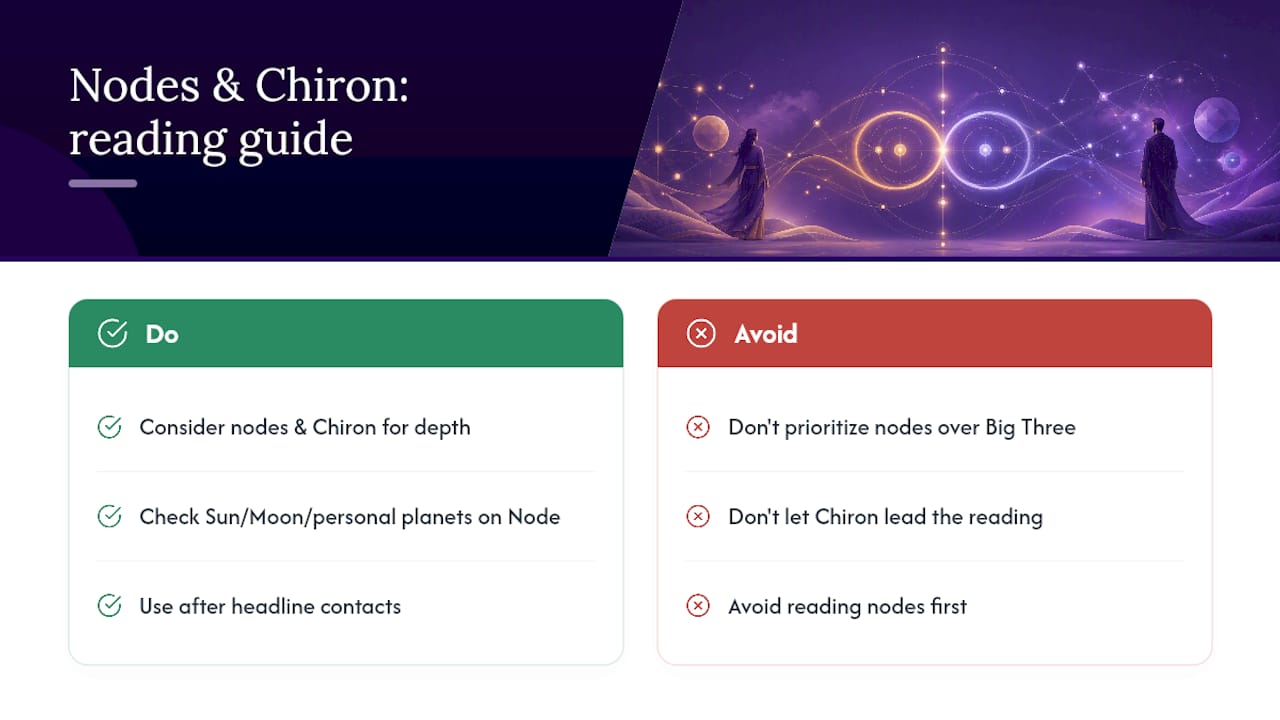
The North and South Nodes rarely get the same attention as Venus and Mars, but they carry real weight in a synastry comparison. Nodal contacts, especially one person's Sun, Moon, or personal planets landing on the other's North Node, often show up in relationships that feel purposeful or fated from the start. The South Node side of that same contact can point to old patterns resurfacing, familiar dynamics that feel comfortable precisely because they're not new.
Chiron works differently. It marks a wound, and in synastry, a contact between one person's planets and the other's Chiron often signals a relationship where healing and hurt sit close together. Someone landing a planet on a partner's Chiron can become either a source of real comfort or a person who repeatedly triggers that old sensitivity, sometimes both at different points in the relationship.
Neither the Nodes nor Chiron should lead a reading. They're not part of the Big Three or the primary relationship planets, and treating a Node contact as more important than a tight Sun square Moon inverts the hierarchy that makes a comparison useful. Read them after the headline contacts and house overlays are already clear. Used that way, they add depth. Used first, they distort the picture before you've even established the relationship's basic tone.
Using Synastry Insight Without Losing Sight of the People Involved
A synastry read is a conversation starter, not a verdict. Use it to ask better questions: where does this contact show up in real life, does this tension feel generative or draining, what pattern do we want to build together. Always get consent before running someone else's birth data through a comparison tool, since a chart is personal information even when the intent is playful. For deeper grounding before your next comparison, Tarosyn's synastry guide is a solid starting point.
— Joseph Calitoy
Get an Interpreted Synastry Reading With Tarosyn
Running the grid yourself tells you what the contacts are. Tarosyn's AI-assisted synastry reading tells you what they mean for your specific situation, translating headline aspects and house overlays into plain language without losing the nuance a raw chart comparison can bury.
Tarosyn's AI Birth Chart generates a personalized natal reading, and the synastry feature extends that into a full relationship comparison, calculating the overlay and interpreting the headline contacts in context. If you'd rather explore compatibility through a different cultural lens first, the Mayan sign compatibility calculator offers another angle worth trying. When you're ready to see your own chart alongside someone else's, start a free synastry reading on Tarosyn's synastry page and see what your headline contact actually says.
Where to Verify the Numbers Yourself
If you want to double check a calculation, Astrolium's synastry tool ranks inter-aspects and shows composite and Davison outputs side by side. The Swiss Ephemeris precision explainer breaks down why calculation libraries matter for house cusps. For unknown birth times, Cafe Astrology's compatibility report explains how to handle missing data responsibly.
Sources
- Natal Compare — Free 2026 | Astrolium
- Swiss Ephemeris precision explained | Paramarsh
- Free compatibility report - Cafe Astrology