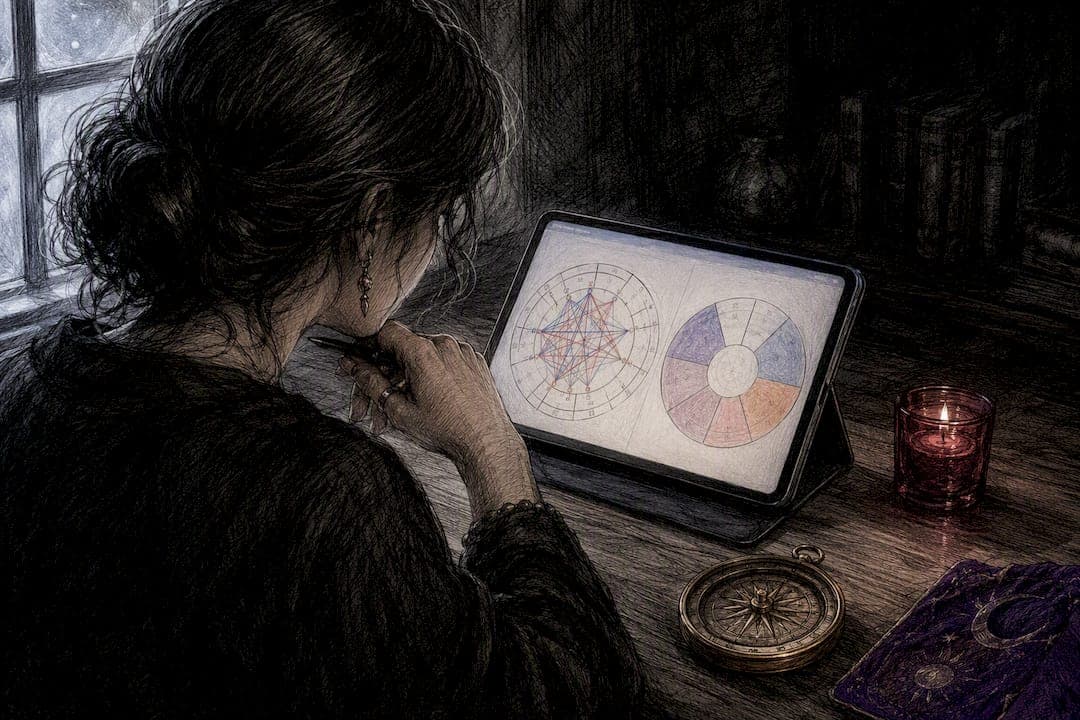
Synastry compares two natal charts to show how two people affect each other, chemistry, friction, attraction, and daily dynamics. Composite creates one chart that represents the relationship itself as its own entity, its purpose, its long-term arc, its timing. Read your natal charts first, then synastry, then composite, in that order.
TL;DR:
- Synastry highlights immediate chemistry through Sun-Moon, Venus-Mars, and emotional Moon aspects, but house overlays can shift significantly with uncertain birth times.
- Composite charts reveal the relationship's core identity, emotional baseline, and external presentation, but they are more symbolic and less reliable for precise timing.
- Timing and accuracy are better managed with transits and progressions on synastry and composite charts, although houses are sensitive to birth time precision.
- Use synastry first for new relationships to assess attraction, then turn to the composite for long-term purpose and identity insights, especially after some shared history develops.
- Combining both charts provides layered insights, but they often answer different questions and may produce seemingly conflicting signals that are still valuable.
Table of Contents
- What Is Synastry, and What Does It Actually Show You?
- What Is a Composite Chart, and What Does It Reveal?
- How Do Synastry and Composite Charts Differ in Practice?
- When Should You Use Synastry vs a Composite Chart?
- How Do You Read Synastry and Composite Together?
- What Do People Get Wrong About Comparing These Charts?
- Who's Behind This Guide, and Why Trust It?
- Why Most People Read These Charts in the Wrong Order
- Run Both Charts Without Doing the Math Yourself
- Sources
- FAQ
What Is Synastry, and What Does It Actually Show You?
Synastry lays two birth charts on top of each other in a biwheel and measures the aspects between them. You are not looking at either person alone. You are looking at the space between them.
A few contacts carry more weight than others. Look for these first:
- Sun-Moon aspects between charts, which often signal a strong sense of recognition or "knowing" each other quickly.
- Venus-Mars contacts, tied to attraction and romantic or sexual chemistry.
- Moon-to-Moon or Moon-to-personal-planet aspects, which shape emotional comfort and how safe two people feel together.
- Outer-planet contacts (Saturn, Uranus, Pluto) touching personal planets, which tend to show commitment, disruption, or intensity depending on the aspect.
House overlays matter too. If your Venus falls in your partner's seventh house, for example, that placement colors how partnership feels between you. But house overlays depend on exact birth times. A birth certificate with a rounded or missing time can shift house placements enough to change the reading entirely, so treat house-based claims cautiously when a birth time is uncertain.
What Is a Composite Chart, and What Does It Reveal?
A composite chart is not two charts combined. It is a new chart built by averaging the zodiacal midpoint of each planet and angle between two people, creating a single symbolic entity that represents the relationship itself. Some practitioners use the Davison chart instead, which finds the actual midpoint in time and space rather than averaging positions, a distinction worth knowing but not essential for most readers.
Three placements do most of the interpretive work:
- Composite Sun shows the relationship's core identity and stated purpose.
- Composite Moon reveals its emotional baseline, how the partnership feels from the inside.
- Composite Ascendant shows how the relationship presents itself to the outside world.
Saturn and Venus in the composite add structural tone and affection style, giving a fuller picture of the relationship's character. You can also progress or transit the composite chart to time shared events, a breakup, an engagement, a career shift affecting both people, using the same techniques you would apply to a natal chart. Because midpoints are symbolic rather than tied to a real moment in time, some astrologers treat composite timing as softer and more thematic than transits to an individual's natal chart.
How Do Synastry and Composite Charts Differ in Practice?
The two charts are built differently, and that difference changes what you can reliably do with each one.
- Calculation. Synastry overlays two real charts and measures aspects between them. Composite averages midpoints into one symbolic chart. Davison finds an actual midpoint moment in time and space.
- Timing capability. Davison charts and natal charts can be transited and progressed using standard methods. Composite charts can be transited too, but because the chart itself is a symbolic construct rather than a real event, some practitioners treat that timing as looser.
- Reliability. Synastry house overlays and composite house placements both suffer when birth times are inexact. Aspects hold up better than houses when data is shaky.
When Should You Use Synastry vs a Composite Chart?
Start with the question you're actually asking. Chemistry questions point to synastry. Structural or timing questions point to composite.
- New relationship, wondering if there's a spark? Run synastry first. It reflects immediate, felt dynamics more directly than a composite ever will.
- Long-term partnership, wondering where it's heading? Lean on the composite. It speaks to shared purpose and identity once a relationship has enough history to have formed one.
- Business partnership or close friendship? Composite often matters more here than romantic chemistry does, since the question is usually "does this collaboration have staying power," not "is there a spark."
- Family relationships? Synastry tends to be more useful, since family bonds aren't chosen and don't need a "purpose" reading the way a partnership might.
Pro Tip: If synastry looks rocky but you're only three dates in, don't rush to a composite reading. Let the relationship exist long enough to have an identity worth reading.
If a relationship shows harsh contacts in both charts at once, especially around Saturn, Pluto, or the seventh house, that's less an astrology puzzle and more a sign to talk to a therapist or counselor, not just a chart.
How Do You Read Synastry and Composite Together?
Running both charts only helps if you read them in the right order and know what to do when they disagree.
- Confirm birth data. Exact birth times matter more here than almost anywhere else in astrology, especially for house-based claims.
- Read each natal chart alone first. You need to know each person's baseline before you can tell what's being amplified or challenged.
- Run the synastry overlay. Note the Sun-Moon, Venus-Mars, and Moon contacts first.
- Generate the composite. Look at the composite Sun, Moon, and Ascendant for the relationship's core identity.
- Layer transits. Apply current transits to the composite to time upcoming shifts.
Conflicts are common and meaningful. Strong synastry paired with a harsh composite often points to real chemistry inside a relationship that struggles to sustain itself structurally. Tense synastry paired with a strong composite can mean day-to-day friction sits inside a partnership that's fundamentally sound. Neither pattern is a verdict. Each chart is answering a different question, and when they align, the signal is simply stronger.
What Do People Get Wrong About Comparing These Charts?
Neither chart is "more accurate" than the other. They're built differently to answer different questions, and treating one as the tiebreaker for the other misunderstands both.
- House-based claims, in either chart, are speculative without a confirmed birth time. Treat them as possibilities, not facts.
- Avoid deterministic language. "This relationship will fail" is not something a chart can tell you; charts show tendencies and themes, not fixed outcomes.
- Respect consent and privacy before running a synastry or composite reading on someone else's birth data, especially if they haven't asked for it.
- For major relationship decisions, marriage, moving in together, ending a long-term partnership, treat astrology as one input alongside real conversation, not a substitute for it.
Who's Behind This Guide, and Why Trust It?
This guide draws on Tarosyn, an AI-powered spiritual ecosystem that brings personalized tarot, astrology, and numerology together with a social community built for self-discovery. The analysis reflects the work of Joseph Calitoy, whose writing on synastry astrology and composite chart basics has covered everything from reading a composite chart in five steps to the headline contacts worth checking first when comparing two birth charts.
Tarosyn's own tools apply these same principles when generating synastry and composite readings for its community.
Why Most People Read These Charts in the Wrong Order
The biggest mistake I see in how people approach this comparison isn't a misunderstanding of either chart individually. It's the instinct to treat composite as the "advanced" or "more serious" version of synastry, something you graduate to once synastry feels too basic. That framing gets it backward. Composite isn't a deeper synastry. It's a different question entirely, and asking it too early gives you an answer to a question you haven't earned yet.
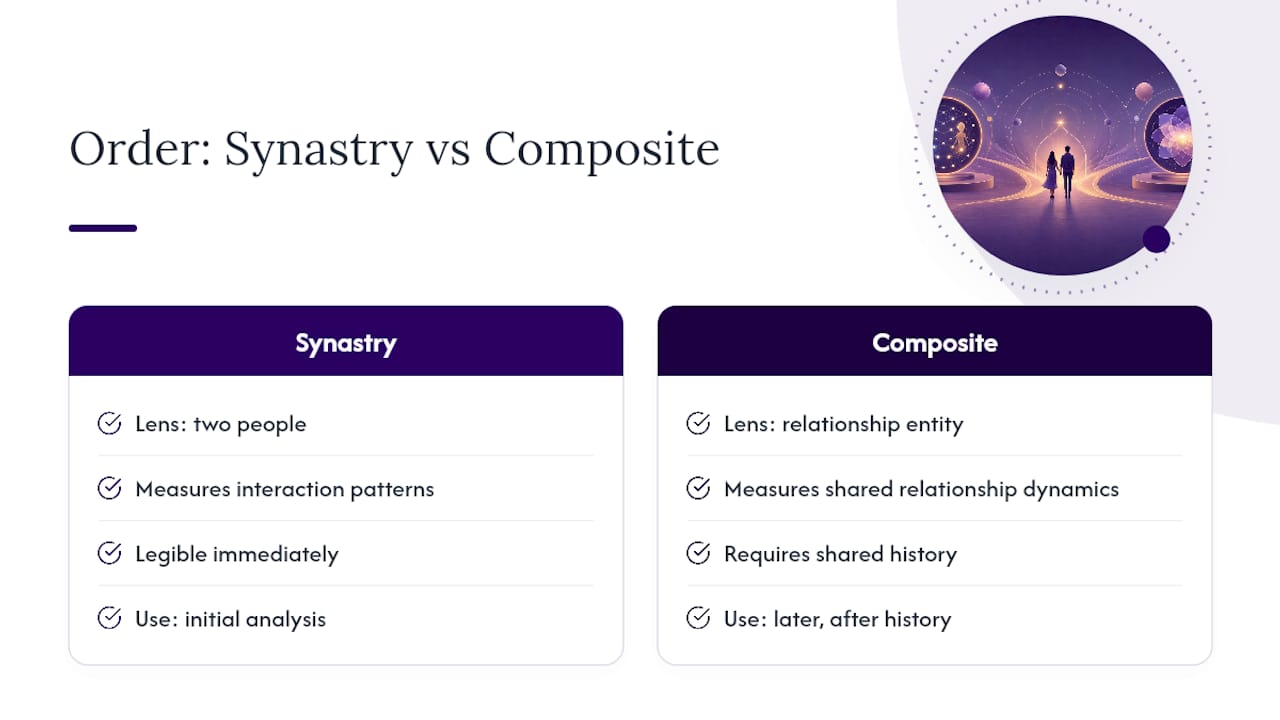
A composite chart on a six-week relationship is a chart of an entity that barely exists. There's no shared history for that Sun and Moon to describe yet. Synastry, by contrast, is legible almost immediately because it's just measuring two real people against each other.
Where conventional advice falls short is treating these charts as competing verdicts on the same relationship, when they're actually built to disagree sometimes. If your synastry is warm and your composite is severe, that's not a contradiction to resolve. It's information. Read the sequence in order, trust each chart for what it's actually built to tell you, and resist the urge to average them into one tidy conclusion.
— Joseph Calitoy
Run Both Charts Without Doing the Math Yourself
Building a composite chart by hand means calculating midpoints for every planet and angle across two people, then interpreting a symbolic chart most beginners have never seen before. Tarosyn handles that math for you and lays out synastry biwheels, a composite generator, and transit overlays in one place, so you can move from "what's our chemistry" to "what's this relationship's long game" without switching tools or starting from scratch.

You can also journal each relationship milestone as it happens, engagements, conflicts, moves, and track how they lined up with transits to your composite over time. Start with a synastry read on the free tools, or go deeper with the Mystic Monthly plan at a monthly price or the Annual Circle at an annual price if you want ongoing access to composite generation, transit tracking, and journaling in one place. Curious what a shared reading looks like first? Browse community readings to explore examples.
Sources
- Synastry vs Composite Chart: Which does what and why?
- Composite chart in Astrology — Definition & Examples
- Composite chart explanation and how practitioners use composite placements
- Composite Chart vs Synastry Chart: Which Reveals More About Your Relationship?
FAQ
Is a composite chart more important than synastry?
Neither chart outranks the other. Synastry tells you how two people affect each other; composite tells you about the relationship as its own entity, and practitioners typically read both in sequence rather than picking one as primary.
What are the worst synastry aspects?
Harsh Saturn, Pluto, or Mars contacts to personal planets tend to create the most friction, though difficult aspects often point to growth areas rather than automatic incompatibility. Context, including the rest of the chart, matters more than any single aspect in isolation.
Are synastry charts accurate?
Synastry aspects between planets are generally reliable, but house-based claims depend on accurate birth times and become speculative without them. Treat house overlays cautiously if either person's birth time isn't confirmed.
What are the strongest synastry indicators for marriage?
Sun-Moon contacts, Venus-Mars harmony, and supportive Saturn aspects between charts are commonly cited as signs of lasting compatibility, though no single aspect guarantees a marriage's success. A well-supported composite Sun and Moon often reinforce that picture once the relationship has enough history to read one.
Can Tarosyn generate both synastry and composite charts?
Yes. Tarosyn builds synastry biwheels and composite charts from birth data you enter, along with transit overlays for timing relationship events.