
A composite chart is a midpoint chart that represents a relationship as its own astrological entity, not two people layered on top of each other. It shows the shared tone, recurring themes, and house emphases the pair generates together. Astrologers use it most often for ongoing, committed relationships or long-term collaborations, where there's enough history for a shared "identity" to actually show up.
TL;DR:
- Composite charts are best used after establishing each partner's natal charts and synastry to understand the recurring patterns of the relationship.
- The accuracy of a composite depends heavily on precise birth times, and interpretations focus on relationship tendencies rather than predictions.
- Heavy emphasis should be placed on key placements such as the composite Sun, Moon, angles, and major aspects with small orbs for meaningful insights.
- Transits and progressions to a composite chart can indicate periods of growth or tension, but their predictive value is limited compared to Davison charts.
- Beginners should avoid dual focus on composite charts alone, instead viewing them as reflective tools that complement foundational natal and synastry analysis.
Table of Contents
- Composite Chart Basics: What the Chart Actually Represents
- How Composite Charts Are Constructed
- Composite vs Synastry vs Davison: When to Use Each
- Key Elements to Check First in a Composite Chart
- A Beginner-Friendly Reading Sequence
- How to Get or Calculate Your Composite Chart
- Common Misconceptions About Composite Charts
- Composite Chart Examples Across Different Relationship Types
- Reading Challenging Aspects in a Composite Chart
- Do Composite Charts Change Over Time?
- Beyond Synastry and Davison: Other Relationship Astrology Tools
- Why the Composite Chart Gets Misread So Often
- Try a Guided Relationship Reading With Tarosyn
- Sources
Composite Chart Basics: What the Chart Actually Represents
The core idea behind composite chart basics comes down to one calculation: midpoints. Take the Sun position from Partner A and the Sun position from Partner B, find the point exactly between them on the chart wheel, and that becomes the composite Sun. Repeat this for every planet, angle, and point, and you get a full chart, but it belongs to neither person individually.
Think of it less like a snapshot of two personalities and more like a blueprint for what those two people build when they combine forces. Your natal chart describes you. Synastry describes how your charts interact. The composite describes the third thing that shows up when you're together, sometimes called the "relationship entity" in composite chart research.
A composite chart tends to answer questions like these:
- How does this relationship present itself to the outside world?
- Where does the couple's shared energy concentrate: home life, career, communication, growth?
- What emotional tone does the partnership default to when nobody's performing for an audience?
- What recurring friction or ease shows up regardless of who initiated it?
How Composite Charts Are Constructed
Building a composite chart starts with math, not intuition. Here's the sequence astrologers actually follow:
- Find the midpoint for each planet and point. On a circular chart, this means picking the shorter arc distance between the two natal positions. If one partner's Venus sits at 5 degrees Aries and the other's sits at 25 degrees Aries, the composite Venus lands at 15 degrees Aries.
- Choose a house system. This is where composite work gets genuinely divided. Some astrologers calculate midpoint house cusps directly from the two natal Ascendants. Others cast the composite houses for the location where the couple first met. Both are widely used, and neither is universally agreed upon as more correct.
- Decide whether a Davison chart fits better. A Davison chart isn't a composite at all. It averages the two birth dates, times, and locations into one real moment in time and space, then casts an actual chart for that moment. Because it corresponds to a genuine astronomical event, a Davison chart supports transit and progression work more reliably than a composite does.
That last point matters more than beginners usually realize. A composite chart has no real "birth moment," so predictive techniques like transits and progressions don't map onto it cleanly the way they do onto a natal or Davison chart. Composites are built for describing pattern, not for timing events.
Composite vs Synastry vs Davison: When to Use Each
Three tools, three different jobs. Confusing them is probably the single most common beginner mistake in relationship astrology.
- Synastry compares two natal charts directly, planet to planet, and shows what triggers what. It answers, "What happens when your Mars touches my Moon?"
- Composite blends the two charts into a new one and shows the relationship's own recurring pattern. It answers, "What does this partnership feel like as its own thing?"
- Davison creates a real time-space midpoint chart, useful when you want a chart that behaves like a natal chart for timing purposes.
The recommended reading order follows that same logic: start with natal basics for each person, layer in synastry to see the interaction points, then bring in the composite for the pattern that emerges once the relationship has some mileage on it. Add a Davison chart when you need to time something, like whether this year favors commitment or conflict. Best practice treats these charts as complementary rather than competing, and no single chart should be read as the final word on a relationship.
Key Elements to Check First in a Composite Chart
Composite charts can look overwhelming at first glance, with dozens of aspect lines crisscrossing the wheel. You don't need all of them.
- Ascendant and angles — sets the relationship's public face and how the partnership approaches new situations.
- Composite Sun — the bond's core purpose and how it expresses itself, similar to how a natal Sun works for an individual.
- Composite Moon — the emotional climate, how safe or volatile the relationship feels day to day.
- Chart ruler — the planet ruling the Ascendant sign, often showing what drives the relationship forward.
- House emphasis — where planets cluster, revealing whether the relationship's energy centers on home, work, communication, or something else entirely.
- Tight major aspects — conjunctions, squares, oppositions, and trines with small orbs carry more weight than loose ones.
These placements described in composite chart interpretation guides translate into real behavior. A composite Moon in Scorpio might mean the relationship runs deep and private, uncomfortable with surface-level small talk. A Venus-Mars conjunction in the composite often points to strong chemistry that shows up consistently, not just in early attraction. Heavy 4th house emphasis frequently shows up in relationships that orient around home, family, or a shared domestic project rather than public visibility.
Pro Tip: Don't try to read every aspect in one sitting. Pick the five items above, write one sentence about each, then look for the theme that repeats across them. That repetition is usually the real story.
A Beginner-Friendly Reading Sequence
Composite charts reward a specific order. Skipping steps is how beginners end up overwhelmed by conflicting signals.
- Confirm your data first. Double check both birth dates, places, and times before calculating anything.
- Read the angles and chart ruler. This sets the relationship's overall orientation before you get distracted by individual planets.
- Move to the composite Sun, Moon, and house emphasis. This tells you the purpose, emotional tone, and area of life where the relationship concentrates its energy.
- Note the tight major aspects. Focus on conjunctions, squares, and oppositions with orbs under 3 degrees.
- Reconcile everything against the natal charts and the relationship's actual history. If the composite suggests emotional intensity and the couple has, in fact, weathered something intense together, that's confirmation, not coincidence.
When signals conflict, look for whatever theme repeats across multiple techniques. A square between composite Mars and Saturn combined with a heavy 10th house emphasis might both point toward the same underlying tension: ambition versus patience. Record your notes in plain language, and phrase suggestions to a couple as possibilities to explore together, not verdicts to accept.
How to Get or Calculate Your Composite Chart
You need three pieces of data for each person: birth date, birth place, and exact birth time. Birth time matters more here than in almost any other chart type, because it determines the Ascendant and house cusps, and inaccurate or missing times reduce house reliability significantly.
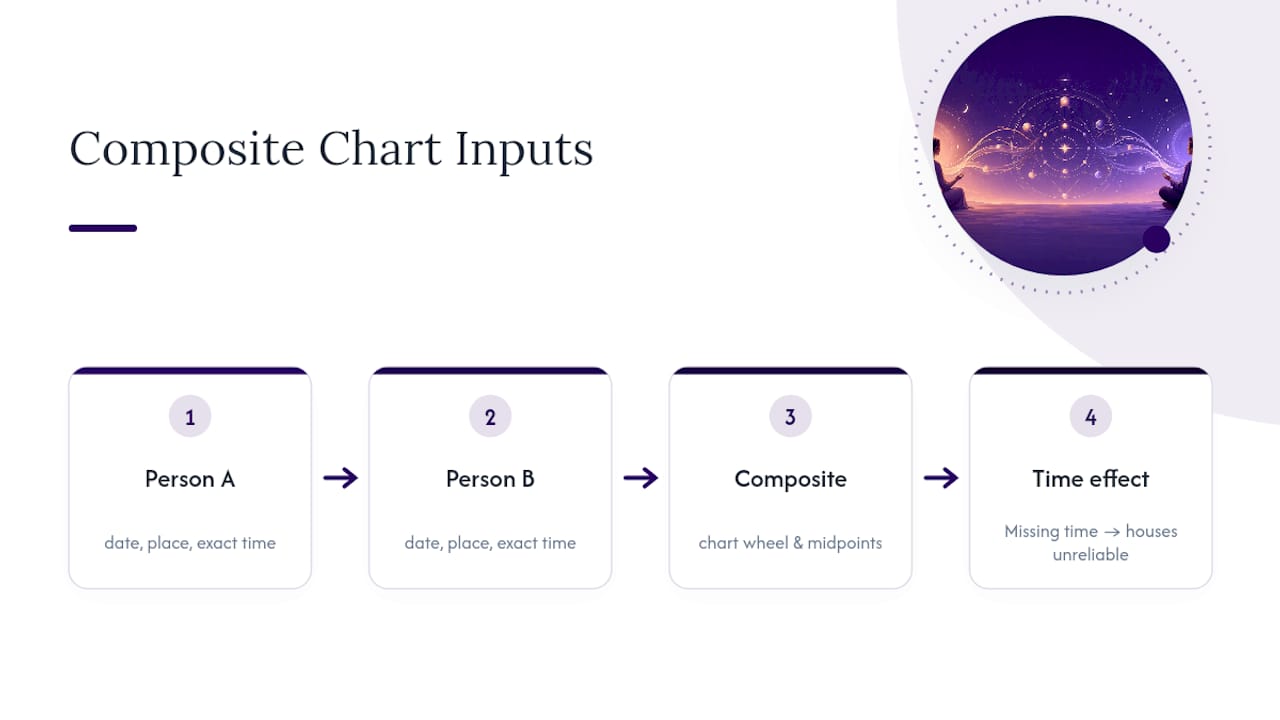
Free online calculators can generate a composite chart wheel in seconds once you enter both sets of birth data. Smartphone apps offer similar functionality, often with visual overlays that make the midpoints easier to see. Tarosyn's reading workflow walks you through entering both people's details and highlights the placements worth reading first, which helps beginners skip the overwhelm of a raw chart wheel.
If one partner doesn't know their exact birth time, use noon as a placeholder, but treat any house or angle interpretation as unreliable. Planet positions and aspects between planets remain accurate even without a birth time. Only the houses and Ascendant suffer.
Common Misconceptions About Composite Charts
Composite charts are not fate. They describe tendencies and shared potential, not a locked-in outcome, and treating one as an "instruction manual" rather than a prophecy keeps the interpretation grounded. Astrologers generally recommend waiting until a relationship has some continuity before reading its composite, since a brand-new pairing hasn't generated enough of a shared "entity" yet to interpret clearly. Avoid using composite placements to make prescriptive claims about whether a relationship should last, whether someone is "safe," or whether consent and boundaries are settled. Charts describe patterns; people decide how to act on them.
Composite Chart Examples Across Different Relationship Types
A romantic composite with the Sun and Venus conjunct in the 7th house often points to a partnership built around mutual visibility, where both people feel more like "themselves" in public as a couple than they might separately. A composite Moon square Saturn in a romantic pairing frequently shows emotional caution, the sense that trust has to be earned slowly rather than assumed.
Business partnerships read differently. A composite emphasizing the 2nd and 10th houses, especially with Saturn or Mercury prominent, often points to a partnership organized around resources, structure, and long-term reputation rather than emotional intimacy. A tight composite Mercury-Jupiter aspect can suggest the partnership communicates ideas expansively and pitches well together, even if the personal chemistry is lukewarm.
Friendship composites tend to lean on the 11th house and Mercury placements. A composite Sun in the 11th house often describes a friendship whose purpose is genuinely about shared community or ideals rather than romantic or financial stakes. Two friends with a composite Jupiter trine the Ascendant frequently describe their bond as easy, expansive, and low drama, the kind of friendship that doesn't require much maintenance to stay warm.
None of these examples work as rigid formulas. The same aspect shows up differently depending on which houses and planets surround it, which is exactly why reading the whole chart, not one isolated placement, matters more than memorizing meanings.
Reading Challenging Aspects in a Composite Chart
Squares, oppositions, and tight conjunctions in a composite chart tend to generate the most anxiety for beginners, and also the most useful information once you stop treating them as red flags.
A composite Mars square Pluto often shows a relationship with real intensity, sometimes power struggles, sometimes just a level of passion that feels bigger than either person expected. That's not automatically bad. It depends heavily on how the couple channels it, something the chart alone can't determine. A composite Sun opposite Moon frequently describes a partnership where the couple's sense of purpose and their emotional needs pull in different directions, requiring conscious negotiation rather than assuming things will sync naturally.
Conjunctions get treated as universally positive by beginners, but a tight composite Saturn conjunct the Ascendant can point to a relationship that feels heavy or overly responsible right out of the gate, even if it's also stable and enduring. Oppositions generally describe a push-pull dynamic between two houses or planets, something the relationship has to balance rather than resolve outright.
The mistake to avoid is reading a single hard aspect in isolation and assuming it predicts conflict. Context matters. A Mars-Saturn square might describe frustrating timing issues in a relationship that's otherwise warm and supportive everywhere else in the chart. Look at how many other aspects support or contradict that one placement before drawing conclusions about what it means for the relationship's day-to-day reality.
Do Composite Charts Change Over Time?
The composite chart itself, calculated once from two fixed birth charts, doesn't change. What changes is how relevant certain placements feel as the relationship matures, and how transiting planets interact with that fixed composite chart over time.
This is where composite work gets genuinely useful for forward-looking questions, with a caveat. Transits to a composite chart can describe periods of growth, tension, or transformation for the relationship, similar to how transits work on an individual's natal chart. A transiting Saturn crossing the composite Sun might coincide with a period where the relationship faces real responsibility, perhaps a move, a financial commitment, or a health situation that tests the partnership's structure.
The limitation worth remembering: because a composite chart has no literal birth moment, some astrologers argue its transits carry less predictive weight than transits to a Davison chart, which corresponds to an actual point in time and space. That's part of why Davison charts show up so often in timing-focused relationship work. If you're trying to answer "is this a good year to get engaged," a Davison chart generally gives you a more astronomically grounded answer than a composite.
Progressions, the slower symbolic movement of a chart forward in time, apply to composites the same way transits do, though with the same caveat about their symbolic rather than literal nature. A progressed composite Moon changing signs, for instance, might describe a genuine shift in how the relationship handles emotional needs, even years into the partnership.
Beyond Synastry and Davison: Other Relationship Astrology Tools
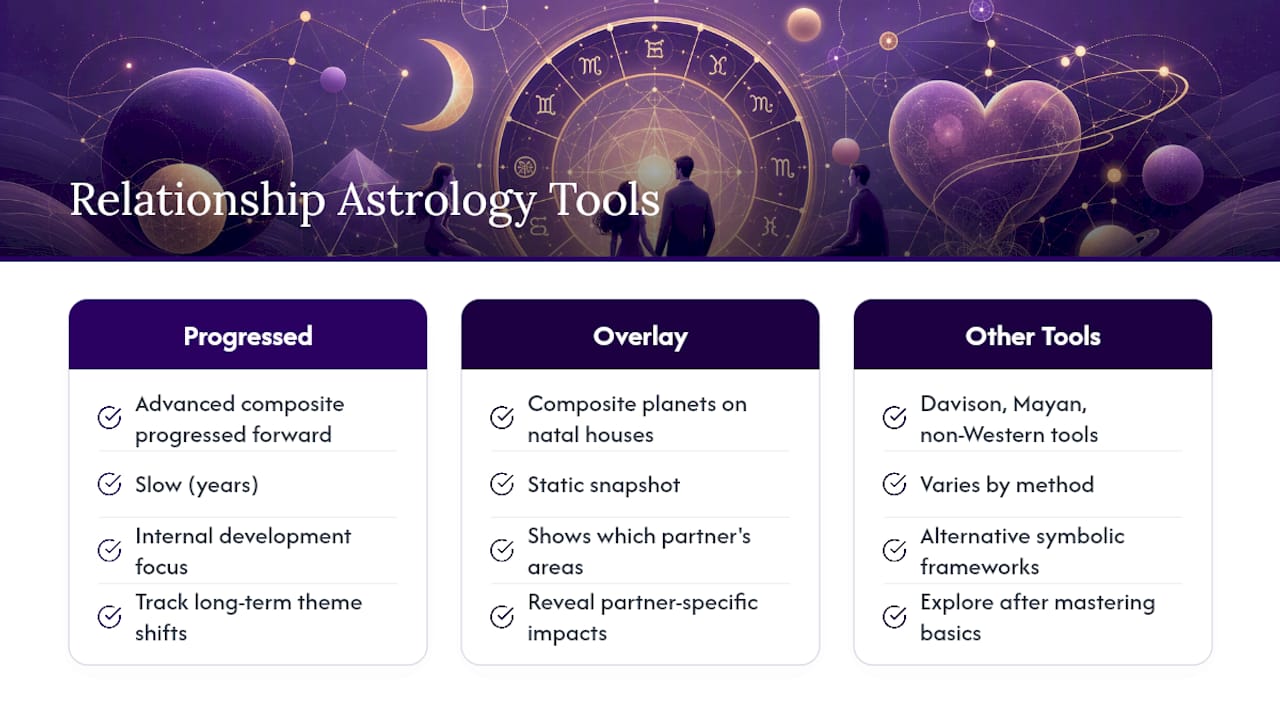
Synastry and the standard composite chart cover most beginner needs, but they're not the only tools in relationship astrology. A progressed composite takes the original composite chart and advances it forward using the same progression techniques applied to natal charts, tracking how the relationship's core themes shift as the years pass. This differs from simply transiting the composite because progressions move more slowly and describe internal development rather than external triggering events.
Some astrologers also compare composite house emphasis against each partner's natal chart in a technique sometimes called composite overlay, checking which houses in each individual's chart the composite planets land in. This can reveal, for example, that the relationship's shared 7th house Sun lands in one partner's natal 10th house, suggesting the relationship affects that person's career visibility more than their partner's.
None of these techniques replace the basics. They're refinements for readers who already understand how synastry comparisons work and want more nuance once they've mastered composite chart basics. For most beginners, mastering the standard composite and knowing when to reach for a Davison chart instead covers the vast majority of practical relationship questions. Additional techniques are worth exploring once those fundamentals feel comfortable, not before. Readers curious about non-Western frameworks for relationship compatibility sometimes also explore tools like the Mayan sign compatibility calculator, which approaches partnership dynamics through an entirely different symbolic system.
Why the Composite Chart Gets Misread So Often
Most beginners treat the composite chart like a verdict machine: plug in two birth times, get a compatibility score, move on. That's backwards, and it's the single biggest reason composite readings disappoint people. A composite chart describes a pattern that only becomes meaningful once the relationship has generated enough real history for that pattern to actually show up.
What gets underestimated is how much the reading order matters. Jumping straight to the composite without first understanding each partner's natal chart is like reading the conclusion of a book without the chapters that got you there. Synastry gives you the interaction triggers. The composite gives you the pattern those triggers produce over time. Skip the first step, and the second one reads like abstract poetry instead of something grounded in the actual people involved.
Tarosyn treats composite reading as a reflective practice, not a prediction engine, pairing chart insights with journaling prompts and tarot pulls that help you sit with a placement instead of reacting to it. That approach fits how composite charts actually work: as material for reflection between two specific people, not universal truths. For readers building foundational knowledge, our birth chart guide and synastry breakdown are the two pieces worth reading before the composite chart at all.
— Joseph Calitoy
Try a Guided Relationship Reading With Tarosyn
Tarosyn turns composite chart basics into something you can actually work with, not just stare at. The platform pairs AI-assisted astrology with journaling prompts and a community of people exploring the same relationship questions, so you're never left interpreting a chart wheel alone.

Enter both birth details, and Tarosyn walks you through the placements worth prioritizing first: angles, composite Sun and Moon, house emphasis, and the aspects most likely to shape the relationship's daily rhythm. You'll also see how other readers in the community interpret similar placements, which helps ground your own reading in something more than guesswork. Tarosyn doesn't hand you a verdict about whether your relationship "works." It gives you language for the patterns already there and space to reflect on what they mean for your specific situation. Start with a public reading to see how the interpretation style feels, or explore the full platform to try a composite reading with your own data.
Sources
Cafe Astrology's composite chart overview covers construction and interpretation in depth. Llewellyn's composite chart journal piece explains house calculation debates and the Davison alternative. Augurine's comparison guide breaks down reading order. Astrologify's interpretation guide offers placement-by-placement detail worth bookmarking.
- Composite Chart: Relationship Astrology | Cafe Astrology
- Working with the Composite Chart | Llewellyn
- Composite Chart: The Relationship’s Chart Explained • Astrologify