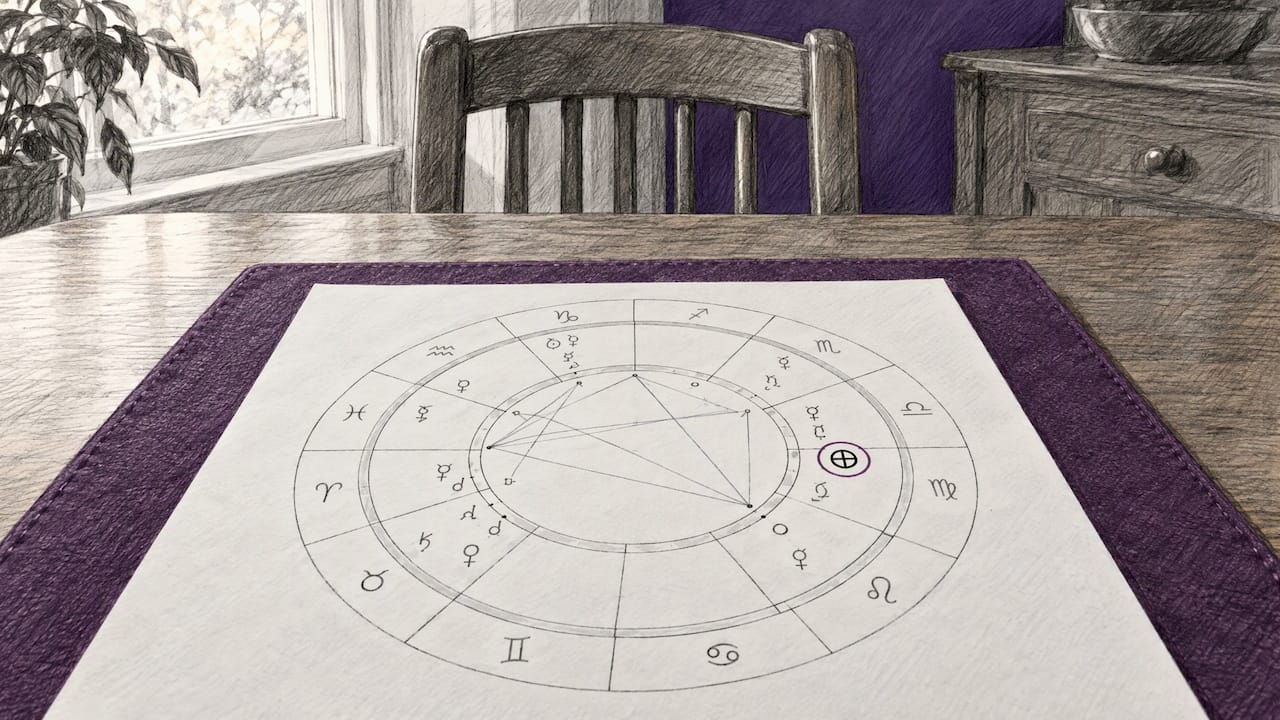
The Part of Fortune is a calculated point in your birth chart that shows where you find ease, well-being and worldly success. It is not a planet. Its sign shows how that ease arrives, and its house shows the area of life where you notice it. You need your exact birth time and place to find it. Tarosyn reads your birth chart with this kind of context in mind, so you can see the point next to your Sun, Moon and rising sign.
TL;DR
- The Part of Fortune (also called the Lot of Fortune or Pars Fortuna) is a mathematical point, not a physical object, built from your Sun, Moon and Ascendant.
- It stands for body, livelihood, prosperity and the kind of luck that comes with simply being alive.
- The formula changes for day and night births. You need an exact birth time to get the sign and house right.
- The house shows where the point works. The sign shows how it works.
- Read it as a theme to reflect on, not a promise of money or a prediction.
Table of Contents
- What the Part of Fortune means
- Is the Part of Fortune lucky?
- How to calculate your Part of Fortune
- Part of Fortune in the houses
- Part of Fortune in the signs
- How to read your Part of Fortune step by step
- Common mistakes
- Use the Part of Fortune in your practice
- Where Tarosyn fits
- Our perspective
- FAQ
- Sources
What the Part of Fortune means
The Part of Fortune represents worldly success and prosperity. Cafe Astrology also links it with the physical body and health, and says it can point to a career or vocation. Many modern astrologers add a softer reading: the area of life where you feel at ease and where good things reach you without much force.
Both readings come from the same idea. In traditional astrology, Fortune describes your life in a body: your health, your possessions and what you do over the course of a life. The Hellenistic author Paulus Alexandrinus, writing in the 4th century, put it this way: Fortune "signifies everything that concerns the body", along with possessions, reputation and privilege.
So when someone asks what the Part of Fortune means, the short answer is this: it shows where life tends to support you.

Lot or part: the same point
You will see three names for it. "Part of Fortune" is the common modern name. "Lot of Fortune" is the name used in the ancient texts and in traditional astrology today. "Pars Fortuna" is the Latin form. They all mean the same point, written in your chart with a cross inside a circle.
Why it is called a point
A planet is a body in the sky. The Part of Fortune is a position worked out from three things: where the Sun is, where the Moon is and which degree of the zodiac was rising on the eastern horizon when you were born. That rising degree is your Ascendant. If you are not sure of yours, our guide to finding your rising sign walks you through it.
The point reflects the relationship between the two lights and the horizon. The Cut describes it the same way: a calculation based on the Sun, Moon and Ascendant.
Is the Part of Fortune lucky?
In traditional practice, yes, it is treated as a benefic point. Skyscript describes it as generally benefic and as a significator of good fortune when it is well placed or in favorable aspect with other planets.
"Lucky" needs care here. Fortune in the old sense includes chance events that can bring gains, and not only a steady income. Read the point as a place where support is available to you, and where it helps to pay attention. It does not mean money will arrive on its own.
Modern readers often frame it as where you find joy. That fits the practice of reflection: you look at the house and sign, then ask where in your own life that theme shows up.
How to calculate your Part of Fortune
You need three degrees from your chart: the Ascendant, the Sun and the Moon. Write each as an absolute degree from 0 to 360, counting from 0° Aries. Aries starts at 0°, Taurus at 30°, Gemini at 60°, and so on in steps of 30°.
The formula depends on whether you were born in the day or at night:
| Birth | Formula |
|---|---|
| Day chart (Sun above the horizon) | Ascendant + Moon − Sun |
| Night chart (Sun below the horizon) | Ascendant + Sun − Moon |
This is the common approach, and the Skyscript glossary confirms the reversal for night charts. An academic paper on Hellenistic lots traces how the ancient authors set out and debated the formula.
If the result is above 360, subtract 360. If it is below 0, add 360.
Day or night?
A day chart has the Sun above the horizon, which means in houses 7 to 12. A night chart has the Sun below the horizon, in houses 1 to 6. Cafe Astrology uses this same definition. Check your chart wheel: if the Sun sits in the top half, it is a day chart.
A worked example
Say a person has an Ascendant of 10° Libra (190°), a Moon at 10° Taurus (40°) and a Sun at 10° Cancer (100°).
- Place the Sun. In whole-sign houses, Libra is house 1, so Cancer is house 10. That is above the horizon, so this is a day chart.
- Use the day formula: 190 + 40 − 100 = 130.
- Convert 130° to a sign. Leo starts at 120°, so 130° is 10° Leo.
- Find the house. Leo is the 11th sign from Libra counting Libra as 1, so the Part of Fortune is in the 11th house.
This person would read the point as Fortune in Leo in the 11th house: ease and support through friends, groups and shared goals, expressed in a Leo way.
Why birth time matters
The Ascendant moves about one degree every four minutes. The Part of Fortune is built on it, so it moves with it. A birth time that is off by an hour can shift the point into another sign, and it can change the house too. If your birth time is only approximate, treat the result as a draft. Check your birth certificate or ask a family member for the time.
If you want to see how a few minutes change your houses, read why twins born 20 minutes apart can have different houses.
Part of Fortune in the houses
The house tells you where Fortune shows up. The house is simply the area of life the point lands in. Here is a short reading for each house. Treat these as common themes, then add your own experience.
| House | Area | What the point suggests |
|---|---|---|
| 1st | Self, body, identity | Initiative and prosperity through leading your own path |
| 2nd | Money, values, possessions | Material and financial ease |
| 3rd | Communication, learning, siblings | Support through writing, speaking, teaching |
| 4th | Home, family, roots | Stability through home and family |
| 5th | Creativity, romance, play | Joy through making things and enjoying life |
| 6th | Daily work, health, routines | Well-being through steady habits and service |
| 7th | Partnerships | Support through close one-to-one relationships |
| 8th | Shared resources, change | Gains through joint money, inheritance or deep change |
| 9th | Travel, study, belief | Growth through learning, teaching and travel |
| 10th | Career, public life | Recognition and a visible role |
| 11th | Friends, groups, goals | Support through community and shared aims |
| 12th | Rest, solitude, the unseen | Fulfillment through reflection and intuition |
Cafe Astrology's house article gives, for example, strong personal initiative for the first house, material and financial success for the second, and fulfillment through introspection and intuition for the twelfth.
The angular, succeedent and cadent houses
Houses 1, 4, 7 and 10 are the angles of the chart. A point there is usually easy to see in daily life. Houses 2, 5, 8 and 11 follow the angles, and houses 3, 6, 9 and 12 come before them. Many astrologers read the angles as the most visible, but any house can carry a strong Fortune. The point is a theme, not a ranking.

Which house system?
Different house systems cut the chart in slightly different ways, and your Part of Fortune can land in a different house depending on the system. Whole-sign houses are the traditional choice for lots. If your chart tool shows another system, note which one you use and stay with it when you compare readings.
Part of Fortune in the signs
The sign shows how Fortune is delivered. In the traditional view, the planet that rules the sign is responsible for bringing the means of life, and its condition matters. A well-placed ruler supports the point. A weak or troubled ruler makes the support less steady.
Two signs come up often in searches:
- Sagittarius: The ruler is Jupiter, the planet of growth, belief and generosity. Fortune here is read as promising income, rank and opportunity through learning, travel, teaching or faith. The outcome depends on how strong Jupiter is in your chart.
- Gemini: The ruler is Mercury, the planet of exchange, skill and information. Fortune here is read as gains through talking, trading, writing and learning quickly. Mercury close to the Sun is usually read as less free.
For other signs, use the same method. Name the ruling planet, find it in your chart, and note its house and sign. That planet shows how the support reaches you.
Aspects to the point
Planets or points that sit close to your Part of Fortune, within a few degrees by conjunction or opposition, add detail. Cafe Astrology names the ruling planet and tightly conjunct or opposite points as further clues. A planet right on the point colors how Fortune feels.
How to read your Part of Fortune step by step
- Get your chart. Use your exact birth date, time and place.
- Find the point. Look for the cross-in-a-circle symbol. If your chart does not show it, calculate it with the formula above.
- Note the house. This is the area of life.
- Note the sign and its ruler. This is the way support arrives.
- Check the ruler. Find that planet's house and sign.
- Write one sentence. For example: "My ease comes through friends and shared goals, in a warm, creative way."
- Test it against your life. Think of the last time things went well. Did it happen in that area?
Keep the reading short. A single clear sentence is more useful than a long list of traits.
Common mistakes
- Using the wrong formula. Day and night births use different formulas. The ancient authors used this split from the start, so mixing them up changes the answer.
- Using a rounded birth time. An hour of error can change the sign.
- Treating it as a money prediction. The point describes a theme and not a payout.
- Ignoring the house system. Compare readings from the same system.
- Reading it alone. Look at it next to your Sun, Moon and rising sign.
Use the Part of Fortune in your practice
For yoga practitioners and spiritual readers, the point works well as a prompt for reflection. Ask which area of life supports you, and how you can spend more time there.
Some ideas:
- Journal: Write about the house theme once a week. What went well? What felt easy?
- Set an intention: Choose a small action in that house, such as reaching out to a friend for an 11th house point.
- Share with a circle: Compare your point with a friend's. Ask what each of you notices.
- Creators: Use the house theme as a topic for content. A 3rd house point suggests writing or speaking. A 5th house point suggests making and playing.
Where Tarosyn fits
Tarosyn is an AI-powered spiritual app that brings tarot, astrology and numerology together with journaling and a community. It reads with your birth chart context and remembers your history, so your notes on the Part of Fortune can sit next to your other readings. You can save readings, track your growth over time and share with friend circles.
The Mystic monthly plan costs $7.99 per month, and the Annual circle costs $59.99 per year. Plans are on the Tarosyn home page.

If you want to understand the rest of your chart, start with your rising sign, which sets the base for your houses and for the Part of Fortune.
Our perspective
Our view is that a chart point is most useful when you can return to it. A single read gives you a theme. A record of how that theme shows up over months gives you a pattern.
That is why we built Tarosyn around memory. Readings remember your history and use your birth chart context, so you do not start from zero each time. Journaling and ritual guidance give you a place to write down what you notice. The community gives you a way to share it, or keep it private.
We aim for guidance that is thoughtful and calm, not predictive. The Part of Fortune fits that approach: it asks where you already find support, and what you want to do with it.
Joseph Calitoy
FAQ
Is the Part of Fortune the same as the Lot of Fortune?
Yes. Part of Fortune, Lot of Fortune and Pars Fortuna are three names for the same calculated point. Traditional astrologers tend to say "lot." Modern astrologers tend to say "part."
How do I find my Part of Fortune without doing the math?
Use a chart that shows it, and enter your exact birth date, time and place. If the point is not shown, switch on the extra points setting or calculate it with the day and night formula in this article. The birth time is the most important input.
What does the Part of Fortune mean in the 2nd house or the 10th house?
In the 2nd house, it points to ease with money, values and possessions. In the 10th house, it points to recognition and support through career and public life. In both cases, the sign adds the style, and the ruling planet shows how well that support is delivered.
Does my Part of Fortune change over time?
Your natal point stays fixed because it comes from your birth moment. It can be activated when planets move across it, and it can be studied again in yearly charts. Our guide to the solar return chart shows how yearly charts work.
Sources
- What Is the Part of Fortune In Astrology? (The Cut)
- Part of Fortune (Cafe Astrology)
- Part of Fortune in Houses: Natal Chart (Cafe Astrology)
- Part of Fortune (Fortuna), Skyscript Glossary
- The Lot of Fortune: To Reverse or Not? (Paulus Alexandrinus quote)
- Calculating the Lots of Fortune and Daemon in Hellenistic Astrology (Culture and Cosmos)