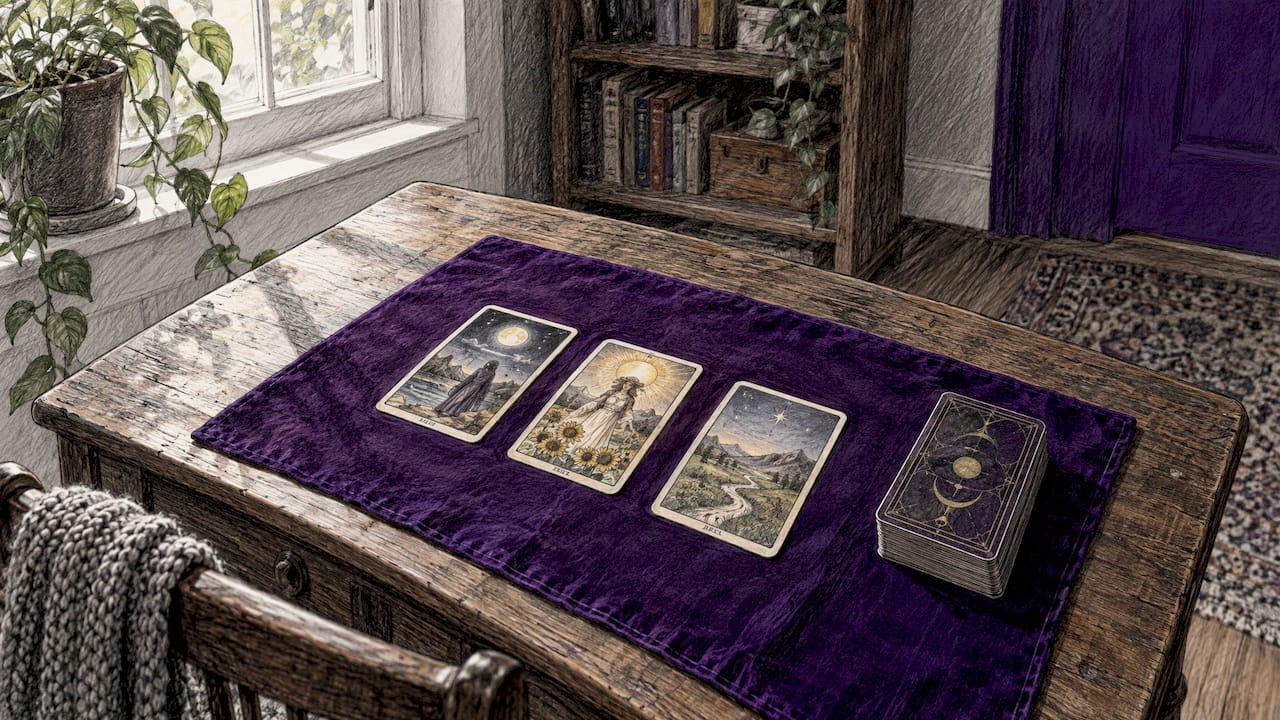
A past present future spread uses three cards in a row. The left card shows what led to your situation. The middle card shows where you are now. The right card shows a direction that may develop next. Read the cards from left to right, as one short story about one situation.
This guide shows you how to pick a question, lay out the cards, read the positions together, and handle cards that feel unclear. Each step is short. Follow them in order.
TL;DR
- Use three cards in a row: past on the left, present in the middle, future on the right.
- Ask one open question about one situation. Write it down before you draw.
- Read the three cards as a connected story, not as three separate answers.
- Treat the future card as a possible direction. Your choices can change it.
- Write a short journal note after the reading. Review it later.
Table of Contents
- What the past present future spread is
- Before you draw: choose one question
- How to lay out the three cards
- How to read the three positions
- A worked example
- Upright and reversed cards
- What to do when the cards seem unclear
- Add a journal note
- Common mistakes
- Other ways to use the same layout
- Our perspective
- Try the spread in Tarosyn
- FAQ
- Sources
What the past present future spread is
A spread is a set layout where each position has an assigned meaning. Mark McElroy's tarot guide defines a spread this way and describes the past, present and future layout as three cards dealt in a straight line and read from left to right.
The three positions are simple:
| Position | Place | What it shows |
|---|---|---|
| Past | Left | Events, habits or feelings that shaped the situation |
| Present | Middle | What is active right now |
| Future | Right | A direction that may develop next |
The spread is popular with beginners because it has few cards and a clear order. It is also used by experienced readers for quick check-ins. Academic tarot resources treat it as a standard exercise. The Monmouth University tarot guide lists a Past, Present, and Future Spread worksheet next to a set of tarot journaling prompts.
What it helps you reflect on
The spread works best for a situation that is moving: a job change, a relationship that is shifting, a habit you are trying to build, a move to a new city. Literary Hub describes tarot spreads as a way to give narrative shape to memories, experiences, desires and fears. In that view, the three cards stand for past circumstances, present circumstances and future opportunities.
This is how we suggest you use it too: as a tool for reflection. It gives you three prompts and a clear order to think in.
Before you draw: choose one question
The question matters more than the shuffle. A vague question gives a vague reading. A question with many parts gives a crowded one.
Use these rules:
- Pick one situation. Do not mix work, family and money in one reading. Pull one spread for each.
- Keep it open. HowStuffWorks advises a simple, open-ended question about what you want insight on, with a clear intention.
- Focus on what you can do. McElroy recommends process questions such as "How can I?" and "What can I do?" because they point to actions within your control.
- Write it down. Put the question on paper before you draw. This keeps you from changing it after you see the cards.
Example questions
- "What shaped how I feel about my current job, and where is it heading?"
- "What do I need to understand about this friendship?"
- "How can I approach the next three months of study?"
If you do not know what to ask, McElroy suggests open prompts such as "What do I need to know right now?" or "What is something important I am overlooking?"
Questions to avoid
- Yes or no questions. They leave the three positions with nothing to describe.
- Questions about what another person thinks or feels. Ask about your own part instead.
- The same question asked again and again until the answer feels better.
How to lay out the three cards
You need a tarot deck, a flat surface and a notebook. Follow these steps.
- Hold your written question. Read it once.
- Shuffle the deck until it feels done. There is no required number of shuffles.
- Deal three cards, or pick three from a fanned deck.
- Place them face up in a row. The Handbook of Tarot Spreads describes the layout as recent past on the left, present in the middle, and near future on the right.
- Look at all three cards before you read any of them.
A second method: three piles
LoveToKnow describes another way. Think about your question while you shuffle. Cut the deck into three piles. Take the top card from each pile and turn them over. Then read them from left to right as a short story. Both methods work. Choose the one you find easier to repeat.
Drawing with an app
You can also draw digitally. Tarosyn gives you AI-powered readings that save to your history, so you can return to a spread later. Your question, the cards and your notes stay together in one place.
How to read the three positions
Read in this order: first the whole row, then each card, then the row again.

Step 1: Look at the whole row
Notice the overall feel. Are the images calm or tense? Do the colors repeat? Do figures face toward or away from each other? Write down your first impression in one line.
Step 2: Read the past card
Ask: what led to this? The card can show a decision, a habit, an event or a feeling. Match it to your own history. If a card does not connect to anything, note that and move on.
Step 3: Read the present card
Ask: what is active now? This card often shows the main tension or the main strength in the situation. It sits in the middle for a reason. It links the other two cards.
Step 4: Read the future card
Ask: what direction is developing? Use the words "may" and "could" here. Tarot guides based on the Waite tradition say the future is not fixed and that a person can change it through actions, thoughts or feelings. So the right-hand card describes a possible path. It does not describe a certain event.
Step 5: Connect the cards
Now read the row as one story. Use a simple sentence frame:
Because of [past card], I am now in [present card], and this may lead toward [future card].
Then ask what you can do. If the future card looks hard, look at the present card for something you can change. If the future card looks good, look at the past card for what helped.
For a deeper walk-through of linking cards, see our guide to building a connected story from a three-card spread. You can also enter your own draw in the free 3-card spread interpreter.

A worked example
The question: "What shaped how I feel about my job, and where is it heading?"
Say you draw these three cards.
- Past: Eight of Pentacles. This card is about steady work and learning a craft. You may have spent years building skills.
- Present: Four of Cups. This card is about boredom and a person who ignores what is offered. You may feel flat about work, and you may be overlooking something.
- Future: Ace of Wands. This card is about a new spark and a new start. A fresh project or role may be available.
Read together: you built skill through steady work. Now you feel flat. A new start may come if you notice what is being offered. The action step: list what you have ignored lately, and check whether one item matches the new energy of the future card.
Note what this reading does not say. It does not say you will get a new job. It gives you a direction to think about and a next step to take.
Upright and reversed cards
If you read reversals, add one step. A reversed card is a card that lands upside down. Waite-based guidance says reversed cards alter or turn the upright meaning, and it advises you to study the artwork because the symbols add nuance.
Here is a simple way to start:
- A reversed card in the past position can show something unresolved.
- A reversed card in the present position can show a block or an inward focus.
- A reversed card in the future position can show a delay or a different route.
These are starting points, not rules. If reversals feel like too much, leave them out and read all cards upright. Many readers do this for their first months. When you are ready, use our three drills for practicing reversals to build a consistent method.
What to do when the cards seem unclear
Sometimes the three cards do not seem to answer your question. Try these steps in order.
- Do not pull more cards. Extra cards usually add noise.
- Check the question. Is it a yes or no question? Rewrite it as an open question and read the same cards again.
- Look for patterns. Find repeated suits, numbers, colors or figures. Patterns are easier to read than single cards.
- Read for themes, not events. Ask what each card is about, not what it predicts.
- Allow "not yet." The situation may still be forming. Write the reading down and come back to it.
Writing is the key step. A note you can read later often makes sense when the cards did not make sense in the moment.
Add a journal note
A spread is a snapshot. A journal makes it useful. After each reading, write four short lines:
- Date and question
- The three cards
- One sentence for each position
- One action you will take this week
Then set a reminder for two to four weeks later. Reread the note and mark what happened and what did not. Over time you will see how you read the cards and how your questions change.
For ready-made prompts, use our list of tarot journal prompts for daily practice. For a broader method, read our practical guide to tarot and self-reflection. If you want to use spreads over several weeks, our four-week self-love spread plan shows one way to do it.
Common mistakes
- Asking too much. One reading, one situation.
- Reading the future card as a fixed result. It shows a possible direction.
- Reading each card alone. The value is in how the three connect.
- Skipping the notes. Without notes, you cannot see change over time.
- Drawing again right away. Sit with the first reading for a day.
- Using the spread for other people's private matters. Keep the focus on your own choices.
Other ways to use the same layout
The three positions can change. The reading steps stay the same.
- Situation, challenge, advice. Use this when you want a plan.
- Mind, body, spirit. Use this for a personal check-in.
- You, the other person, the connection. Use this for a relationship, with the focus on your side.
- Yesterday, today, tomorrow. Use this as a short daily practice.
Start with past, present and future until it feels natural. Then try one variation for a week and compare your notes.
Our perspective
We built Tarosyn around one idea: a reading is more useful when it remembers. A single three-card draw gives you a snapshot. A series of draws, saved with your questions and notes, gives you a pattern.
This is why our AI-powered readings keep your history and use your birth chart context when you want it. The past card in a spread then connects to what you have already written, not only to the card itself. We aim for guidance that is emotionally aware and reflective. We do not aim for fixed predictions.
We also think the spread should fit how you like to practice. Some people want to keep it private. Others want to share a reading with friends. Tarosyn supports both, and we design for privacy from the start.
Our advice is simple. Ask one clear question. Read the three cards as one story. Write a note. Return to it later.
Joseph Calitoy
Try the spread in Tarosyn
Tarosyn lets you draw a three-card spread, save the reading and add journal notes. You can also use astrology and numerology context in the same place. Plans are Mystic monthly at $7.99 per month and Annual circle at $59.99 per year.

See the current plans on the Tarosyn home page. Start with one question and one spread.
FAQ
Can I do a past present future spread without a physical deck?
Yes. You can draw three cards in an app and follow the same steps. Write your question first, read the cards left to right, and save a note. The method does not change.
Does the future card predict what will happen?
No. Treat it as a possible direction. Waite-based guidance says the future is not fixed and can change with your actions, thoughts or feelings. Use the card to decide what to do next.
How often should I draw this spread?
Draw it when a situation changes, or once a week as a check-in. Do not repeat the same question on the same day. Review your notes after a few weeks to see what shifted.
What if I do not know what to ask?
Use an open prompt. McElroy suggests questions such as "What do I need to know right now?" or "What is something important I am overlooking?" Write the question down, then draw.
Do I need to read reversed cards?
No. You can read every card upright. Add reversals when you feel steady with the basic positions.
Sources
- Tarot Worksheet Exercises, Monmouth University tarot guide
- Inspiration in the Cards: How Tarot Can Help Us Narrativize Our Lives, Literary Hub
- Three-Card Spread: A Beginner's Guide, HowStuffWorks
- A Guide to Tarot Card Readings, Chapter 5, Mark McElroy
- Handbook of Tarot Spreads
- How to Use Tarot Spreads, LoveToKnow
- Tarot booklet based on the interpretations of Arthur Edward Waite