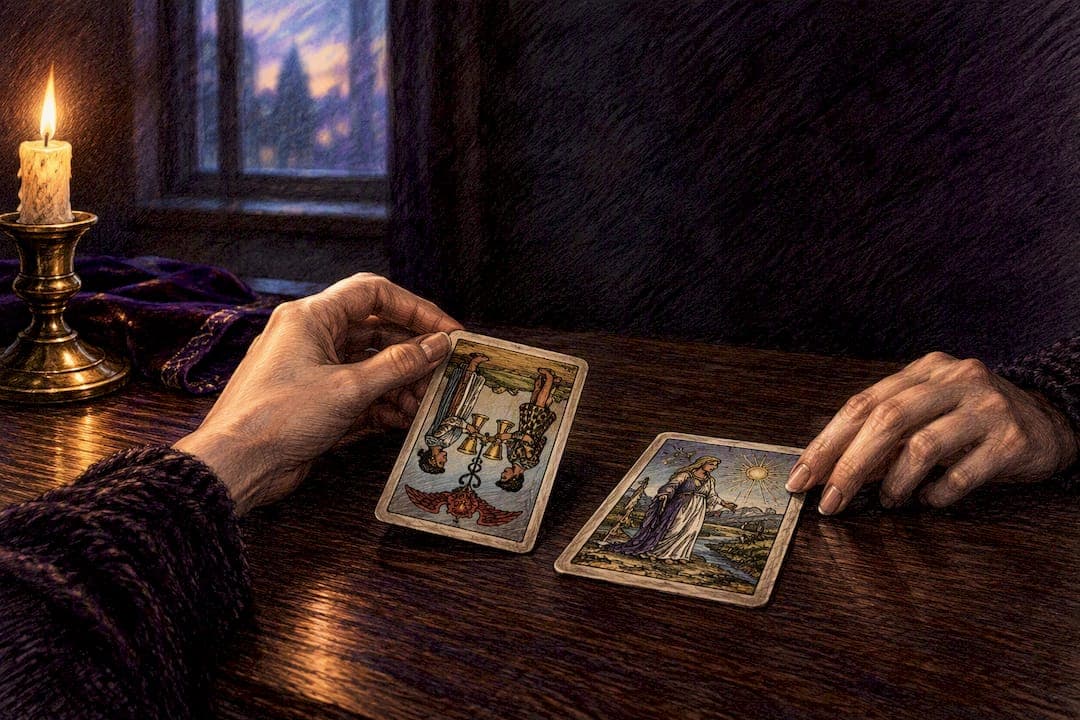
Reversed tarot cards add nuance to a reading, but reading them is optional. The most common frameworks are blockage, opposite, internalized, shadow, and diminished energy. If you are new, learn upright meanings first. Once you add reversals, pick one frame from resources like Mary K. Greer style methods and a reversals quick reference sheet, then stay consistent unless the context tells you otherwise.
TL;DR:
- Using a consistent default framework like internalized energy helps maintain clarity and pattern recognition across readings involving reversals.
- Shuffling methods influence reversal frequency; overhand shuffles naturally produce more reversals, while riffle shuffles minimize them.
- Reversed cards' meanings vary depending on their position and surrounding cards, requiring careful contextual analysis rather than automatic positive or negative assumptions.
- Beginners should master upright meanings first before adding reversals, and many experienced readers experiment with multiple frameworks to find their most intuitive approach.
- Regular practice through journaling and comparing interpretations helps develop reliable intuition and personal rules for interpreting reversals effectively.
Table of Contents
- Common frameworks for interpreting reversals
- Should you read reversals? community practices and decision checklist
- How spread position and surrounding cards affect reversed meanings
- Practice drills and worked examples to build reliable intuition
- Practitioner tips and common pitfalls from experienced readers
- A personal rule for reading reversals and why it holds up
- Practice tools that make reversal work easier
- Sources
- FAQ
Common frameworks for interpreting reversals
There is no single dictionary for what a reversed card means. Instead, experienced readers work from a small set of frameworks and test each one against the card, the spread, and the person asking the question.
Each framework changes the same card in a different direction:
- Blockage: the card's energy exists but cannot flow. A reversed Ten of Cups might mean happiness is present but stuck behind old resentment.
- Opposite: the meaning flips fully. Reversed Strength could point to weakness or a total loss of control.
- Internalized: the energy turns inward. A reversed Three of Cups might describe private celebration instead of a group event.
- Shadow: the darker or hidden side of the card surfaces. A reversed Emperor could highlight rigid control rather than steady leadership.
- Sequence or return: the reversal sends you back to the card before it, asking you to reread that card's advice.
- Diminishing power: the card's force is weaker than usual, not absent. A reversed Six of Wands might mean a smaller win rather than no win at all.
A practical tutorial on reversals ranks these options from simple to complex and walks through card examples so a reader can see how each approach produces a different reading from the same draw.
Take the Ten of Swords reversed. Under blockage, pain is present but not yet released. Under opposite, the worst has passed and recovery has begun. Under internalized, the querent is processing a loss privately rather than dramatically. Under shadow, the card exposes a tendency to see oneself as a victim. Four readings, one card, and each one is defensible depending on what surrounds it.
Most readers do better picking one framework as a default and sticking with it across a reading. Consistency builds pattern recognition over time, and jumping between frameworks card by card tends to produce readings that feel scattered rather than sharp. That said, when two frameworks both fit the same card in the same spot, there is nothing wrong with naming both possibilities out loud and letting the querent tell you which one lands. Symbolism on the card itself often points toward one framework more than another, so look at the image before you default to a rule.
Should you read reversals? community practices and decision checklist
Reading reversals is a choice, not a requirement. A well-known tarot forum thread shows many professional readers skip reversals entirely and focus only on upright meanings, arguing that 78 cards already carry enough range without adding a mirrored meaning to each one. Other readers consider reversals essential for catching nuance a straight upright reading would miss. Neither camp is wrong. The same forum discussion notes that beginners are usually told to master upright meanings before adding reversals at all.
If you are deciding where you land, work through this short checklist:
- Learn the 78 upright meanings first, without exception.
- Choose a default: either ignore reversals completely or commit to reading them.
- Set a shuffle and deck-handling rule so reversals appear (or do not) consistently.
- Decide in advance when you will override your default, such as when a querent's question is clearly about hidden blockages.
Shuffling method controls whether reversals show up at all. An overhand shuffle that flips cards during mixing produces reversals naturally. A riffle shuffle that keeps every card facing the same way will not. If you want to explore reversals, shuffle in a way that turns some cards around. If you decide reversals are not for you, standardize your deck so every card faces the same direction before each reading.
Pro Tip: Write your reversal rule on a sticky note inside your tarot box. Read it before every session until it becomes automatic.
How spread position and surrounding cards affect reversed meanings
The same reversed card means something different depending on where it lands. A three card spread with past, present, and future positions treats a reversed card differently than a spread with an "advice" or "obstacle" slot.
Watch for double negatives. If a card in an "avoid this" or "obstacle" position appears reversed, do not simply flip the negative meaning into a positive one. A tarot practitioner guide warns against this exact trap: a reversed Five of Pentagons in an obstacle slot is not automatically good news. Read the reversal as a modifier on the obstacle instead, something like the difficulty is less severe than it first appears, or it shows up in an unexpected form.
Some points to check before locking in an interpretation:
- Does the reversal point back to the card before it, asking you to revisit that card's meaning in light of the new one?
- Does a nearby upright card support or contradict the reversed reading you are leaning toward?
- Is the reversal sitting in a position (advice, outcome, timing) that changes what "blockage" or "opposite" would even mean here?
- Would this same card, upright, in this exact position, tell a completely different story?
Spreads with a built-in sequence, like the horseshoe spread, make the return-to-previous-card cue easier to spot because the positions already build on each other.
A simple process keeps this from turning into guesswork: check the card's position first, read its upright meaning, apply the reversal framework you have chosen as your default, then test that reading against the cards next to it. If the reading still feels forced after that check, switch frameworks rather than forcing the first one to fit.
Practice drills and worked examples to build reliable intuition
Reading reversals well is a skill built through repetition, not a fact you memorize once. Three drills help:
- Single-card daily journal: draw one card each day, note whether it is upright or reversed, and write down your gut reaction before consulting any reference.
- Three-framework trial: pull one reversed card and interpret it three ways (blockage, opposite, internalized), then write which version matched your day.
- Reversal-only spread: pull three to five cards and keep reshuffling until every card lands reversed, then practice building a full reading using only reversed meanings.
Here are three short worked examples using the same method.
The Two of Cups reversed in a relationship reading. Under blockage, the connection exists but communication has stalled. Under opposite, the reading points to a breakup or mismatch. Under internalized, one person is pulling back emotionally without saying so out loud. If the card next to it is the Five of Cups upright, the internalized reading gains weight, since disappointment often causes withdrawal rather than open conflict.
The Eight of Swords reversed in a career reading. Blockage suggests the person feels stuck but has not tried to leave. Opposite suggests they have already found a way out. Diminishing power suggests the trapped feeling is fading but has not fully resolved. A nearby Ten of Wands upright, which shows exhaustion from carrying too much, tends to support the diminishing power reading over the others.
The Queen of Swords reversed comparing an advice position to an outcome position. In advice, it can mean stop being so harsh with yourself. In outcome, it can mean a decision made too quickly, without enough thought. This is the kind of shift a single court card example makes clear: the same face card changes its message entirely based on where it sits.
A quick reference sheet for reversals lists ten distinct ways to read a reversed card, each with per-card shorthand, giving you a structured way to compare outcomes across frameworks as you drill.
Keep a simple journal template for each entry: card and position, framework used, your interpretation, and a note a few days later on whether it rang true. Reviewing that log after a month usually reveals which framework you reach for most often, and that pattern often points to your natural default going forward.

Practitioner tips and common pitfalls from experienced readers
Skilled readers rarely commit to one reversal meaning on instinct alone. Instead, they run a quick mental test, trying two or three frameworks against the card in seconds and picking whichever one fits the querent's story.
Experienced teachers recommend a mental trial of several reversal methods on each reversed card, choosing the one that best fits the querent and spread rather than committing to a single fixed meaning. TABI Tarot Tutorial
Common pitfalls to avoid: forcing a strict opposite reading when it creates a contradiction with nearby cards, reading every reversal as automatically negative, and ignoring the card's own imagery, especially for shadow-related energy that a strict opposite reading tends to flatten. If an interpretation feels stretched, that is usually a sign to switch frameworks rather than push harder on the first one.
A personal rule for reading reversals and why it holds up
A workable starting rule looks like this: default to the internalized framework for most reversed cards, and override it for shadow or blockage only when the imagery or the querent's question points there directly. This keeps readings consistent while leaving room for cards that clearly call for something else.
Log every reversed card you read against this rule for a set stretch of readings, then check which interpretations held up over time. Preferences shift with practice. A rule that feels solid after ten readings may loosen after a hundred, and that is a normal part of building a personal method rather than a sign the rule failed.
— Joseph Calitoy
Practice tools that make reversal work easier
You do not need special software to practice reversals. Paper journaling works fine, and many readers build strong instincts that way. Some digital tools give you a faster way to do the same thing:
- Save every reading so you can compare how a reversed card played out against your notes weeks later.
- Use curated spreads that make position-based cues, like advice versus outcome, easier to track.
- Get community feedback from other readers working through the same cards.

If you want a structured place to log your reversal practice and revisit past readings, the Annual circle plan runs $59.99 a year, or try the Mystic monthly plan at $7.99 a month. Start a reading and save your first journal entry today.
Sources
- Tarot Tutorial: Reading Reversals – TABI
- Why I don't read reversals in tarot — TarotForum
- Tarot reversals quick reference sheet (PDF)
FAQ
Is it okay to not read reversals in tarot?
Yes, plenty of professional readers skip reversals entirely and focus only on upright meanings, and a well-known tarot forum thread shows many professional readers skip reversals entirely and focus only on upright meanings, confirming this is a common, accepted practice. Beginners are usually advised to master upright meanings first before deciding whether to add reversals at all.
Why does God forbid tarot?
This question falls outside what tarot practice guides or reversal frameworks address, since it is a matter of individual religious belief rather than tarot method. Different faith traditions and individual believers hold different views on tarot, so this is worth exploring through your own religious or spiritual community rather than a tarot guide.
What does it mean if I keep pulling reversed tarot cards?
Frequent reversals usually come down to your shuffle method rather than a message from the cards themselves, since an overhand shuffle that flips cards during mixing produces more reversals naturally. If you want fewer reversals, adjust how you shuffle, or treat the pattern as a nudge to slow down and check for blocked or internalized energy across your reading.
How do you get reversals in tarot?
Reversals happen when a card ends up facing the opposite direction from the rest of the deck during a shuffle or draw. Using an overhand shuffle, or intentionally turning some cards around before shuffling, is the simplest way to introduce reversals into your practice.