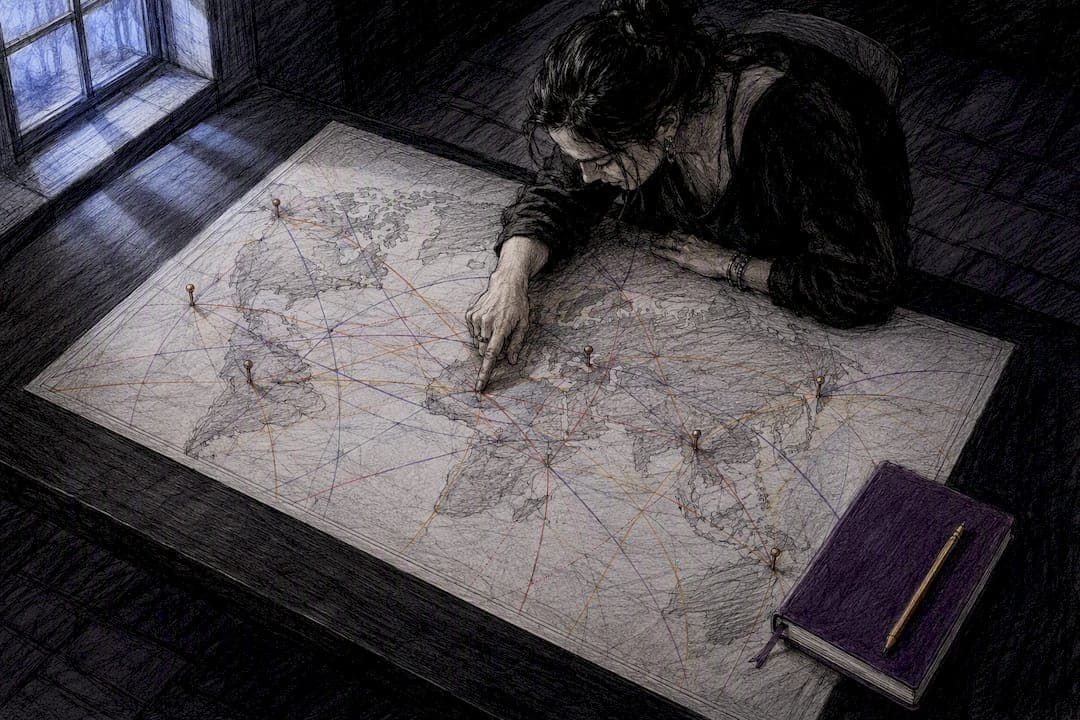
An astrocartography map takes your natal chart and projects it onto a world map, drawing lines where each planet was rising, setting, culminating, or underfoot at the exact moment you were born. Generate your map first, using your accurate birth date, time, and place. Then treat every line you see as a tendency worth testing, not a guarantee, before you plan a trip, a move, or anything else around it.
TL;DR:
- Your birth time must be precise, as even a 15-minute error can significantly shift the lines that influence your location choices.
- Lines nearest to your target location, especially within a few hundred kilometers, carry more influence and are more worth considering in planning.
- Interpret planetary lines in relation to their angles; for example, Venus DC suggests relational ease, while Venus AC relates to personal attractiveness.
- Cross-check your generated map with a second source and validate the themes by visiting or testing locations before making permanent decisions.
- Don’t treat a line as absolute destiny; instead, view it as a tendency that interacts with your natal chart and current transits.
Table of Contents
- What Is Astrocartography and How Is a Map Built?
- How to Generate an Accurate Map (Step by Step)
- Which Planet-Angle Combinations Matter Most?
- How Close Does a Line Need to Be to Matter?
- What's the Best Way to Read and Compare Locations?
- What Mistakes Do Beginners Make With Astrocartography?
- How Do You Test and Refine Your Map's Signals?
- Where Can You Learn More or Generate a Map Yourself?
- A Beginner's Honest Take on Astrocartography
- Sources
What Is Astrocartography and How Is a Map Built?
An astrocartography map projects your birth chart onto a world map, plotting a line everywhere on Earth where a planet held one of four specific positions relative to the horizon or the meridian at your exact birth moment. Those four positions are the Ascendant (rising), Descendant (setting), Midheaven (culminating overhead), and Imum Coeli (underfoot). Each of the ten planets and points astrologers track can generate up to four lines, one for each angle, so a full map can carry dozens of overlapping lines crisscrossing every continent.
The angle a line represents matters as much as the planet on it. A Venus line means something different depending on whether it's your Venus Ascendant line or your Venus Midheaven line, because the angle determines which life area the planet's energy shows up in:
- Ascendant (AC): identity, physical presence, how you show up and initiate
- Descendant (DC): relationships, partnerships, one-on-one dynamics
- Midheaven (MC): career, public reputation, life direction
- Imum Coeli (IC): home, roots, family, private emotional life
Birth time drives all of this. The Ascendant and Descendant move fast, shifting meaningfully with just a few minutes of time error, and even the slower Midheaven and Imum Coeli lines can drift across a map if your recorded birth time is off. A map built on a guessed birth time isn't really your map. It's a rough sketch.
How to Generate an Accurate Map (Step by Step)
Your map is only as good as the data you feed it. Here's the process that produces a result worth trusting:
- Pull your exact birth details. You need the full date, the time down to the minute, and the specific city and hospital or address if you have it. A birth certificate is the gold standard; a parent's memory is a distant second.
- Choose a tool that shows your data clearly. Free calculators work fine for a first look, but confirm the tool displays your time zone, coordinates, and house system before you read anything into the lines.
- Check the time zone conversion. This is the single most common error beginners make. If your birth city observed daylight saving time or a regional time offset that's changed since your birth year, verify the tool applied it correctly.
- Turn on parans and city-distance features if available. More capable tools will calculate exactly how far a chosen city sits from your nearest planetary line, in miles or kilometers, and will flag paran crossings automatically.
- Cross-check against a second source. Run your data through a different calculator once. If the lines land in the same places, your data is solid.
Pro Tip: If you don't know your exact birth time, request a birth certificate copy from your state's vital records office before you generate anything. A time error of even 15 minutes can shift your Ascendant and Descendant lines by a noticeable distance, which changes which cities light up on your map entirely.
Which Planet-Angle Combinations Matter Most?
Once your map is accurate, the real work is translating lines into meaning. Every planet carries a consistent theme, and the angle it touches tells you where that theme plays out.
- Sun: vitality, visibility, confidence. On the MC, it can mean career recognition; on the IC, a strong sense of home.
- Moon: emotional comfort, domestic rhythms, public mood. Moon DC often shows up as easy emotional rapport with people you meet there.
- Venus: attraction, ease, aesthetic pleasure. Venus DC is the classic "relationships come easily here" line; Venus AC often reads as feeling more attractive or at ease in your own skin.
- Mars: drive, conflict, physical energy. Mars lines can sharpen ambition on the MC or stir friction on the DC.
- Jupiter: growth, luck, opportunity. Jupiter MC frequently correlates with career breaks and expanded visibility; Jupiter IC can mean a home base that expands your resources.
- Saturn: structure, discipline, and sometimes restriction. Saturn lines aren't automatically bad, but they tend to demand more patience and effort wherever they land.
- Mercury: communication, learning, quick thinking. Strong for cities tied to writing, teaching, or negotiation work.
Even a single well-placed Venus or Jupiter line does not override the rest of your chart's conditions. Practitioners consistently stress that line meanings shift depending on how that same planet behaves in your natal chart. A Jupiter MC line will read very differently for someone whose natal Jupiter sits comfortably in a confident sign than for someone whose Jupiter is tied up in a difficult natal aspect. The map tells you where a theme activates. Your birth chart tells you how that theme tends to express itself for you specifically.
How Close Does a Line Need to Be to Matter?
Distance is where most beginners get confused, because a line drawn across a continent doesn't mean the entire continent feels the effect equally. Astrocartography works on an orb of influence, meaning a line's strength fades the farther you get from it.
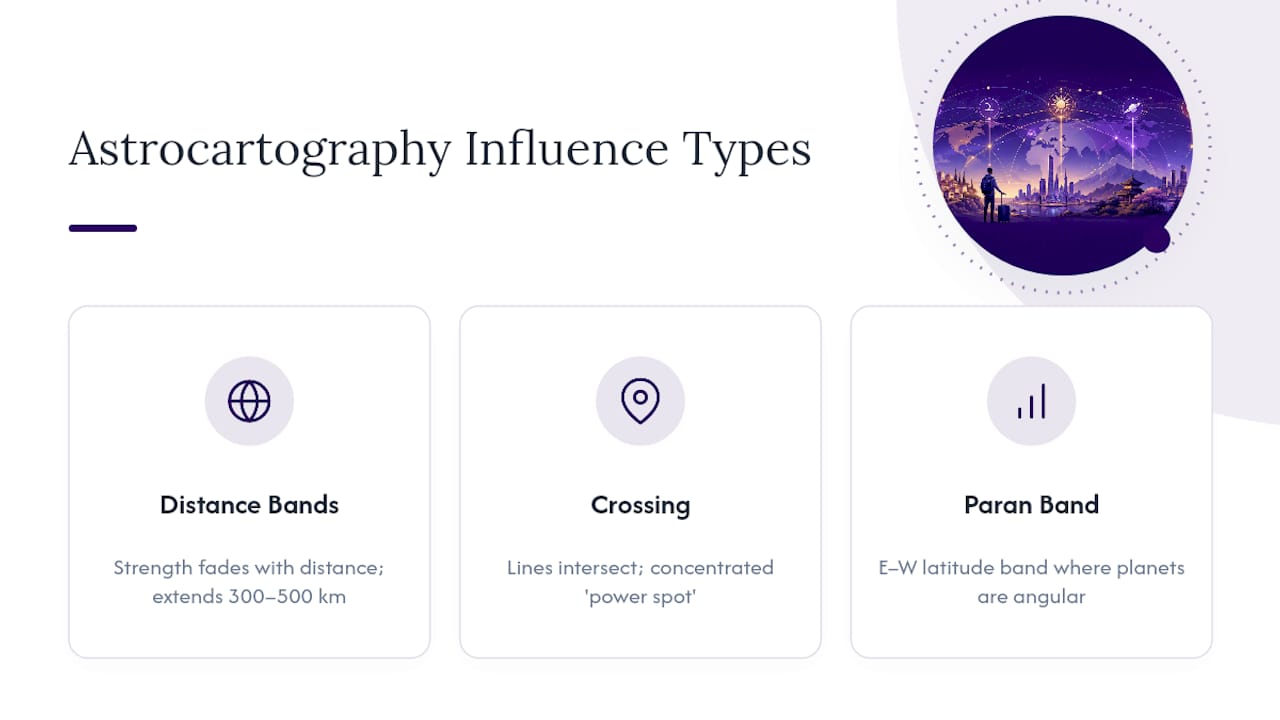
These practical distance bands give you a starting framework, though many practitioners will still credit a line's influence up to 300 to 500 km away if the planet involved is a major one like Jupiter or Saturn.
Two other signals matter beyond simple distance. A crossing happens where two planetary lines physically intersect on the map, concentrating both planets' energies into one specific spot. Guides often treat crossings as the strongest "power spots" on a chart, worth more attention than either line alone. A paran is different: it's a horizontal band running east to west at a specific latitude, marking where two planets were simultaneously angular (both touching an angle) at your birth moment, even if their individual lines never cross. Parans and crossings are commonly underused by beginners, yet they often explain why a city feels significant even when no single line runs directly through it.
What's the Best Way to Read and Compare Locations?
Trying to decode an entire world map at once is the fastest way to feel overwhelmed. The workflow that actually works starts small and stays concrete.
- Pick a place you already know well. This could be where you grew up, went to college, or lived for a few years.
- Find the nearest line or lines to that city. Note the planet and the angle.
- Ask yourself if the theme matches your real experience there. If your Mars MC line runs near your hometown and you remember it as a competitive, driven place for your career, that's a useful calibration point.
- Repeat the process for a place you're actually considering, whether for a trip, a move, a job, or a relationship.
- Compare the two places side by side using the same criteria: nearest line, planet, angle, distance, and how well the theme fits your actual goal.
This city-first method is the standard recommendation across most reading guides, and for good reason: it grounds an abstract map in evidence you can actually check.
A few things to weigh once you're comparing candidates:
- Does the line's theme actually match what you want from this location, or just sound appealing in the abstract?
- Are there practical constraints (visa status, job market, cost of living) that outweigh the astrological read?
- What transits or progressions are active right now, since even a great natal line can feel muted during a difficult transit period, or amplified during a supportive one?
If a location scores well on paper, the only real test is a short visit. Book a trip, pay attention to how you feel and what happens, and treat the outcome as data rather than proof either way.
What Mistakes Do Beginners Make With Astrocartography?
The biggest mistake is treating a line as destiny rather than a tendency. A Saturn line through a city doesn't mean you'll be miserable there. It usually means that location asks more discipline and patience of you, which some people thrive on and others find draining.
- Don't skip verifying your birth time before trusting any AC or DC line, since those two shift fastest with time errors.
- Don't read a line in isolation from your natal chart. The same planet acts differently for different people.
- Do use local-space lines or parans when you're evaluating a specific neighborhood rather than an entire city.
- Do give nearby lines more weight than distant ones, especially when two locations both seem to "hit."
Pro Tip: When two candidate cities each have an appealing line, give the edge to whichever one sits closer to the line's exact path. A Venus DC line running through downtown carries more weight than the same line grazing the outer suburbs 60 miles away.
How Do You Test and Refine Your Map's Signals?
A map is a starting point, not a verdict. The most reliable way to build confidence in your results is to pair them with other tools and actually test them. Save your generated chart, run it through an AI-personalized reading to see how the themes on a given line echo through your broader natal chart, and bring specific questions to an online community for outside perspective.
- Save your astrocartography results alongside your natal chart breakdown so you can cross-reference planet placements.
- Plan a short visit to your top candidate city before committing to anything permanent.
- Journal what you notice: mood, opportunities, friction, ease.
- Compare notes with others in the community who've tested similar lines.
Author Joseph Calitoy's take on responsible use follows below, and it's worth reading before you overcommit to any single line on your chart.
Where Can You Learn More or Generate a Map Yourself?
Beyond the workflow above, a handful of resources are worth bookmarking as you keep studying.
- How to Read Your Astrocartography Map, a free interactive tool with distance and orb calculations built in
- Complete Guide to Reading Your Astrocartography Map, a deeper explainer on parans and crossings
- How to Read an Astrocartography Map, an interactive guide built around the city-first comparison method
- Tarosyn's birth chart self-analysis guide, for pairing natal placements with your map's lines
A Beginner's Honest Take on Astrocartography
Treat your map as one input among several, not a verdict on where you belong—consider exploring broader spiritual approaches like those offered by Shantana Telise Healing | Quantum Channel & Multidimensional Healer. The most useful thing you can do early on is test it against a place you already know, then journal what actually happens on a trip before trusting an unfamiliar line. Try mapping a city you've already lived in and see if the nearest line matches your memory of it. Bring what you find to a community of people doing the same experiment, and let the map earn your trust one comparison at a time.
— Joseph Calitoy
Sources
- How to Read Your Astrocartography Map (Free Tool + Guide)
- Complete Guide to Reading Your Astrocartography Map | AstroChart Blog
- How to Read an Astrocartography Map | Interactive Guide