An astrology aspect is the angular distance between two points on your birth chart, usually two planets, measured along the ecliptic in degrees from 0 to 360. Aspects show whether planetary functions blend, clash, or cooperate. Start by finding the five major aspects on your chart: conjunction, opposition, square, trine, and sextile. Those five carry the most weight and give you a reading you can trust before you touch anything else.
TL;DR:
- Exactness and orb size matter, with the closest and applying aspects exerting the strongest influence, especially for fast-moving planets like the Moon.
- Prioritize the five major aspects—conjunction, opposition, square, trine, and sextile—before exploring minor aspects for a clearer overall reading.
- Long-term themes rely more on slow outer planets' aspects, which influence patterns spanning decades, unlike faster planets affecting short-term moods.
- When interpreting, focus on tight orbs, applying motion, and patterns like T-squares or grand trines to identify dominant influences and potential challenges.
- Aspects indicate potential and dynamic tension, not fixed outcomes, encouraging conscious choices based on the context provided by signs, houses, and planetary combinations.
Table of Contents
- What Is an Astrology Aspect, Exactly?
- The Five Major Aspects Every Beginner Should Learn First
- What Do Minor Aspects Add to a Chart Reading?
- How Do You Prioritize Aspects When Reading a Chart?
- How Should Beginners Interpret Aspects Without Fatalism?
- A Quick Cheat Sheet You Can Use Right Away
- Why This Approach Works Better for New Chart Readers
- Want a Guided Reading Instead of Doing It Alone?
- Sources
- FAQ
What Is an Astrology Aspect, Exactly?
An aspect exists when two chart points sit at a specific angular distance from each other, measured in ecliptic longitude. Picture your birth chart as a 360 degree wheel. Every planet, plus your Ascendant and Midheaven, occupies a point on that wheel. When you measure the gap between two of those points, you get an angle. Certain angles repeat often enough in astrological tradition to earn names and meanings.
You will meet three versions of this measurement as you keep studying:
- Natal aspects are fixed at the moment of birth and describe your personality and lifelong patterns.
- Transit aspects form between a planet's current position and a natal planet, marking short term events or shifts.
- Synastry aspects compare two people's charts point by point, which is how compatibility gets assessed in relationship astrology.
None of these angles need to be exact to count. Astrologers use a margin called an orb, usually a few degrees on either side of the precise angle. A conjunction with a 1 degree orb reads far stronger than one sitting at 7 degrees, because closeness to exact registers as intensity. Orb size varies by aspect type and by which astrologer you ask, but the principle holds everywhere: nearer to exact means louder in the chart.
The Five Major Aspects Every Beginner Should Learn First
Ptolemy catalogued five aspects roughly 1,800 years ago, and they remain the backbone of aspect interpretation today. Learn these five before anything else. They explain most of what shows up in a typical reading.
Conjunction (0°). Two planets sit almost on top of each other. Their energies fuse rather than interact, which can amplify a trait until it dominates. A Sun conjunct Mercury person often thinks and expresses identity as one seamless function.
Opposition (180°). Two planets sit directly across the wheel from each other, creating a push and pull axis. This aspect shows up constantly in relationship themes, since it often plays out through other people. Moon opposite Saturn can feel like emotional needs and self-discipline pulling in opposite directions.
Square (90°). A 90-degree angle creates friction that demands action. Squares are the tension that builds motivation, not comfort. Mars square Pluto often shows up as intense drive paired with power struggles.
Trine (120°). This is the easiest aspect to work with. Trines connect signs of the same element, so energy moves without resistance. Venus trine Jupiter often shows up as natural charm and a knack for attracting good fortune.
Sextile (60°). A softer cousin of the trine, sextiles represent opportunity that still needs a little effort to activate. Mercury sextile Uranus can signal quick, original thinking that flourishes once it's put to use.
| Aspect | Angle | Typical orb | Shorthand meaning |
|---|---|---|---|
| Conjunction | 0° | typically up to a few degrees | Fusion, amplification |
| Sextile | 60° | generally a few degrees | Opportunity, ease with effort |
| Square | 90° | usually a few degrees | Friction, drive |
| Trine | 120° | ~5°–7° | Flow, natural talent |
| Opposition | 180° | typically a few degrees | Polarity, relationship dynamics |
Orb ranges shift slightly depending on which planets are involved. Aspects to the Sun or Moon typically get wider orbs than aspects between two outer planets.
What Do Minor Aspects Add to a Chart Reading?
Minor aspects fill in detail once you already understand the five majors. They use narrower orbs, often just 1 to 3 degrees, so they only register when nearly exact.
- Semisextile (30°) links neighboring signs and adds subtle, often awkward adjustment between two areas of life.
- Quincunx (150°) connects signs with nothing in common, creating a nagging sense that something needs constant fine tuning.
- Quintile (72°) points to a creative or unusual talent, tied to the harmonic family of aspects built on dividing the circle by five.
- Sesquiquadrate (135°) behaves like a minor square, adding low grade irritation that builds gradually.
- Septile (about 51.43°) shows up rarely in casual reading but is associated with fated or unusually timed events in harmonic aspect theory.
Minor aspects shade a story that the major aspects already told. They rarely change the headline of a chart on their own. A useful rule for beginners: read every major aspect first, form your interpretation, then check minors only to add nuance or resolve a detail that still feels unclear.
How Do You Prioritize Aspects When Reading a Chart?
Every chart has more aspects than you can meaningfully interpret at once, so prioritizing matters more than memorizing every angle. Exactness is your first filter. An aspect within 1 degree of exact outweighs one sitting near the edge of its orb, even if both share the same name.
Next, consider whether the aspect is applying or separating. An applying aspect forms when the faster moving planet is approaching the exact angle, which tends to feel like building momentum, especially in transit work. A separating aspect has already passed exact and is moving apart, which often feels like fading influence or a lesson already absorbed.
Planet speed changes the story too. The Moon moves roughly 13 degrees a day and colors short, personal, situational moods. Saturn, Uranus, Neptune, and Pluto move slowly enough that their aspects describe long stretches of a life, sometimes a full decade or more. Weigh a Saturn square Mars far more heavily for long-term pattern reading than a Moon square Mars, which may just describe a passing mood.
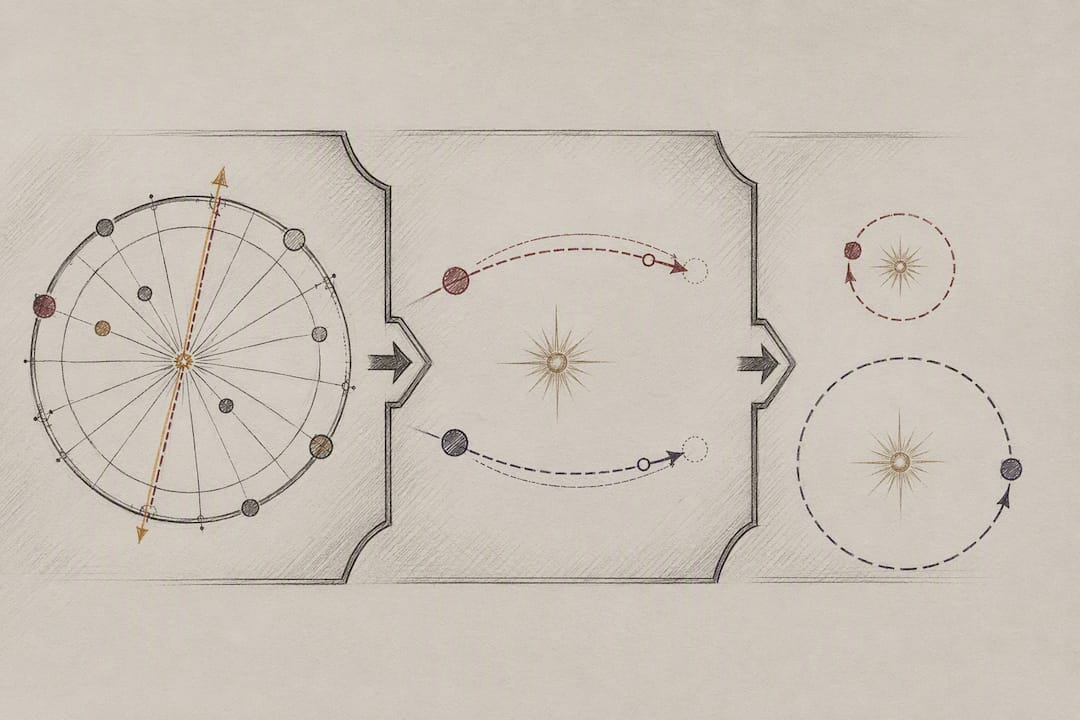
Aspect patterns deserve special attention. A T-square forms when two planets oppose each other and both square a third, creating a pressurized triangle that demands resolution. A grand trine links three planets in a flowing triangle, often signaling talent that feels almost too easy to use. An unaspected planet, one with no major connections to anything else in the chart, tends to operate independently, sometimes feeling disconnected from the rest of the personality.
Use this order when you sit down with a new chart:
- Identify all five major aspects first.
- Rank them by orb, tightest to widest.
- Note which are applying and which are separating.
- Flag any involving slow outer planets for long-term themes.
- Check for patterns like T-squares or grand trines.
- Only then layer in minor aspects for extra detail.
Pro Tip: Print your chart and physically circle every aspect line under 2 degrees of orb before you interpret anything else. That circle is where the chart is speaking loudest.
How Should Beginners Interpret Aspects Without Fatalism?
Aspects describe potential, not a locked outcome. Astrology writers and researchers alike frame aspects as prompts for conscious choice rather than a script you're forced to follow. A square does not guarantee conflict. It signals where friction is likely to appear, which gives you a chance to notice the pattern before it runs on autopilot.
The most useful interpretations combine three ingredients: the two planets involved, the aspect type connecting them, and the houses and signs they occupy. Mars square Saturn in one chart might show up as frustrated ambition. In another chart, with different house placements, it might describe disciplined physical training that pays off over years. The aspect explains the dynamic; the rest of the chart explains the context.
Try these small exercises as you learn:
- Notice one moment this week when you felt emotionally reactive, then check if your Moon forms a square or opposition to Mars or Saturn.
- Pick a trine in your chart and ask where that ease might be going unused rather than developed.
- When you catch yourself repeating a pattern, look for the aspect connecting the two planets involved, not just one planet in isolation.
Pro Tip: A tense aspect you actively work with usually produces more growth over time than an easy aspect you never have to think about.
A Quick Cheat Sheet You Can Use Right Away
Keep these one line prompts nearby while you practice:
- Conjunction: same energy, doubled. Watch for one trait overpowering the rest.
- Opposition: a tug of war. Look for the other person or situation completing the picture.
- Square: built in friction. Expect action, not comfort.
- Trine: effortless flow. Ask if you're actually using the gift.
- Sextile: an open door. It still needs you to walk through it.
- Applying: rising momentum, pay attention now.
- Separating: fading influence, a lesson likely already learned.
Worked example: a chart shows Mars square Saturn at 1 degree orb (applying), and Venus trine Jupiter at 6 degrees (separating). Rank the Mars-Saturn square first for its tight orb and applying motion; it likely describes an active, current tension between drive and restriction. The Venus-Jupiter trine, wider and separating, suggests an earlier phase of easy abundance that's already settled into the background.
Why This Approach Works Better for New Chart Readers
Most beginners drown in a chart because they try to read every aspect at once, minor and major, tight and loose, with equal weight. That's backwards. Prioritizing by orb and planet speed first, then layering in nuance, keeps interpretation grounded instead of overwhelming. This piece leans on that order deliberately, pulling from established aspect theory rather than trend driven shortcuts. For deeper practice, pair this framework with a full birth chart self-analysis guide or study how aspects connect to recurring life themes over time.
— Joseph Calitoy
Want a Guided Reading Instead of Doing It Alone?
Reading your own aspects line by line takes practice, and it's easy to misjudge an orb or miss a pattern your first few times through. There are tools that combine a birth chart with AI-powered readings that remember your history and connect the dots between planets, houses, and aspect patterns instead of leaving you to cross-reference them by hand.
Some beginner-friendly tools pair astrology with reflective journaling and daily horoscopes, so the same chart insight keeps showing up in context instead of sitting static after one reading. The Mystic monthly plan runs $7.99 per month, or save with the Annual circle at $59.99 per year. Start with your daily horoscope to see how your aspects show up day to day, then explore a full subscription plan when you're ready for the complete birth chart breakdown.
Sources
FAQ
What Is Considered the Hardest Aspect in Astrology?
The square is generally considered the most challenging major aspect because its 90 degree angle creates built-in friction between two planetary functions. Oppositions can feel equally hard, but they play out as external tension with another person or situation rather than internal pressure.
What Are the Best Aspects in Astrology?
Trines and sextiles are usually considered the most favorable because they connect compatible signs and let planetary energy flow with little resistance. That said, an aspect experts call easy still needs to be used actively, or the talent it points to can go undeveloped.
How Do I Find My Own Aspects?
You need your exact birth date, time, and location to generate an accurate chart, since aspect angles depend on precise planetary positions at that moment. A birth chart guide walks through the basics, and a personalized reading through Tarosyn can map your aspects for you automatically.
What Is the "Fakest" Zodiac Sign?
This is a popular meme-style question with no basis in astrological technique. Aspects, not sun signs alone, determine personality complexity, so no single sign is more or less "genuine" than another under real chart interpretation.
Do I Need to Learn Minor Aspects as a Beginner?
No. Master the five major aspects first, since they carry the bulk of a chart's story, and treat minor aspects as optional shading once you're comfortable reading conjunctions, squares, trines, oppositions, and sextiles with confidence.