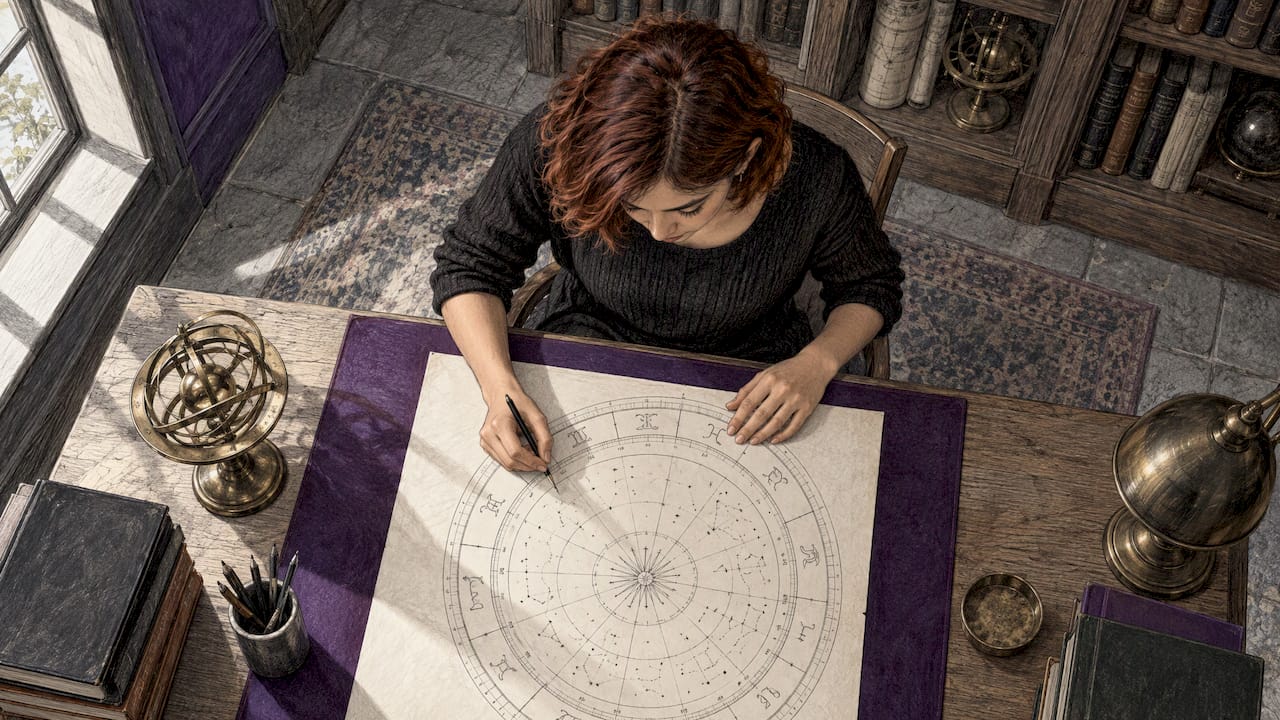
A decan is one third of a zodiac sign. Each sign covers 30 degrees, and each decan covers 10 of them. That gives 36 decans in the full zodiac. Two people with the same Sun sign can sit in different decans, and that is one reason their charts read differently.
This guide explains what decans are, where the idea comes from, how to find your own decan, and how to read it without overstating it.
TL;DR
- A decan is a 10-degree section of a sign. Each sign has three, so the zodiac has 36.
- Your decan depends on the degree of your planet in its sign, not only on your birth date.
- Two main systems assign a ruling planet to each decan. They give different answers for many decans, so check which one a source uses.
- Read the decan as a detail inside the whole chart. It adds nuance. It does not replace your Sun, Moon or rising sign.
- Decans started in ancient Egypt and changed as they moved through Greek, Arabic and Indian astrology.
Table of Contents
- What a decan is
- Where decans come from
- The 36 decans and their rulers
- How to find your decan
- How astrologers read a decan
- Common mistakes
- How to use your decan in practice
- Our perspective
- Try your chart in Tarosyn
- FAQ
- Sources
What a decan is
The zodiac is a circle of 360 degrees. It is divided into 12 signs of 30 degrees each. A decan splits one sign into three equal parts of 10 degrees. The University of Oxford Museum of the History of Science defines decans as 36 equal 10° divisions, starting at 0° Aries and ending at 30° Pisces. Each sign therefore holds three decans.
The parts are simple to remember:
- First decan: 0° to 9°59′ of the sign.
- Second decan: 10° to 19°59′.
- Third decan: 20° to 29°59′.
Each decan also has a planetary lord. The same Oxford glossary lists a planet or luminary (the Sun or Moon) for each one. The idea is that the sign sets the main style, and the decan adds a second influence from its ruling planet.
You may also see decans called faces. The Oxford glossary describes faces as 10° divisions, each governed by one of five planets or either luminary. In modern writing the two words are often used for the same thing.

Where decans come from
Decans did not start as part of the zodiac. According to the Oxford glossary, they began as Egyptian star constellations that marked days and the hours of the night. Later they became 10° zodiac divisions. By the early 11th century they were ruled by planets.
A 2017 article in Greek, Roman, and Byzantine Studies gives more detail. It explains that Egyptian decans were stars or star clusters used to mark nighttime hours and ten-day intervals of the Egyptian year. They were later taken into Hellenistic astrology.
The same research describes a practical use. In early Roman Egypt, decans were used in amuletic healing. Practitioners matched decans to diseases or parts of the body. They used the names, images and materials linked to each decan.
The path of the idea was not straight. The Oxford glossary says decans appear first in Egyptian astrology and later in Indian astrology, while faces seem to be native to Arabic astrology. A scholarly post on John Dee's work on the 36 decans notes that Dee compared and collated texts because the transmission of decan terms through Graeco-Egyptian sources was not straightforward.
This matters for a practical reason. When two astrologers give you different rulers for the same decan, they are often using different historical traditions. One is not simply wrong.
The 36 decans and their rulers
There are two common ways to assign a planet to each decan. Both are old, and both are in use today.
Triplicity method. The three decans of a sign are ruled by the traditional rulers of the three signs in the same element. The first decan belongs to the sign's own ruler. The Oxford glossary gives a table of this kind. For example, Aries is Mars, Sun, Jupiter; Taurus is Venus, Mercury, Saturn; and Pisces is Jupiter, Moon, Mars.
Chaldean order. The seven classical planets run in a repeating sequence: Mars, Sun, Venus, Mercury, Moon, Saturn, Jupiter. The sequence starts at 0° Aries with Mars and continues without a break through all 36 decans. Many modern decan charts use this system.
The table below shows both systems for all twelve signs. Rulers are listed in order: first, second and third decan.
| Sign | Triplicity method | Chaldean order |
|---|---|---|
| Aries | Mars, Sun, Jupiter | Mars, Sun, Venus |
| Taurus | Venus, Mercury, Saturn | Mercury, Moon, Saturn |
| Gemini | Mercury, Venus, Saturn | Jupiter, Mars, Sun |
| Cancer | Moon, Mars, Jupiter | Venus, Mercury, Moon |
| Leo | Sun, Jupiter, Mars | Saturn, Jupiter, Mars |
| Virgo | Mercury, Saturn, Venus | Sun, Venus, Mercury |
| Libra | Venus, Saturn, Mercury | Moon, Saturn, Jupiter |
| Scorpio | Mars, Jupiter, Moon | Mars, Sun, Venus |
| Sagittarius | Jupiter, Mars, Sun | Mercury, Moon, Saturn |
| Capricorn | Saturn, Venus, Mercury | Jupiter, Mars, Sun |
| Aquarius | Saturn, Mercury, Venus | Venus, Mercury, Moon |
| Pisces | Jupiter, Moon, Mars | Saturn, Jupiter, Mars |
The triplicity rows for Aries, Taurus and Pisces match the examples in the Oxford glossary. The other rows follow the same rule. Pick one system and keep using it. Mixing the two will confuse your reading.
If you want the background on how the signs themselves are set, read our guide on how zodiac signs are determined.
How to find your decan
You need the degree of the planet, not only the date. Follow these steps.
- Get your birth chart. You need your birth date, birth time and birth place. A chart tool will list the sign and degree of each planet.
- Find the placement you want. Start with your Sun. Then look at your Moon, rising sign and other planets.
- Read the degree. Ignore the minutes for now. A planet at 14° Leo is in the second decan of Leo.
- Match the degree to a decan. 0° to 9° is the first decan. 10° to 19° is the second. 20° to 29° is the third.
- Look up the ruler. Use one system from the table above.
A quick estimate from your birth date
The Sun moves a little less than one degree per day. So the first ten days or so after the Sun enters a sign are usually the first decan. The next ten days are usually the second. The last ten days are usually the third.

This is only an estimate. The date a sign starts changes slightly from year to year. If you were born within a few days of a decan boundary, or near the edge of a sign, use a chart to check the exact degree.
Worked example
Say your Sun is at 23° Gemini. That is the third decan of Gemini. Using the triplicity method, the ruler is Saturn. Using the Chaldean order, the ruler is the Sun. Both are valid readings in their own systems. Write down both and see which one fits your chart better when you read the rest of it.
Your Moon, rising sign and other planets also have decans. A full chart can show many of them.
How astrologers read a decan
Astrologers read a decan as a second layer on top of the sign. The sign gives the main approach. The decan ruler adds a tone.
Here is a simple way to do it:
- First decan: the sign is often described as being closest to its core style. In the triplicity method, this decan has the sign's own ruler.
- Second decan: the sign is mixed with the nature of the second ruler.
- Third decan: the sign is mixed with the nature of the third ruler, and its themes are often described as more blended or more distant from the sign's core.
These readings are traditions of interpretation. They are not measured facts. Treat them as prompts for reflection.
A short example with the triplicity method: Aries is ruled by Mars. A first-decan Aries has Mars twice, so the sign's direct, active style is described as strong. A second-decan Aries is tied to the Sun, which astrologers link to visibility and pride. A third-decan Aries is tied to Jupiter, which is linked to growth and belief.
If you want to compare this with the broader sign traits, see our guide to astrology and personality by zodiac sign.
Decans and tarot
Some tarot traditions link the 36 small cards of the Minor Arcana (the 2s through 10s) to the 36 decans. Each card is tied to a sign and a ruling planet. If you read tarot, this link can add a second layer to a card. You can see the same kind of cross-link in our piece on tarot and numerology connections.
Common mistakes
Using the date only. A date gives you a rough decan for the Sun. Other planets need their own degrees.
Mixing systems. Choose triplicity or Chaldean. Stay with it for the whole chart.
Treating the decan as fate. A decan is one detail. It does not set your personality, career or relationships.
Ignoring cusps. If a planet sits at 29° or 0° of a sign, check the exact time. A few minutes of birth time can change the sign or decan.
Skipping the rest of the chart. Houses, aspects and the Moon change how a decan shows up. For more on common errors, see our list of astrology misconceptions.
How to use your decan in practice
Use the decan as a question, not an answer. Here are four ways to do that.
- Journal prompt. Write down the sign and the decan ruler. Ask: where do I see both styles in my week?
- Compare people. If two friends share a Sun sign, check their decans. See whether the difference helps explain how they act.
- Check compatibility. Look at the decan rulers of two people. Do the planets match, support or clash? Our guide on zodiac compatibility pairings shows how planets are compared.
- Link to a ritual. Pick the ruling planet's day or theme and set a small routine. Keep it simple and repeatable.
If you use chakra practice, you can also see how planets are matched to energy centers in our chakra and astrology guide.
Our perspective
Decans are useful because they make a sign less generic. A Sun sign describes millions of people. A decan, a Moon degree and a rising sign start to describe one person.
We build Tarosyn around that idea. Our readings are designed to use your birth chart context and to remember your history. They are not meant to give a fixed prediction. They are meant to give you something to reflect on.
When you read a decan, keep a record. Note what fits and what does not. Over time, your notes tell you more than any table. A journal that stays with your readings makes this easy.
We also think privacy matters here. Birth data is personal. You should decide what you share and what stays your own practice.
Joseph Calitoy
Try your chart in Tarosyn
If you want to see how your placements read together, open Tarosyn. You can use AI-powered astrology with birth chart context, save your readings, and add journal notes as you go. Plans are Mystic monthly at $7.99 per month and Annual circle at $59.99 per year. Luna packs are also available. See the details on the Tarosyn site.
Start with your Sun decan. Then add your Moon and rising sign. Save the reading and return to it later.
FAQ
What are decans in astrology?
Decans are 10-degree sections of a zodiac sign. Each of the 12 signs has three, which makes 36 in total. Each decan has a planetary ruler that adds a second tone to the sign.
How do I find my decan?
Find the sign and degree of your planet in a birth chart. Degrees 0 to 9 are the first decan, 10 to 19 the second, and 20 to 29 the third. For a rough Sun estimate, use the first, middle and last ten days of the sign. Check a chart if you were born near a boundary.
Why do different sources give different decan rulers?
There are two main systems. One uses the traditional rulers of the signs in the same element. The other uses the Chaldean order of planets. The historical record also shows decans passing through Egyptian, Indian and Arabic traditions, so more than one table exists. Pick one and use it consistently.
Do decans change my Sun sign?
No. Your Sun sign stays the same. The decan only describes which third of that sign your Sun falls in. It adds detail to the sign and does not replace it.
Are decans the same as faces?
They describe the same 10-degree divisions, and many modern writers use the words as one. Historically the terms come from different traditions. Decans appear first in Egyptian and Indian astrology, while faces seem native to Arabic astrology.
Sources
- University of Oxford Museum of the History of Science: Glossary, decans
- University of Oxford Museum of the History of Science: Glossary, faces
- Decanal Iconography and Natural Materials in the Sacred Landscape (Greek, Roman, and Byzantine Studies, 2017)
- Decanal Iconography and Natural Materials, amuletic healing in early Roman Egypt
- John Dee's Astronomicon and the Thirty-Six Decans