
Astrological ages are defined as periods of roughly 2,160 years, each shaped by Earth's axial precession shifting the spring equinox backward through a zodiac constellation. Understanding how astrological ages work gives you a framework for reading broad cultural patterns across millennia. The full cycle, known as the Great Year or Platonic Year, spans approximately 25,920 years and passes through all twelve zodiac signs. Each age carries a distinct archetypal character that colors religion, art, politics, and social structure during its span. You are living through one of those transitions right now.
How astrological ages work: the precession of the equinoxes
The mechanism behind astrological ages is a slow wobble in Earth's rotation called the precession of the equinoxes. Earth spins like a top, and its axis traces a wide circle over time due to gravitational pull from the Moon and the Sun. That wobble shifts the position of the vernal equinox point relative to the fixed stars at a rate of roughly 50.3 arc-seconds per year.

The practical result is that Earth's axis shifts approximately one degree every 72 years. That rate means the equinox point takes about 2,160 years to move through one zodiac constellation and about 25,920 years to complete the full circuit. Because the movement runs backward through the zodiac, the sequence of ages goes Pisces, Aquarius, Capricorn, and so on, rather than forward.
Two zodiacs matter here. The tropical zodiac is fixed to the seasons and the equinox point itself. The sidereal zodiac is fixed to the actual star positions. Western astrology uses the tropical system, which means astrological ages are calculated by tracking where the equinox point falls against the backdrop of sidereal constellations. That distinction is why the calendar year and the astrological age do not align neatly.
- Earth's axis wobbles due to lunar and solar gravity.
- The wobble shifts the vernal equinox backward at 50.3 arc-seconds per year.
- One full zodiac sign takes roughly 2,160 years to pass.
- Twelve signs complete one Great Year of approximately 25,920 years.
- The direction of travel is retrograde through the zodiac.
Pro Tip: If you want to feel the scale of precession, note that the North Star was not Polaris during the Age of Taurus. It was Thuban in the constellation Draco. The sky itself changes over these timescales.
Why do experts disagree on exact age start dates?
Calculating exact age boundaries is genuinely difficult, and no universal consensus exists. The most common method divides the Great Year into twelve equal segments of 2,160 years each. That approach is clean mathematically, but the actual zodiac constellations are not equal in size.
The International Astronomical Union defined official constellation boundaries in 1930, and those boundaries differ significantly from the equal 30-degree divisions astrologers traditionally use. Ophiuchus, for example, sits along the ecliptic but is not counted as a zodiac sign in astrology. These boundary differences produce wildly different start dates for the same age.
The transition between ages is not a single moment but a multi-century overlap. Because zodiac constellation boundaries are uneven and somewhat subjective, astrologers treat age shifts as gradual processes with coexisting cultural themes rather than clean historical breaks.
Proposed start dates for the Age of Aquarius alone range from 1844 CE to 2597 CE depending on the system used. Some astrologers point to the Bahá'í Faith's founding in 1844 as a symbolic marker. Others use astronomical software to calculate the precise moment the equinox crosses the constellation boundary. The disagreement is not a flaw in the system. It reflects the genuine complexity of mapping a continuous astronomical process onto discrete symbolic categories.
- Equal-division systems produce start dates around 2000 CE.
- Constellation-boundary systems produce dates as late as 2597 CE.
- Historical-event systems anchor dates to cultural milestones.
- Most working astrologers treat transitions as century-long overlapping phases.
What are the cultural themes of major astrological ages?
Each astrological age carries a dominant archetypal theme that shows up across religion, governance, art, and technology. These themes are not predictions. They are symbolic lenses for reading collective human behavior at civilizational scale.
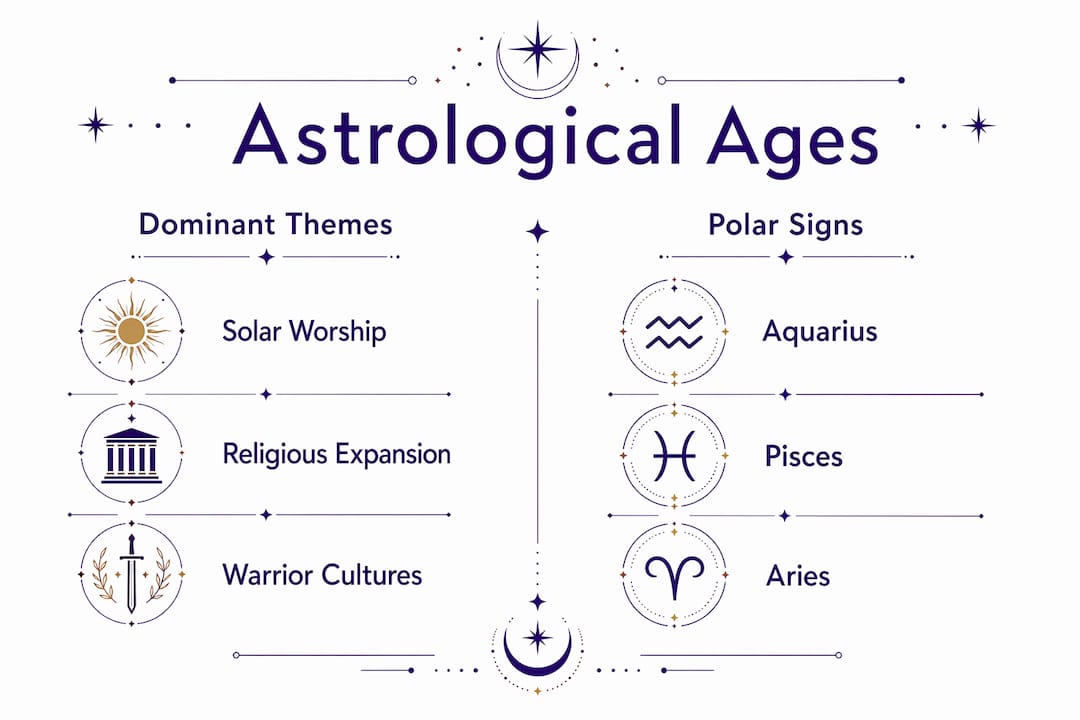
Each age is also shaped by its opposite zodiac sign, which provides a counterpoint to the dominant energy. Pisces is polar to Virgo. Aquarius is polar to Leo. That polarity creates tension and balance within each age, preventing any single archetype from running unchecked.
| Age | Approximate Period | Dominant Themes | Polar Sign |
|---|---|---|---|
| Leo | 10,800–8,640 BCE | Solar worship, royalty, heroic mythology | Aquarius |
| Cancer | 8,640–6,480 BCE | Matriarchy, agriculture, lunar cults | Capricorn |
| Taurus | 4,320–2,160 BCE | Bull worship, earth fertility, early cities | Scorpio |
| Aries | 2,160 BCE–0 CE | Warfare, iron, heroism, monotheism | Libra |
| Pisces | 0–2,160 CE | Faith, sacrifice, institutional religion | Virgo |
| Aquarius | 2,160 CE onward | Networks, science, collective consciousness | Leo |
The Age of Pisces offers the clearest historical example. Christianity, Islam, and Buddhism all expanded dramatically during this period, and fish symbolism appears across all three traditions. The Piscean archetype of faith, sacrifice, and transcendence shaped two millennia of human spiritual life. The Virgo polarity showed up as an emphasis on service, ritual precision, and moral purity as counterweights to Piscean mysticism.
The Age of Aries before it was defined by iron weapons, warrior cultures, and the rise of monotheistic religion. The Hebrew Bible, the Greek heroic tradition, and the Roman Republic all emerged during Aries' span. The Libra polarity expressed itself through legal codes, diplomatic treaties, and the concept of justice as a social ideal.
Pro Tip: When reading about any historical period, ask which astrological age it falls in. You will start noticing how consistently the dominant cultural obsessions match the age's archetype. It does not explain everything, but it adds a useful layer of pattern recognition.
How do transitions between astrological ages unfold?
Transitions between ages are not switches. They are long, overlapping phases that can span centuries. Precessional drift causes old and new themes to coexist, creating cultural tension and creative ferment rather than clean historical breaks.
The shift from Taurus to Aries illustrates this well. Bull worship did not vanish overnight when Aries began. The Minoan civilization continued its bull cults well into what astronomers calculate as the Aries period. The Hebrew Bible's story of the golden calf reads, in this framework, as a cultural conflict between a dying Taurean archetype and the emerging Arian one.
The current transition from Pisces to Aquarius follows the same pattern. Estimates place this transition from the mid-19th century to the late 26th century, with overlapping themes active simultaneously. That is a span of roughly 700 years during which Piscean and Aquarian energies compete and blend.
- Old hierarchical institutions (Piscean) coexist with decentralized networks (Aquarian).
- Organized religion declines in some regions while spiritual individualism grows.
- Centralized broadcast media gives way to peer-to-peer information systems.
- Scientific rationalism (Aquarian) clashes with renewed mysticism (Piscean shadow).
- Political authority fragments as collective movements gain power.
The Age of Aquarius will not arrive as a sudden utopian shift. It will continue as a period of social tension and transformation as Piscean institutions decline and Aquarian themes of decentralization and collective consciousness evolve. Recognizing this helps you read current events without expecting either a clean break or a simple regression.
How can understanding astrological ages enrich your perspective?
Astrological ages set broad cultural climates, not personal destinies. Your birth chart describes your individual path. The age you are born into describes the collective backdrop against which that path unfolds. The distinction matters because it prevents both fatalism and magical thinking.
Using ages as a symbolic lens means asking what archetypal energies are dominant right now and how you can work with them rather than against them. During a Pisces-to-Aquarius transition, for example, skills like network thinking, digital literacy, and comfort with ambiguity carry more cultural weight than they did a century ago. That is not destiny. It is context.
Integrating old and new paradigms is the practical work of living through a transition. You can hold Piscean values like compassion, spiritual depth, and communal faith while also building Aquarian capacities like independent thinking, technological fluency, and collective organizing. These are not opposites. They are complements. Astrology as a self-discovery tool works best when it helps you see both the individual and the collective picture clearly.
Pro Tip: Read your birth chart alongside the current age context. Your natal placements tell you your personal strengths. The age tells you which of those strengths the culture most needs right now. That overlap is where personal purpose and collective relevance meet.
Understanding how astrology predicts life themes at the individual level becomes richer when you also understand the macro cycle running underneath it. The two scales of analysis reinforce each other.
Key Takeaways
Astrological ages are 2,160-year periods driven by Earth's axial precession, each carrying distinct archetypal themes that shape collective culture without determining individual fate.
| Point | Details |
|---|---|
| Precession drives the cycle | Earth's axis wobbles one degree every 72 years, shifting the equinox through the zodiac over 25,920 years. |
| Boundaries are genuinely debated | Unequal constellation sizes and differing systems produce age start dates that vary by centuries. |
| Each age has a polar counterpoint | The opposite zodiac sign provides balance, creating cultural tension that prevents any single archetype from dominating. |
| Transitions overlap for centuries | Old and new age themes coexist for hundreds of years, producing cultural upheaval and creative synthesis. |
| Ages set context, not destiny | They describe collective archetypal climates, not personal outcomes, and work best as interpretive tools. |
The part most astrology writing gets wrong about age transitions
Most popular writing on astrological ages treats the Age of Aquarius like a scheduled event with a confirmed arrival date. That framing misses the entire point of how these cycles work. I have spent years reading both the astronomical literature and the astrological commentary, and the honest conclusion is that transitions are the most interesting part of the system, not the destination.
What strikes me most is how accurately the Pisces-to-Aquarius overlap describes the present moment. You can see Piscean themes (institutional religion, centralized authority, collective faith) actively breaking down alongside Aquarian themes (decentralized networks, scientific skepticism, individual spiritual seeking) actively building up. Neither has won. Both are real. That is exactly what a multi-century overlap looks like from the inside.
The practical takeaway is to resist the urge to declare the old age dead or the new one fully arrived. The most grounded approach is to hold both sets of values consciously. Use the Piscean inheritance of depth, compassion, and communal meaning. Build the Aquarian capacities of independent thinking and networked collaboration. The people who navigate transitions well are not the ones who pick a side. They are the ones who synthesize.
Skepticism about the system is healthy. These are symbolic frameworks, not physical laws. But dismissing them entirely means losing a genuinely useful lens for reading civilizational patterns. Use it lightly, use it critically, and it will add real texture to how you understand history and your own moment in it.
— Joseph
Tarosyn's tools for reading the current age
Archetypal themes are not just civilizational abstractions. They show up in individual readings, daily energies, and the cards you pull on a given morning. Tarosyn connects the macro patterns of astrological ages to the personal level through AI-powered tarot and astrology tools built for exactly this kind of self-inquiry.
Browse public tarot readings on Tarosyn to see how Piscean and Aquarian archetypes are showing up in real community spreads right now. The tarot archetypes library maps the major arcana to the same symbolic vocabulary that underlies astrological ages, giving you a direct bridge between the cards you draw and the collective energies in play. If you want to go deeper into the current Pisces themes still active in this transition, the Pisces horoscope on Tarosyn offers daily context grounded in that archetypal tradition.
FAQ
What are astrological ages in simple terms?
Astrological ages are roughly 2,160-year periods defined by which zodiac constellation the spring equinox aligns with, driven by Earth's slow axial wobble called precession. Each age carries a distinct set of cultural and archetypal themes that shape collective human development.
How long does one astrological age last?
One astrological age lasts approximately 2,160 years. The full cycle of all twelve ages, called the Great Year or Platonic Year, takes roughly 25,920 years to complete.
Are we currently in the Age of Aquarius?
The transition from Pisces to Aquarius is underway but not complete. Estimates place the overlap period from the mid-19th century to the late 26th century, meaning both Piscean and Aquarian themes are active simultaneously right now.
Why do astrologers disagree on when ages begin?
Astrologers disagree because actual zodiac constellations vary in size, and the International Astronomical Union's official boundaries differ from the equal 30-degree divisions used in traditional astrology. Different calculation methods produce start dates that vary by centuries.
Do astrological ages affect individual people directly?
Astrological ages set collective archetypal climates, not personal destinies. They describe the broad cultural backdrop of an era. Your individual birth chart remains the primary tool for understanding your personal path within that larger context.