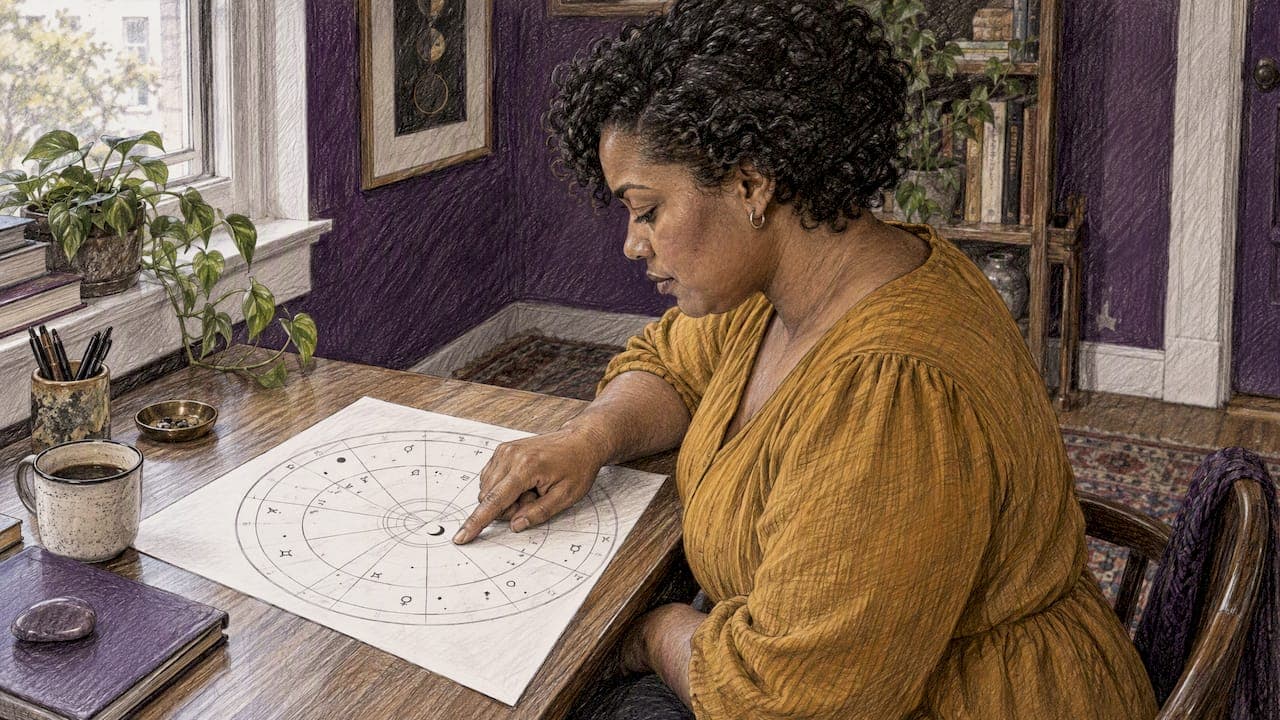
A lunar return chart is a map of the sky for the moment the Moon comes back to the exact degree it held when you were born. That happens about once a month. Astrologers read the chart as a theme for the period until the next return: your moods, routines, home life and daily rhythms. Use it as a reflection tool, not a forecast.
This guide shows you how to get your chart, what to look at first, and how to turn it into a simple monthly practice.
TL;DR
- A lunar return chart is cast for the moment the transiting Moon returns to your natal Moon's exact degree. It covers one lunar cycle, not a calendar month.
- Cast it for the place where you are, not where you were born. Location changes the houses.
- Read in this order: Moon sign, Moon house, rising sign, then aspects to the Moon.
- Treat it as a symbolic framework for reflection and planning. It does not predict events.
- Write down a short intention at each return and review it at the next one.
Table of Contents
- What a lunar return is
- How long a lunar return period lasts
- How to get your lunar return chart
- How to read a lunar return chart
- Worked example
- What a lunar return chart can and cannot do
- A simple monthly lunar return ritual
- Our perspective
- Use Tarosyn with your lunar return
- Common mistakes to avoid
- FAQ
- Sources
What a lunar return is
Every month, the Moon moves through the whole zodiac. At some point it reaches the same sign and degree it held in your birth chart. That moment is your lunar return. As Llewellyn explains, you then factor in where you currently live to build the return chart.
The idea is the same as a solar return. In a solar return, the Sun comes back to its natal position once a year, near your birthday. People describes the lunar return as the monthly version of that. In astrology dictionaries, a return is a chart for the moment a body comes back to the zodiac position it held in a reference chart, usually the natal chart. It is most often applied to the Sun and Moon.
The Moon in astrology stands for feelings, family, home, habits and daily rhythms. So the lunar return chart is read for emotional and practical themes. It describes how you may feel and what may need your attention.

Lunar return meaning in one sentence
Your lunar return shows the emotional tone and the daily-life focus of the next lunar cycle, based on where the Moon sits by sign, house and aspect.
Lunar return vs. new moon vs. full moon
These are different things.
- New and full moons happen for everyone at the same time. They relate to the Sun and Moon, not to your personal chart.
- Your lunar return is personal. The Moon returns to your natal degree, so the date and time differ for each person.
Two people can share a full moon but have a lunar return days apart.
How long a lunar return period lasts
The Moon takes a little under a month to return to the same degree. The chart covers the time from one return to the next. That is one lunar-return period, not a fixed calendar month. Your return may land on the 3rd one month and the 30th of the previous month.
Because of this, do not read your chart as "May" or "June." Read it as "from this return to the next." Mark both dates on your calendar.
How to get your lunar return chart
You need three things:
- Your birth date.
- Your birth time, as exact as you can get it.
- Your current location.
Follow these steps.
- Find your natal Moon degree. Look at your birth chart. Note the sign and the degree, for example 14° Taurus.
- Find the next return date. Use a lunar return calculator. Enter your birth data and choose the current date.
- Set the location to where you are. Use your city today. If you travel and will be away for the whole cycle, some astrologers cast it for the travel location. Pick one and stay consistent.
- Generate the chart. Save the image or the list of placements.
- Note the return time. Convert it to your time zone. The rising sign changes about every two hours, so the exact time matters.
If you do not know your birth time, the Moon sign and aspects still work. The houses and rising sign will not be reliable. Use a birth certificate or ask the hospital or county records office for the time.
Why location matters
The Moon returns to the same zodiac degree for everyone, but the houses depend on where you stand on Earth. Llewellyn's guide says to use your current place of residence. A return cast for Chicago and one cast for Miami can place the Moon in different houses.
How to read a lunar return chart
Start simple. Do not try to read every symbol on the first pass. Use this order.
1. The Moon's house
The house where the Moon sits is the main focus of the cycle. It points to the area of life that holds your attention.
| House | Area of life | Questions to ask |
|---|---|---|
| 1st | Self, body, appearance | What do I need to change about how I show up? |
| 2nd | Money, values, resources | What do I spend on, and why? |
| 3rd | Communication, siblings, short trips | Who do I need to talk to? |
| 4th | Home, family, roots | What does my home need? |
| 5th | Creativity, play, romance | Where can I have fun? |
| 6th | Work routines, health habits | Which habit needs a reset? |
| 7th | Partners, close relationships | What do I need from others? |
| 8th | Shared money, intimacy, endings | What am I ready to release? |
| 9th | Travel, study, beliefs | What do I want to learn? |
| 10th | Career, public life | What goal needs effort? |
| 11th | Friends, groups, hopes | Who is in my circle? |
| 12th | Rest, solitude, the subconscious | Where do I need quiet? |
The house meanings above are standard in Western astrology. Different astrologers weigh them differently, so use them as prompts.
2. The Moon's sign
The sign shows the style of your emotions during the cycle. A Moon in Cancer asks for comfort and closeness. A Moon in Capricorn asks for structure. Compare it with your natal Moon sign. If the two match, you may feel more like yourself. If they differ, you may notice a shift in mood. For a deeper look at your natal Moon, read our guide on moon sign meaning.
3. The rising sign
The rising sign of the return chart sets the tone of the cycle and how you meet the world. It also decides the house layout. Compare it with your natal rising sign. Note which house the return Sun and other planets fall in.
4. Aspects to the Moon
Aspects are angles between planets. Look at which planets touch the Moon.
- Conjunction (same degree): the planet's theme joins your emotions. A conjunction with Saturn can feel serious. With Venus, it can feel soft.
- Trine and sextile: ease and support.
- Square and opposition: tension that asks for action.
Do not read a square as bad. It marks where effort is needed.
5. Angular planets
Planets near the 1st, 4th, 7th or 10th house cusps carry extra weight. Note any that sit within a few degrees of those points.
Worked example
Say your return chart shows the Moon in Virgo in the 6th house, with a square to Mars.
- Sign (Virgo): you want order, details and useful work.
- House (6th): the focus is routines, health habits and daily tasks.
- Square to Mars: you may feel irritable or rushed when things are not done.
A practical reading: this cycle suits fixing your schedule. Plan rest, keep tasks small, and avoid taking on too much. Pick one habit, such as a regular sleep time, and track it until the next return.
This is an example of the method. It is not a rule about Virgo or the 6th house for every person.
What a lunar return chart can and cannot do
The lunar return can describe emotional responses and events, but it is not a crystal ball, a tarot reading or a biorhythm chart. Use it as a symbolic monthly framework and keep your own choices central.
Here is how to apply that:
- Use it to name your mood. "I feel unsettled because my Moon is in the 12th house" gives you a reason to rest.
- Use it to plan. Schedule hard conversations when the Moon is in a supportive aspect, if that helps you feel ready.
- Do not use it for medical, legal or financial decisions. Talk with a licensed doctor, attorney or financial adviser for those.
A simple monthly lunar return ritual
A chart is only useful if you act on it. Try this routine.
- Before the return: Look up the exact time. Clear a few minutes around it.
- At the return: Sit somewhere quiet. Write the date, time and your city.
- Write three lines: the Moon's sign and house, one word for how you feel, one intention for the cycle.
- Draw one tarot card. Ask: "What do I need to know about this cycle?" Write the card name and your first reaction. Our guide on tarot and self-reflection shows how to journal a card.
- During the cycle: Check in once a week. Note any events that match the theme, and any that do not.
- At the next return: Read your notes. Write what happened. Then start a new chart.
If you want a calm practice to pair with this, a Buddhist guide to the third eye covers meditation on intuition.
After three or four cycles, you will see patterns. You might find that your Moon in the 4th house cycles line up with family calls, or that fire-sign Moons make you restless. Your own records matter more than any general list.
Our perspective
We built Tarosyn around one idea: a reading is useful when it connects to your history. A single lunar return chart shows one cycle. Several charts, with your notes next to them, show you.
That is why we focus on three things.
- Context. A reading should know your birth chart. The Moon's house means more when you compare it with your natal Moon.
- Memory. Save your readings and journal entries. Then review them at the next return.
- Privacy and choice. Keep your practice personal, or share it with friends. You decide.
We do not treat a lunar return as a prediction. We treat it as a prompt. It tells you what to look at. You decide what to do.
— Joseph Calitoy
Use Tarosyn with your lunar return
Tarosyn combines AI-powered tarot, astrology and numerology with journaling. You can save readings, add notes and track your growth from one cycle to the next. Check the Cosmic Calendar for celestial events, and read your sign's daily horoscope between returns.
Plans are published on the Tarosyn home page: Mystic monthly at $7.99 per month, or Annual circle at $59.99 per year. See the subscription terms before you subscribe.
Common mistakes to avoid
- Using your birth city. Use your current location.
- Reading it as a calendar month. The cycle runs from return to return.
- Ignoring the time zone. Check that the return time is in your zone.
- Reading one symbol alone. Combine the Moon's sign, house and aspects.
- Expecting fixed events. The chart describes themes. It does not guarantee outcomes.
- Skipping the review. Reread your notes at the next return.
FAQ
What is a lunar return chart?
It is a chart cast for the moment the Moon returns to the exact degree of your natal Moon. It is read for emotional and practical themes from that return until the next one. The chart is a tool for reflection, not a guaranteed prediction.
How often do I get a lunar return?
About once a month. The Moon takes a little under a month to come back to the same degree, so the dates shift each cycle. Check a calculator for your exact times.
Do I need my birth time for a moon return chart?
You need it for houses and the rising sign. Without it, you can still read the Moon's sign and its aspects. Try to find your birth time from a birth certificate or hospital records for the full reading.
Should I use my birth city or my current city?
Use your current city. The houses depend on your location at the time of the return. If you will be away for the whole cycle, pick one location and use it every time.
How is a lunar return different from a solar return?
A solar return happens once a year, when the Sun returns to its natal position, near your birthday. A lunar return happens about monthly, when the Moon does. The solar return sets a yearly theme, and the lunar return a monthly one.
Sources
- How to Read a Lunar Return, Llewellyn Worldwide
- A Guide to Your Lunar Return and What It Means, People
- Return, Astrology Software dictionary