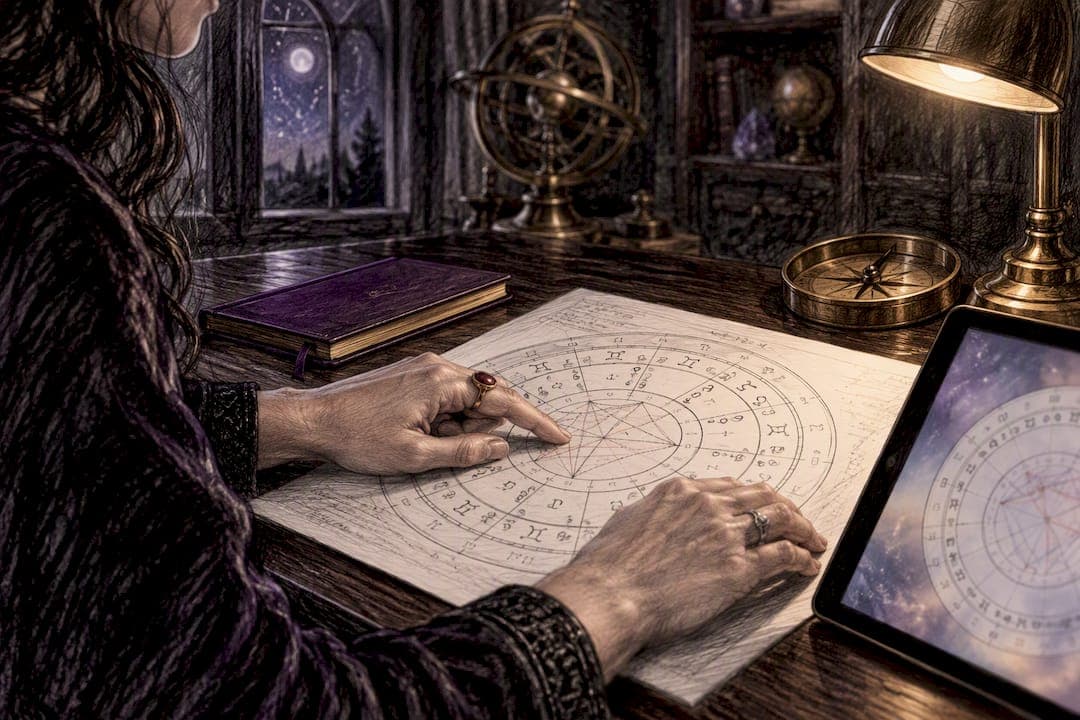
A progressed chart maps your psychological development over time using the day-for-a-year rule: one day after your birth equals one year of your life. It shows inner shifts, not outer events, and the progressed Moon is the fastest, most-used marker of these chapters. Online calculators handle the math, so you don't need an ephemeris to get started.
TL;DR:
- Progressed Moon changes signs approximately every 2.5 years, indicating emotional phases, while the progressed Sun typically shifts once every 30 years, signifying long-term identity changes.
- Calculating your progressed chart involves counting your age in days, then using a calculator or ephemeris to find planetary positions for that date, with accuracy most crucial for the Moon and angles.
- The progressed Moon’s house placement often reveals the current life focus more than its sign, making it the most active marker for internal shifts over the next few years.
- External events are better explained by transits, while progressions show internal readiness, meaning significant changes often precede external manifestations by months.
- Progressed charts are interpretive tools reflecting internal psychological development, not precise predictions, and should be used alongside other charts and timing methods for holistic understanding.
Table of Contents
- What Progressed Chart Basics Actually Cover
- How to Calculate Your Progressed Chart Step by Step
- Reading the Progressed Moon, Sun, and Angles
- Mapping the Timeline: Degrees, Years, and Lunation Cycles
- Interpreting Progressions: A Practical Checklist
- What Progressed Charts Can't Tell You
- Learning Progressed Astrology With Tarosyn
- An Astrologer's Note on Timing and Patience
- Ready to See Your Own Progressed Chart in Context
- Sources
- FAQ
What Progressed Chart Basics Actually Cover
A progressed chart is built from your natal chart using secondary progressions, the method astrologers rely on to track slow, internal change across a lifetime. The day-for-a-year technique treats each day after birth as a symbolic year of life, moving your planets forward at that scaled pace instead of tracking their actual current positions.
This is different from two other tools you've probably heard of. Transits track where planets actually are right now in the sky, relative to your birth chart, and they describe outer events and timing triggers. Solar returns reset every year on your birthday, giving a snapshot of themes for the twelve months ahead. Progressions move slower and cover longer arcs, which is why practitioners reach for them when they want to talk about internal chapters rather than a single week or month.
Astrologers tend to prefer progressions when a client is asking "who am I becoming" rather than "what's about to happen." A few practical distinctions worth holding onto:
- Transits show external pressure and timing; progressions show internal readiness.
- Solar returns reset annually; progressions unfold gradually across years and decades.
- Progressions layered with transits often explain why an event lands when it does, not just why it happens at all.
How to Calculate Your Progressed Chart Step by Step
Getting your own progressed chart takes four steps, and most of the heavy lifting is arithmetic you'll never actually do by hand.
- Count your age in days. If you're 35, you look at the planetary positions exactly 35 days after your birth date, per the day-for-a-year rule.
- Pull positions from an ephemeris or calculator. A reliable progressed-chart tool does this instantly once you enter your birth data.
- Choose biwheel or standalone. A biwheel places your progressed planets on an outer ring around your natal chart's inner ring, letting you see both layers at once. A standalone progressed chart drops the natal ring entirely, which is useful once you already know your natal placements well and just want a cleaner read on the progressed layer alone.
- Check your data quality. Progressed planets need only your birth date and location, but the progressed Moon, ascendant, and midheaven need your exact birth time.
Many calculators default to noon on the progressed day for simplicity, and that shortcut is fine for slower planets like Mercury through Saturn. It's not fine for the Moon or the angles, where even small time errors shift the result.
Pro Tip: If your birth time comes from memory rather than a birth certificate, verify it before trusting your progressed Moon's house placement. A two-hour error can move it into a different house entirely.
Reading the Progressed Moon, Sun, and Angles
The progressed Moon is the workhorse of any progressed reading. It moves roughly 12 to 13 degrees per year, changing signs about every 2.5 years and marking the emotional and situational "chapters" of your life. Its house placement often matters more than its sign, since the house tells you which life area is currently absorbing your attention.
The progressed Sun moves far slower, about 1 degree per year, so it only changes sign roughly once every 30 years. When it does, that shift tends to mark a genuine identity turning point rather than a passing mood.

The progressed ascendant and midheaven describe how you present yourself and how your sense of calling evolves, but both are highly sensitive to birth-time accuracy, more so than almost anything else in the chart.
Inner planets like Mercury, Venus, and Mars progress at their own uneven paces and occasionally shift from retrograde to direct (or the reverse) within the progressed timeline, which can noticeably change how a planet functions for a period of years.
Where the numbers land: the progressed Moon shifts sign about every 2.5 years, the progressed Sun about every 30 years, and outer planets barely move at all in a standard secondary-progressed chart.
When indicators conflict, weight them by timeframe. The progressed Moon governs near-term mood and focus, typically what's active over the next several months. The progressed Sun and angles govern the long arc, the decade-scale reorientation you're living through rather than the week you're having.
Mapping the Timeline: Degrees, Years, and Lunation Cycles
The numbers behind progressions are worth memorizing, because they let you connect a progressed placement to an actual age. The Moon covers roughly 12 to 13 degrees per year, or about 2.5 years per zodiac sign. The Sun covers close to 1 degree per year, about 30 years per sign. Mars crawls at roughly half a degree per year, and Jupiter and Saturn barely move at all across a typical human lifespan.
The progressed Moon completes its full 12-sign cycle roughly every 27 to 30 years, giving most people two, sometimes three, full emotional cycles across a lifetime.
Progressed new moons and full moons matter here too. A progressed new moon opens a fresh multi-year phase; a progressed full moon marks the culmination point of whatever theme started building years earlier. Outer planets rarely form exact progressed aspects because they move so little, but when they do, the contact tends to describe a slow, generational-feeling undercurrent rather than a single event.
Interpreting Progressions: A Practical Checklist
Reading a progressed chart works best as a sequence, not a grab bag of isolated facts.
- Start with your natal chart as the baseline. If you need a refresher on your placements, a natal chart reading is the right foundation before layering anything else on top.
- Set up a biwheel with progressions on the outer ring so you can see both layers simultaneously.
- Identify your progressed Moon's current sign and house first. This is usually the fastest-moving, most immediately relevant signal.
- Note any recent or upcoming progressed ingresses (sign or house changes), since these mark chapter breaks.
- Look for progressed-to-natal aspects within a tight orb, often around 1 degree applying or half a degree separating, because wider orbs generate more hits but far less timing precision.
- Watch for a progressed new or full moon landing near an important natal point.
- Cross-check with current transits. An event tends to land when a transit activates a configuration your progressions have already been building toward.
Pro Tip: Journal your progressed Moon's house and sign at the start of each year. Reviewing those notes later often reveals a theme you were living out long before you consciously named it.
For a deeper look at orb usage and how tightly to read a contact, aspect interpretation basics are worth a slower read before your first self-reading.
What Progressed Charts Can't Tell You
Secondary progressions are a symbolic framework, not a scientific model. No peer-reviewed mechanism explains why the technique works, and it's best treated as an interpretive lens for reflection rather than a predictive instrument.
A few honest caveats:
- Birth-time accuracy matters most for the Moon, ascendant, and midheaven. Verify your time against a birth certificate when precision counts.
- Composite charts, built from midpoints between two people's placements, can't be progressed in the standard way. A Davison chart, built from real midpoint time and location, can be progressed and is the better relationship-timing tool.
- Avoid deterministic language. "The progressed Moon suggests a shift in focus" holds up better than "this will happen."
- Never treat a progressed chart as the sole basis for a major decision. It's one lens among several.
Learning Progressed Astrology With Tarosyn
Joseph Calitoy writes on progressed and predictive astrology for Tarosyn's educational content, focusing on making multi-year timing techniques usable for every day self-reflection rather than professional forecasting alone.
If you're working through your own progressed chart, Tarosyn's library and tools give you a few places to keep going:
- Blog guides on natal charts, aspects, and composite versus Davison charts for relationship work.
- Saved readings you can revisit as your progressed Moon moves through new houses.
- Community insights from other users tracking similar progressed cycles.
- Subscription tiers for readers who want ongoing, structured guidance rather than a one-off lookup.
Saving readings and journaling alongside them turns a single snapshot into an actual record of how your progressed chapters played out.
An Astrologer's Note on Timing and Patience

The gap between progressed readiness and visible change is where most people lose confidence in the technique. A progressed Moon moving into the 10th house often shows up months before any actual career shift, as a restlessness or a pull toward more visibility that hasn't found its outlet yet. Clients frequently ask why "nothing happened," when what actually happened was internal: attention relocated before circumstances caught up.
Good interpretation leaves room for that lag. Phrase progressed findings as invitations to notice a shift already underway, not predictions with a due date. That framing respects the reader's agency and matches what progressions are actually built to show: an internal timeline, not a fixed outcome. Track it in a journal, revisit it when a transit lines up, and the pattern usually becomes obvious in hindsight even when it wasn't obvious in the moment.
— Joseph Calitoy
Ready to See Your Own Progressed Chart in Context
Tarosyn turns these timing layers into something you can actually track, not just calculate once and forget. Because readings save automatically and connect back to your birth chart context, you can watch your progressed Moon's house shifts and progressed lunations unfold over real months instead of re-explaining your chart from scratch every time you check in.

Start with a birth chart reading to establish your natal foundation, then explore how your progressed Moon and angles are shaping your current chapter. For readers who want ongoing guidance rather than a single lookup, the Annual circle plan runs $59.99 per year and Mystic monthly runs $7.99 per month, both unlocking deeper astrology tools and saved-reading history. Tarosyn is an AI-powered spiritual ecosystem, and every reading here is meant to support your own reflection, not replace it. Open the app and check what your progressed Moon is doing this year.
Sources
- Secondary Progressions Calculator — Your Evolving Inner Self | TropicalAstro
- Secondary progressions: the day-for-a-year technique | Astrolium
- Secondary progressions — Cafe Astrology
- Progressed Charts 101 + How An Astrologer Interprets Them | mindbodygreen
FAQ
What Does Your Progressed Chart Tell You?
A progressed chart shows how you're psychologically developing over years, not what specific events will happen. It's built using the day-for-a-year technique, so it reads more like an inner weather pattern than a forecast.
How Do I Calculate My Progressed Chart?
Count the number of days equal to your current age, then look up planetary positions for that day after your birth date using an ephemeris or an online progressed-chart calculator. Most calculators need only your birth date, time, and location to generate an accurate biwheel.
How Do You Interpret a Progressed Composite Chart?
Composite charts, built from midpoints between two people's placements, cannot be progressed using the standard secondary method because they're mathematical constructs rather than real-time charts. A Davison chart, which uses the actual midpoint time and location, is the correct alternative for progressing a relationship chart.
What Are the Worst Natal Chart Placements in Astrology?
There's no fixed list of "worst" placements. Every placement, including ones traditionally called difficult, functions as a specific developmental theme rather than a fixed negative outcome, and progressions often show how a challenging natal placement matures and softens over time.
Can Tarosyn Help Me Track My Progressed Chart Over Time?
Yes. Tarosyn saves your readings automatically, so you can revisit your progressed Moon's house and sign as it shifts and journal alongside those changes. Subscription options like Mystic monthly at $7.99 per month unlock deeper tools for ongoing tracking.