Your moon sign is the zodiac sign the Moon occupied at the exact moment you were born, and it maps your emotional wiring, not your public personality. Where your Sun sign shows your core identity and your Rising sign shapes first impressions, your moon sign governs instinct, comfort, and how you react when no one is watching. Knowing it explains why you cry at things others shrug off, or why certain environments calm you instantly.
TL;DR:
- Your moon sign reflects how you instinctively react and seek comfort, which can differ greatly from your Sun sign's core identity.
- Accurately determining your moon sign requires precise birth data, especially birth time, as the moon shifts signs roughly every 2.5 days.
- Each moon sign has specific emotional needs and stress responses, such as Taurus craving stability or Scorpio needing privacy, guiding self-awareness and relationship dynamics.
- Moon phase influences when you act on your feelings, with new moons inclined toward impulsive starts and full moons toward completion or release.
- Understanding your moon sign helps manage reactions, address emotional patterns, and improve compatibility by recognizing each partner's innate comfort zone.
Table of Contents
- What Is a Moon Sign in Astrology?
- How Do You Find Your Moon Sign?
- What Does Each Moon Sign Mean?
- Does Moon Phase Matter Too?
- Why Does Moon Sign Matter for Relationships?
- Where Did the Moon Sign Concept Come From?
- How Does the Moon Interact With the Rest of Your Chart?
- What Do People Get Wrong About Moon Signs?
- How Can You Actually Use Your Moon Sign?
- How Should You Actually Use This Information?
- Get Personalized Moon Sign Insight Every Day
- Sources
- FAQ
What Is a Moon Sign in Astrology?
A moon sign describes your automatic, early wired emotional responses. It is the part of your chart that runs quietly in the background, shaping what makes you feel safe long before you consciously decide anything. Astrologers treat it as the emotional counterpart to the Sun sign's identity and the Rising sign's social mask.
The Moon governs instinct, emotional memory, and the specific conditions under which you relax. Yoga Journal describes it as the placement that governs emotions, instincts, and comfort needs, separate from the ambition or willpower tied to the Sun. Three quick contrasts make the roles clear:
- Sun sign: your core identity, ego, and stated goals.
- Rising sign: the first impression you give strangers.
- Moon sign: your private reactions, comfort needs, and emotional defaults.
This is why a bold, confident Leo Sun can still cry alone in the car. The Moon runs a separate emotional operating system.
How Do You Find Your Moon Sign?
You need three pieces of data: your exact birth date, your birth time down to the minute, and your birth city. The Moon shifts into a new sign roughly every 2.5 days, so being born at 11:50 p.m. instead of 12:10 a.m. can land you in an entirely different moon sign.
Here's the actual workflow:
- Gather your birth certificate or hospital record for the precise time.
- Enter date, time, and location into a natal chart calculator or app like Tarosyn, which builds the chart automatically.
- Cross check the result against an ephemeris or a professional astrologer if the Moon changed signs close to your birth hour.
If you don't know your birth time, don't guess randomly. Astrologers recommend checking official records first, or narrowing the possibilities to a time range and testing which sign's description fits your actual emotional patterns best.
Pro Tip: If your birth time is uncertain and the Moon changed signs that day, read both possible moon sign profiles side by side. The one that feels uncomfortably accurate is usually the right one.
For a fuller walkthrough of how houses and aspects change the picture, see how a birth chart works.
What Does Each Moon Sign Mean?
Each moon sign gives you a distinct emotional shorthand: what soothes you, what stresses you, and one practical way to respond. These are tendencies, not verdicts. Use them as prompts to notice your own patterns rather than fixed labels.
- Aries Moon: Reacts fast and needs movement to process feelings. Soothed by physical activity or venting immediately rather than sitting still. Stress shows up as short temper or impatience. Try a quick walk before responding to anything that upset you.
- Taurus Moon: Craves stability and physical comfort. Soothed by routine, food, and familiar surroundings. Stress shows up as stubbornness or shutting down. Try changing your environment slowly instead of resisting change outright.
- Gemini Moon: Processes emotion through talking and mental stimulation. Soothed by conversation, variety, and new information. Stress shows up as overthinking or restlessness. Try writing feelings out before talking them through with someone else.
- Cancer Moon: Deeply tied to home and emotional security. Soothed by nurturing others or being nurtured, plus quiet time at home. Stress shows up as moodiness or withdrawal. Try naming the specific need behind the mood instead of retreating silently.
- Leo Moon: Needs recognition and warmth to feel emotionally steady. Soothed by affection, creative expression, and being seen. Stress shows up as pride masking hurt feelings. Try telling someone directly that you need reassurance.
- Virgo Moon: Finds comfort in order and being useful. Soothed by solving problems and tidying physical space. Stress shows up as self-criticism or anxious overplanning. Try lowering the bar on one task today instead of perfecting all of them.
- Libra Moon: Needs harmony and balanced connection. Soothed by pleasant company and aesthetic environments. Stress shows up as people-pleasing or avoiding conflict. Try stating your actual preference before agreeing to someone else's.
- Scorpio Moon: Feels everything intensely and needs emotional depth. Soothed by privacy and honest, unfiltered conversation. Stress shows up as suspicion or emotional shutdown. Try sharing one true feeling instead of guarding all of them.
- Sagittarius Moon: Needs freedom and a sense of forward motion. Soothed by travel, humor, and new experiences. Stress shows up as restlessness or blunt honesty that lands wrong. Try naming what you're actually running from before you bolt.
- Capricorn Moon: Finds security in achievement and structure. Soothed by accomplishing something concrete and having a clear plan. Stress shows up as emotional distance or overworking. Try letting someone help you before you're at your limit.
- Aquarius Moon: Processes feelings intellectually and needs independence. Soothed by space to think and unconventional outlets. Stress shows up as detachment or intellectualizing pain. Try sitting with a feeling before analyzing it.
- Pisces Moon: Absorbs the emotions of everyone nearby. Soothed by solitude, music, and creative escape. Stress shows up as avoidance or emotional overwhelm. Try setting one small boundary before you feel flooded.
We Love Horoscope offers similarly practical, sign-by-sign emotional signatures if you want to compare interpretations against these.
Does Moon Phase Matter Too?
Your moon sign tells you how you feel things. Your birth moon phase, whether new, waxing, full, or waning, adds a layer about when you act on those feelings. Cosmopolitan explains that phase modifies themes of initiation versus consolidation: a New Moon birth leans toward starting things impulsively, while a Full Moon birth leans toward completing or releasing them.
- A Cancer Moon born under a New Moon might rush into emotional attachments quickly.
- The same Cancer Moon born under a Full Moon might process feelings only after they've fully surfaced.
Treat phase as a secondary nuance. Sign, house placement, and aspects still carry more interpretive weight.
Why Does Moon Sign Matter for Relationships?
Sun sign compatibility gets the headlines, but moon sign compatibility governs whether you feel comfortable living alongside someone day to day. The AstroTwins note that moon sign compatibility matters for long-term relationships precisely because it maps daily comfort needs, not just first attraction.
Elemental shorthand helps here:
- Fire moons (Aries, Leo, Sagittarius) need enthusiasm and independence from partners.
- Earth moons (Taurus, Virgo, Capricorn) need reliability and physical presence.
- Air moons (Gemini, Libra, Aquarius) need conversation and mental connection.
- Water moons (Cancer, Scorpio, Pisces) need emotional depth and reassurance.
A Fire Moon paired with a Water Moon often clashes over pacing. The Fire Moon wants quick resolution; the Water Moon needs to feel the conflict fully first. Naming that difference out loud, rather than assuming your partner processes emotion the same way you do, resolves more fights than either person expects.
Pro Tip: Before your next disagreement, ask what your partner's moon sign needs to feel safe, not just what they said. Often the real issue is a mismatched comfort need, not the topic on the table.
Where Did the Moon Sign Concept Come From?
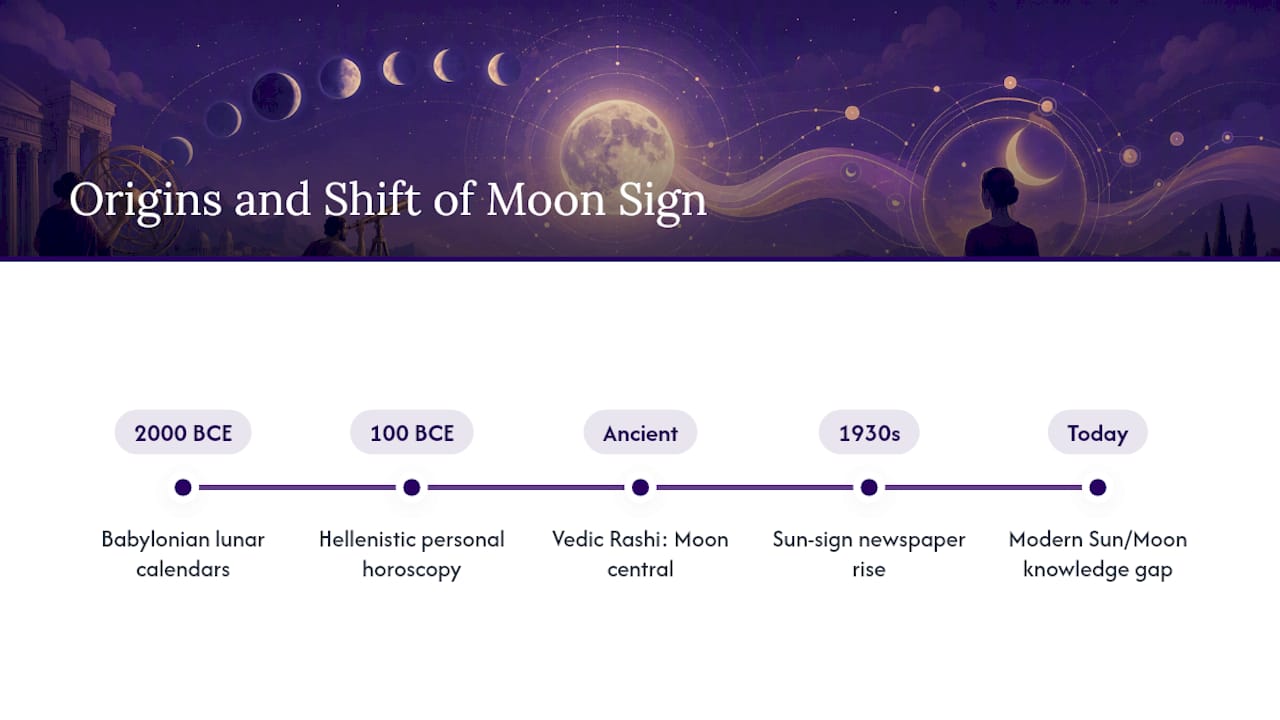
Lunar tracking predates Western astrology by centuries. Babylonian astronomers charted the Moon's path against the zodiac as early as the second millennium BCE, building the earliest known lunar calendars for agricultural and religious timing. Hellenistic astrologers later folded these lunar positions into personal horoscopy around the first century BCE, assigning the Moon its role as ruler of the body, emotion, and the mother figure in a birth chart.
Vedic astrology, developed independently in India, actually centers the Moon sign, called the Rashi, as the primary placement for personality readings, ranking it above the Sun sign in importance. This is a meaningful cultural divergence from Western tropical astrology, where the Sun sign became the dominant public identifier through 20th century newspaper horoscope columns.
That shift toward Sun sign dominance in the West was largely a media convenience. Sun sign horoscopes only require a birth date, no birth time or location, making them cheap to mass produce for daily newspapers starting in the 1930s. Moon sign interpretation stayed in the domain of individual chart readings because it demands more precise birth data.
The result is a strange modern gap: most people can recite their Sun sign instantly but have never calculated their Moon sign, even though many astrological traditions consider it the more emotionally revealing placement.
How Does the Moon Interact With the Rest of Your Chart?
Your moon sign never operates alone. It sits in a specific house, which shows where in life your emotional patterns play out most strongly, a Moon in the 10th house ties emotional security to career recognition, while a Moon in the 4th house ties it directly to home and family.
Aspects, the angles the Moon forms with other planets, add further texture. A Moon in tight connection with Mercury tends to process emotions verbally and analytically. A Moon aspecting Venus often blends emotional needs with affection and aesthetic pleasure. A Moon aspecting Saturn frequently signals emotional caution learned early, sometimes from a restrained or demanding household.
The Moon's relationship to Mercury, Venus, Mars, and the outer planets shapes intensity and expression, but the sign itself sets the baseline temperament. Think of the sign as the language your emotions speak, and the house and aspects as the sentences you actually form with it.
This layered structure is why two people with the same moon sign can still feel noticeably different day to day. A Scorpio Moon in the 1st house wears its intensity openly. A Scorpio Moon in the 12th house hides that same intensity from almost everyone, processing it privately instead. Reading moon sign alone gives you the raw material; house and aspect placement tell you how that material actually shows up in a life.
What Do People Get Wrong About Moon Signs?
The biggest misconception is treating moon sign like a second Sun sign, a public personality label you can announce at a party. It isn't. Almanac notes that moon sign traits are often more visible to close family and partners than to casual acquaintances, because they surface in private, unguarded moments, not social settings.
A second common error is assuming moon sign predicts what you'll do, rather than what you instinctively need. A Capricorn Moon doesn't guarantee career success. It signals that achievement and structure make that person feel emotionally secure, which is a different claim entirely.
People also frequently confuse moon sign with moon phase, treating them as interchangeable. They aren't. Your moon sign is fixed at birth and describes emotional style. Moon phase describes timing and initiative, and it shifts in meaning depending on the sign it's paired with.
Finally, many assume a difficult moon sign placement is a flaw to fix. It isn't. A Scorpio Moon's intensity or a Cancer Moon's sensitivity aren't problems, they're information about what that person needs to function well. The goal of moon sign work is recognition, not correction.
How Can You Actually Use Your Moon Sign?
Knowing your moon sign is most useful as a tool for catching yourself in the moment, right before a reaction takes over. If you know your Moon needs quiet processing time, you can ask for a pause during conflict instead of shutting down and confusing your partner.
It also reframes old patterns. Someone with a Virgo Moon who's always been called "too critical" might instead recognize that their nervous system calms down through problem solving, and redirect that instinct toward useful tasks instead of nitpicking people they love.
For decision-making, moon sign insight works best as a gut-check layer. Before a major choice, ask what your Moon actually needs to feel settled, not just what looks logical on paper. A Sagittarius Moon forcing itself into a rigid, unchanging routine will feel that mismatch as chronic restlessness long before they can name why.
The most practical use is testing responses in routine moments, how you react at 2 a.m. when something goes wrong reveals more than any public persona. Journaling those small reactions against your moon sign profile turns an abstract placement into a genuinely useful self-awareness habit.

How Should You Actually Use This Information?
Joseph Calitoy, writing from Tarosyn's ongoing work in AI-guided astrology, treats moon sign as a starting point, never a finished portrait. Responsible interpretation joins sign with house placement and aspects; the sign alone tells you the emotional language, not the full sentence.
Two ways to test this yourself: journal your emotional reaction the next time something upsets you, then check it against your moon sign's comfort pattern. Or build a five minute evening ritual, tea, quiet, no screens, tailored to what actually soothes your specific Moon.
— Joseph Calitoy
Get Personalized Moon Sign Insight Every Day
A static profile tells you what your Moon needs in general. Tarosyn tells you what it needs today, built from your actual birth chart instead of a generic sign summary.
A natal chart is built from exact birth data, with daily personalized horoscopes layered on top so moon sign insight updates with planetary movement instead of sitting static in an article. An AI-assisted journaling feature can let users log emotional reactions right after they happen and track patterns against the chart over time, turning self-awareness work into a habit instead of a one-time read. The Mystic monthly plan runs $7.99 per month, or you can commit to the Annual circle for $59.99 per year if you already know this is a practice you'll stick with. Check your daily horoscope now to see how your moon sign is playing out today, or head to Tarosyn to build your full chart and start tracking.
Sources
FAQ
What Is a Moon Sign in Simple Terms?
Your moon sign is the zodiac sign the Moon occupied at your exact birth moment, and it governs your emotional instincts and comfort needs. It works alongside your Sun and Rising signs but focuses specifically on how you react privately, not how you present publicly.
How Is a Moon Sign Different From a Sun Sign?
Your Sun sign shapes your core identity and stated goals, while your moon sign shapes your instinctive emotional reactions and comfort needs. You can share a Sun sign with someone and still process emotion completely differently because your moon signs differ.
Can I Find My Moon Sign Without Knowing My Birth Time?
You can estimate it, but accuracy drops sharply since the Moon changes signs roughly every 2.5 days. Check official birth records first, or compare both possible sign profiles against your actual emotional patterns to narrow it down.
Does Tarosyn Calculate Moon Signs?
Yes, Tarosyn builds a full natal chart from your birth date, time, and location, which includes your moon sign alongside daily personalized horoscopes. Current subscription pricing and features are listed on the Tarosyn site.
Is Moon Sign Compatibility More Important Than Sun Sign Compatibility?
For long-term emotional comfort, many astrologers weigh moon sign compatibility more heavily because it maps daily comfort needs rather than surface attraction. Sun signs matter for shared goals and identity, but moon signs matter for how peacefully two people actually coexist.