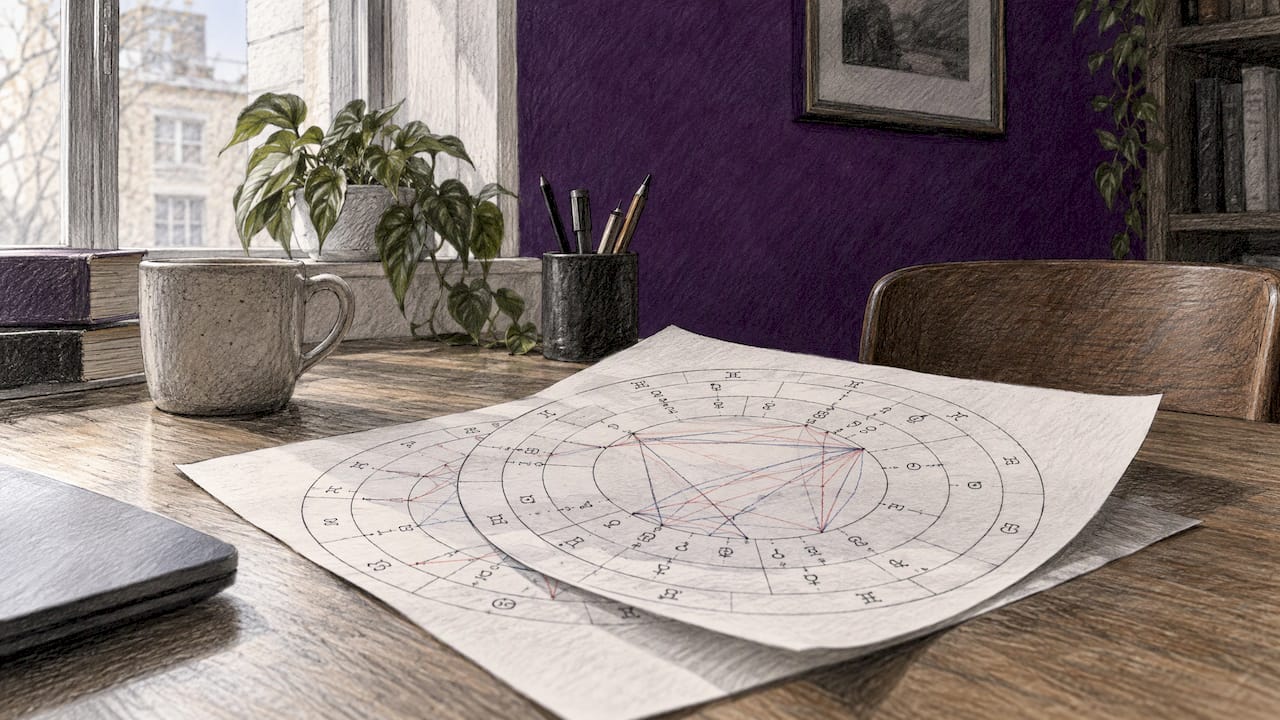
A synastry house overlay shows where your partner's planets land in your birth chart, and where yours land in theirs. The house names the area of life that planet touches. The planet names the kind of energy. The sign and the aspects add the tone. Read in that order, overlays tell you where the relationship is felt day to day. Below you will find all 12 houses, how overlays differ from aspects, and what to do when one birth time is missing.
TL;DR
- An overlay is a placement: one person's planet falls in a house of the other person's chart. Do this both ways.
- Read the house first. Then add the planet, the sign, the aspects and each person's natal chart.
- An overlay shows the arena where the relationship plays out. It does not decide whether the relationship works.
- Houses need a reliable birth time for the person whose houses you use. Without it, use signs and aspects.
- Overlays and aspects work best together. Aspects show the dynamic. Houses show where it happens.
Table of Contents
- What a synastry house overlay is
- How to read an overlay in five steps
- The 12 houses in synastry
- Quick reference table
- What 1st house synastry suggests
- Overlays versus aspects
- What overlays can and cannot tell you
- Synastry without a birth time
- Worked example
- Where to start with Tarosyn
- Our perspective
- FAQ
- Sources
What a synastry house overlay is
Synastry compares two birth charts. Each chart has 12 houses, and each house covers one area of life. When you place the second person's planets on the first person's chart wheel, each planet falls in one house. That placement is the overlay.
An overlay has two directions:
- Their planets in your houses show how they affect your life.
- Your planets in their houses show how you affect theirs.
The two lists are rarely the same. One person may feel the bond in the home and family area. The other may feel it in friendship or work. Check both before you draw a conclusion.
If you want the full background on comparing two charts, start with our guide to synastry astrology and how to read it.
How to read an overlay in five steps
Practitioner guidance on this topic says a reliable reading begins with the house, then adds the planet, sign, aspects and natal context. Use this order.
- Find the house. Place their planet on your chart. Note the house number.
- Name the planet. The Sun is identity and attention. The Moon is mood and need. Venus is affection and values. Mars is drive and friction. Saturn is structure and responsibility.
- Add the sign. The sign shows the style. A Mars in Cancer feels different from a Mars in Aries.
- Check the aspects. Does that planet also form a contact with one of your planets? A supportive contact softens the overlay. A tense contact sharpens it.
- Return to the natal chart. Look at what that house already holds in your own chart. A house with several planets in it is already busy, so an overlay there is felt strongly.
The most common mistake is to stop at step one. "Their Venus is in my 7th house" is a start. It is not a reading.
Tarosyn can do the placement math for you. You add both birth details, and the app places the planets on both charts. That removes the manual step where most people make errors. Our guide on the math and limits of AI synastry readings explains what is calculated and what is interpretation.
The 12 houses in synastry
Use these as one-line starting points. Each line describes what happens when the other person's planets fall in that house of your chart.

1st house: identity and first impressions
The 1st house covers identity, appearance and immediacy. Their planets here make you feel seen, or make you feel changed in their presence. You may act more like yourself, or more like the version of yourself they bring out.
2nd house: values and security
The 2nd house covers values, self-worth, security, money and possessions. Planets here affect how stable and valued you feel. Money habits and shared spending choices often come up.
3rd house: talk and daily contact
The 3rd house covers communication, learning, siblings and daily movement. Planets here create frequent contact: texts, short trips, long talks. It is a strong house for friendship and conversation.
4th house: home and roots
The 4th house covers home, roots, family, privacy and emotional foundations. Planets here can feel like being at home with a person, or like old family patterns showing up. This house often matters for couples who live together.
5th house: romance and play
The 5th house covers romance, pleasure, creativity, play and children. Planets here bring fun and attraction. They also bring the wish to create something together.
6th house: routines and work
The 6th house covers routines, work, service, health habits and practical cooperation. Planets here show up in chores, schedules and who helps whom. It suits coworkers and roommates as well as partners.
7th house: partnership
The 7th house is the traditional partnership house. It highlights commitment, projection, equality, conflict and one-to-one bonds. Many readers look here first for a sense of "this is my partner."
8th house: trust and intensity
The 8th house covers trust, sexuality, shared resources, secrecy, power and transformation. Planets here intensify the bond. Questions of control, privacy and shared money tend to surface. Conflict handling matters in this house, and writing on emotional intimacy in marriage gives useful context for how couples build trust.
9th house: beliefs and growth
The 9th house covers belief, travel, higher learning, culture and worldview. Planets here widen your outlook. Couples with these overlays often travel together or debate ideas.
10th house: direction and public life
The 10th house covers career, reputation, direction, ambition and public roles. Planets here show how you support or pressure each other's goals. They also show how the two of you look to others.
11th house: friends and future plans
The 11th house covers friendship, networks, community and future plans. Planets here make a relationship feel like a friendship first. They also tie the two of you to shared circles.
12th house: dreams and the hidden
The 12th house covers dreams, solitude, hidden attachment, projection, compassion, sacrifice and unconscious material. Planets here can feel deeply connected and hard to explain. They can also blur boundaries, so name what each of you needs.
These house meanings follow the common descriptions found in house-by-house synastry guides. For the same houses in a single chart, see our birth chart houses guide.
Quick reference table
| House | Main theme | What overlays often feel like |
|---|---|---|
| 1st | Identity | Being seen, quick chemistry |
| 2nd | Values, money | Stability or money questions |
| 3rd | Communication | Constant contact, talk |
| 4th | Home, family | Comfort, family patterns |
| 5th | Romance, play | Fun, attraction |
| 6th | Routines, work | Practical teamwork |
| 7th | Partnership | Commitment, mirroring |
| 8th | Trust, power | Intensity, shared resources |
| 9th | Belief, travel | Shared growth, debate |
| 10th | Career, status | Ambition, public image |
| 11th | Friends, plans | Friendship, shared circles |
| 12th | Dreams, hidden | Deep bond, blurred lines |
What 1st house synastry suggests
The 1st house is about how you come across and how you feel when someone arrives. When their Sun, Venus or Mars falls in your 1st house, you notice them quickly. They may seem to wake up your self-image.
When their Saturn falls here, the effect is different. You may feel watched or held to a standard. That can be steadying or tiring, depending on the rest of your chart.
Check the reverse too. If your planets fall in their 1st house, you are the one who stands out in their eyes. People often feel the 1st house overlay most in the first weeks of knowing each other.
Overlays versus aspects
An aspect is an angle between a planet in your chart and a planet in theirs. Aspects show how two energies interact: ease, friction, attraction or pressure. An overlay shows the area of life where that interaction lands.
A simple way to hold the two:
- Aspect: what the connection does.
- House: where it happens.
Suppose your Venus makes a trine to their Moon. That points to warmth and comfort. If their Moon also falls in your 4th house, the warmth shows up at home. If it falls in your 10th house, it shows up in how you support each other's work.
Many readers ask which matters more. Aspects are usually treated as slightly more central, because they describe the exchange directly. Houses add the setting. Use both. If you want to go deeper on one planet, our guide to Venus synastry aspects shows how each contact reads in love. For a wider view of the strongest contacts, see these headline contacts when you compare birth charts.
What overlays can and cannot tell you
An overlay is an arena, not an outcome. Practitioner guidance puts it this way: an overlay shows where the relationship is experienced. It does not decide whether the relationship succeeds. It also does not cancel natal patterns, timing, maturity or free will.
Use overlays to ask better questions:
- Where do we connect easily?
- Where do we need more care?
- Which area of life does each of us bring energy to?
Do not use them to give a verdict such as "we will last" or "this will fail." A chart comparison gives you language for what you already notice. It is a tool for reflection and for talking with each other.
Synastry without a birth time
You can still do useful work when one birth time is missing. You just need to know which parts to trust.
What you lose. The Ascendant moves about one degree every four minutes, and the other house cusps follow it. Without a birth time, house positions are unknown. That means you cannot see which of their houses your planets fall in. Their Rising sign, Midheaven, IC and Descendant also need an hour.
What you keep. Signs and most planetary aspects remain useful. The aspects between their planets and yours can still be read. The Moon is the middle case. It moves fast, so read it with care when it is near a sign change.
A practical routine:
- Use the person whose birth time you know as the chart wheel. Their houses are reliable, so you can still place the other person's planets in them.
- Skip the reverse overlay, since it needs the unknown person's houses.
- Focus on aspects, signs and the elements involved.
- Treat anything involving the Moon as softer if the Moon is near a sign boundary.
The reliability of the hour matters on a scale. A time from an official record supports houses and angles. A time that is only approximate is better used for signs and close aspects. If there is no reliable hour, do not anchor the reading in houses or angular points.
If you are unsure how much a few minutes change, read about what happens when two people are born 20 minutes apart. The same logic applies to your own record: a time that is off by a few minutes can shift a house cusp.
Worked example
Say your partner's Venus falls in your 7th house, and their Mars falls in your 8th house.
- House: 7th is partnership. 8th is trust and intensity.
- Planets: Venus is affection. Mars is drive.
- Signs: Their Venus is in Libra, so affection is expressed through fairness and harmony. Their Mars is in Scorpio, so drive is private and intense.
- Aspects: Their Venus trines your Moon. That supports warmth and comfort.
- Natal context: Your 8th house holds your Saturn, so closeness may feel serious at first.
Reading: the bond feels like partnership, and their desire has depth. You may need time to trust it. This is a description of a pattern to be aware of. It is not a prediction.
Where to start with Tarosyn
If you want the placements done for you, Tarosyn offers astrology that includes birth chart, daily horoscope and synastry compatibility. You can save readings, add journaling and track your growth over time. Our readings remember your history and use your birth chart context. You can also keep your practice personal or share it with friends in the community.
Plans are the Mystic monthly at $7.99 per month and the Annual circle at $59.99 per year, with a free trial period before the subscription starts. See the options on Tarosyn.
If you are deciding between chart types, read how to choose between synastry and composite first.
Our perspective
We built Tarosyn around one idea: a reading should help you reflect, not tell you what will happen.
House overlays fit that idea well. They name the area of life where two people meet. They give you a place to start a conversation. We design our readings to remember your history and to bring in your birth chart context, so an overlay is read in light of who you are and not as a stand-alone line.
We also think the work does not end with the chart. Journaling lets you write down what you notice in the relationship. Saved readings let you come back and compare. Over time you see which themes repeat and which change.
Use the chart to ask questions. Use your own judgment to answer them.
Joseph Calitoy
FAQ
What do houses mean in synastry?
Houses show the area of life where one person's planets act on the other person. A planet in your 5th house touches romance and play. A planet in your 4th touches home and family. Read the house first, then add the planet and sign.
What is a synastry house overlay?
It is the placement of one person's planets onto the other person's house wheel. You do it in both directions. Each direction shows how one person affects the other's life.
Are aspects or houses more important in synastry?
Aspects are usually seen as slightly more important, because they show how two planets interact. Houses add the setting where it happens. A good reading uses both together.
Can I read synastry without a birth time?
Yes, in part. Signs and most aspects still work. House placements for the person without a time are unknown, so skip their houses. You can still place their planets in the houses of the partner whose time you know.
What is first house synastry?
It happens when one person's planet falls in the other's 1st house. It often feels like being seen quickly or being changed by the other person's presence. The planet involved sets the tone.
Sources
- Practitioner guidance on analyzing synastry house overlays
- House-by-house synastry overview
- Relationship readings without an accurate birth time
- Birth time reliability and what houses need
- Understanding emotional intimacy in marriage