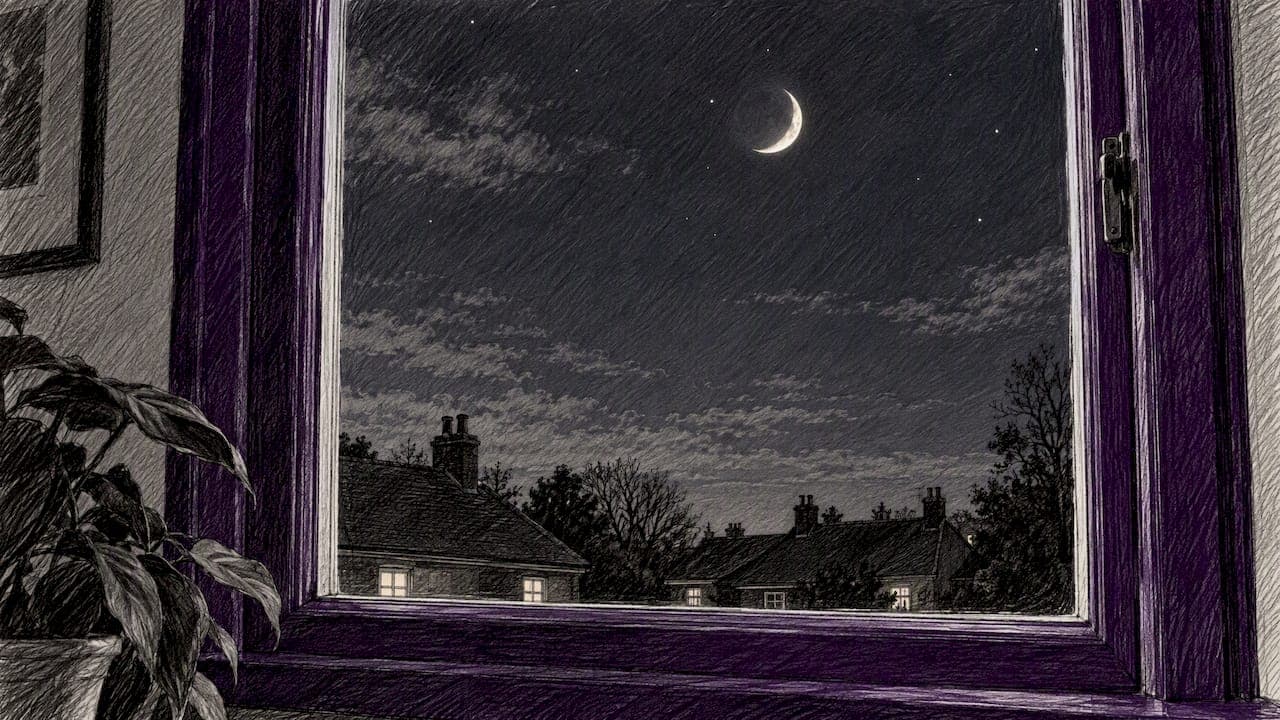
A void of course Moon is the stretch of time between the Moon's last major aspect to a planet in its current zodiac sign and the moment it enters the next sign. In that window, the Moon makes no further qualifying contact. Traditional astrology treats this as a timing condition: matters started now may drift, stall, or come to nothing. It is not a guaranteed bad event.
This guide explains the meaning, the calculation, the length of the period, and a practical way to plan around it. Read it once, then check your own calendar.
TL;DR
- A void of course Moon (also called a void Moon or VOC Moon) starts after the Moon's last major aspect in a sign and ends when it enters the next sign.
- Traditionally, it is a poor time to start important things and a fine time for routine tasks, rest, and review.
- It can last a few minutes or more than a day. Most periods are a few hours.
- Astrologers do not all calculate it the same way. Check which method your calendar uses.
- Treat it as a planning tool, not a prediction.
Table of Contents
- What a void of course Moon means
- How astrologers find the void period
- How long a void of course Moon lasts
- What astrologers recommend during a void Moon
- A simple way to plan around it
- Void Moon and your birth chart
- Void of course Moon in groups and practice
- Our perspective
- Track your practice in Tarosyn
- Common mistakes
- FAQ
- Sources
What a void of course Moon means
The Moon moves through all twelve zodiac signs in about a month, spending roughly two and a half days in each. While it moves, it forms angles to the other planets. These angles are called aspects.
A Moon is void of course when it has finished its last major applying aspect in its current sign and will make no further qualifying aspect before it enters the next sign. Augurine's guide describes this as a timing consideration in horary and electional astrology. A matter begun in the window may not develop as planned.
The phrase "of course" refers to the Moon's course, meaning its path. "Void" means empty. The Moon is moving, but it is not connecting to anything.
The traditional reading
In horary astrology, an astrologer answers a question using the chart of the moment it was asked. If the Moon is void in that chart, the old logic is that nothing further will happen. Whether that is good or bad depends on the question. Lunarium's article makes this point: a void Moon on a question about ending something can be a good sign.
In electional astrology, you choose a start time for an event. Here the void Moon is a time to avoid.
The symbolic reading
Many modern astrologers read the void Moon as a pause. Kim Rogers-Gallagher, writing for Llewellyn, describes it as the stretch before the Moon changes signs, traditionally linked to feeling fuzzy, vague, or scattered. Use this as an observation to test, not a rule to accept.
How astrologers find the void period
The method most astrologers teach is simple. Find the Moon's last aspect to a planet before it leaves its sign. From the exact time of that aspect until the Moon changes sign, the Moon is void. The Astrology Podcast describes this approach as using the Moon's last Ptolemaic aspect.
Which aspects count
The Ptolemaic aspects are five:
- Conjunction (0 degrees)
- Sextile (60 degrees)
- Square (90 degrees)
- Trine (120 degrees)
- Opposition (180 degrees)
Which planets count
This is where calendars differ. In the traditional calculation, only the seven classical bodies count: the Sun, Moon, Mercury, Venus, Mars, Jupiter, and Saturn. Modern astrologers may also include Uranus, Neptune, and Pluto, according to Augurine.

The result is that two calendars can show different void times for the same day. Neither is wrong. They use different rules.
Older definitions
There are other definitions too. The Medieval Astrology Guide compares the common sign-boundary method with older methods. One checks whether the Moon is within orb of an applying aspect. Another looks ahead 30 degrees. The sign-boundary method focuses on what is left of the Moon's path in the sign. The older methods focus on whether contact is about to happen.
Pick one method and use it consistently. You will learn more from one method over several months than from switching often.
How long a void of course Moon lasts
The length varies a lot. John Townley's article for Astrology Software says void periods range from a few minutes to more than a day. Lunarium says the interval can last a few minutes or, more rarely, about two days.
The length depends on two things:
- When the Moon makes its last aspect.
- When the Moon enters the next sign.
If the last aspect is close to the sign change, the void is short. If the last aspect happens early in the sign, the void is long.
A void Moon happens every few days, so you will meet one often. A typical week has two or three. The exact times shift with your time zone, so use a calendar set to your location. The Cosmic Calendar on Tarosyn lists celestial events you can check alongside your plans.
Reading a void Moon table
A void Moon table usually shows four things:
| Item | What it tells you |
|---|---|
| Start time | The moment of the Moon's last major aspect |
| End time | The moment the Moon enters the next sign |
| Sign | The sign the Moon is leaving |
| Time zone | The zone the times are shown in |
Check the time zone first. A void that ends at 1:08 PM in one zone ends at a different clock time in another.
What astrologers recommend during a void Moon
The core advice is consistent across the traditional sources: do not start important things. Keep routine things going.
What to avoid
Traditional guidance suggests holding off on actions that need dependable follow-through. Townley notes that void periods are traditionally seen as unfavorable for tangible decisions that need reliable support. Common examples astrologers give:
- Signing a contract or lease
- Making a large purchase
- Launching a website, product, or campaign
- Starting a new job or a new course
- Having a first meeting where the outcome matters
Some astrologers also advise against elective medical procedures. Do not delay urgent medical care for any astrological reason. If a procedure is scheduled, talk to your doctor about the schedule, not to a calendar.
What fits well
The same sources point to a different kind of activity:
- Routine work you already started
- Finishing, editing, and reviewing
- Cleaning, filing, and organizing
- Rest, a walk, or a quiet evening
- Meditation and journaling
- Reading and research
If you want a calm object for these hours, some people keep a stone linked to the Moon nearby. You can read about moonstone meaning and symbolism if that appeals to you. It is a personal choice, not a requirement.
What if you cannot avoid it
Sometimes a deadline, a flight, or a booked appointment falls in the window. Astrologers who use the void Moon do not usually ask you to cancel. They suggest these steps:
- Do the thing. Fixed commitments still happen.
- Double-check details. Read the contract twice. Confirm times.
- Leave room for revision. Expect that a first version may need changes.
- Do not read the result as a verdict. A stall is a stall, not a sign.
A simple way to plan around it
You do not need to track every void window. Use this short routine instead.
- Choose one calendar and one calculation method.
- Once a week, note the void windows that overlap your plans.
- Move important starts outside those windows when you can.
- Put routine tasks and rest inside them.
- Write down what happened.
Step 5 matters most. After two or three months, you can see whether the void windows match anything in your own life. If they do not, you can drop the practice. If they do, you have personal evidence, which is stronger than any general rule.
A journal works well here. Note the date, the void times, what you did, and how it went. In Tarosyn, you can save readings and journal entries in one place and look back on them later.
Void Moon and your birth chart
The void Moon is a general timing idea. It applies to everyone in the same way at the same time. Your birth chart is personal.
Your natal Moon shows how you process feelings and what makes you feel safe. If you want to understand your own lunar patterns, start with your moon sign meaning. To see how the Moon is moving through your year, read about the lunar return chart.
The two ideas can work together. The void Moon tells you when the general timing is quiet. Your chart tells you how you tend to respond to quiet. Some people feel restful. Others feel restless. Notice which one you are.
Void of course Moon in groups and practice
The void Moon fits shared practice as well. Some groups schedule quiet gatherings, silent sits, or reflection time in void windows and keep launches and decisions for other times. You can read how moon circles support community life for ideas.
If you practice yoga, the same logic applies. A void window suits a slower, restorative class more than a hard new challenge. See the astrology guide for yoga practice for poses by sign.

Our perspective
We see the void Moon as a useful habit, not a rule. It gives you a reason to slow down for a few hours every few days. That alone is a benefit, whatever you believe about astrology.
We also think the claims should stay modest. Traditional sources describe the void Moon as a timing condition. They do not say it causes disasters. If a calendar or a person tells you to fear it, step back.
What we recommend:
- Use the void Moon as a prompt to review, not to panic.
- Keep a record of your own experience.
- Read the void window together with your birth chart, not alone.
- Keep the practice private or share it with a group. Both are fine.
This is how we build readings at Tarosyn. Guidance should be calm and reflective. It should remember your history and use your own chart context. It should not make blunt predictions.
— Joseph Calitoy
Track your practice in Tarosyn
Tarosyn is an AI-powered app for tarot, astrology, and numerology. You can save readings, write journal entries, and review your history. It also has a community for sharing and reflection.
There is a free tier. Paid plans are Mystic monthly at $7.99 per month and Annual circle at $59.99 per year. Compare them on the Tarosyn home page or see the subscription plans.
For a quick start, open the daily horoscope and read your sign's note for the day. Then check the void window and plan from there.
Common mistakes
Treating every void as bad
The void Moon is not a bad day. Routine work, rest, and review are well supported by the traditional view. Only new starts are discouraged.
Mixing methods
If you use one calendar for Monday and a different one for Tuesday, the times will not line up. Pick one.
Ignoring the time zone
Void times shift with location. Set the calendar to your own zone.
Delaying needed action
Do not skip a medical visit, a legal deadline, or a safety task because of a void window. These come first.
Expecting proof
The void Moon is a tradition. It is not a scientific finding. Test it in your own life and decide for yourself.
FAQ
What does void of course Moon mean?
It means the Moon has made its last major aspect in its current sign and will make no more before it changes signs. Traditionally, this suggests that new matters may drift or not develop. It is a timing idea, not a prediction of harm.
How often does a void of course Moon happen?
It happens every few days, because the Moon changes signs about every two and a half days. A typical week has two or three. Check a calendar set to your time zone for exact times.
How long does a void Moon last?
Sources describe a range from a few minutes to more than a day, and in rare cases about two days. Most periods run a few hours. The length depends on when the last aspect happens and when the sign change follows.
What should I avoid during a void Moon?
Traditional advice is to avoid starting important things, such as signing contracts, making large purchases, or launching projects. Routine tasks, rest, and review are fine. Never postpone urgent medical care or legal deadlines for this reason.
Sources
- Void-of-Course Moon, Augurine
- Moon Void-of-Course, Llewellyn Worldwide
- About the Void-of-Course Moon, Lunarium
- Defining the Void of Course Moon, The Astrology Podcast
- Void Moon, Medieval Astrology Guide
- Astrology Articles #198, Astrology Software