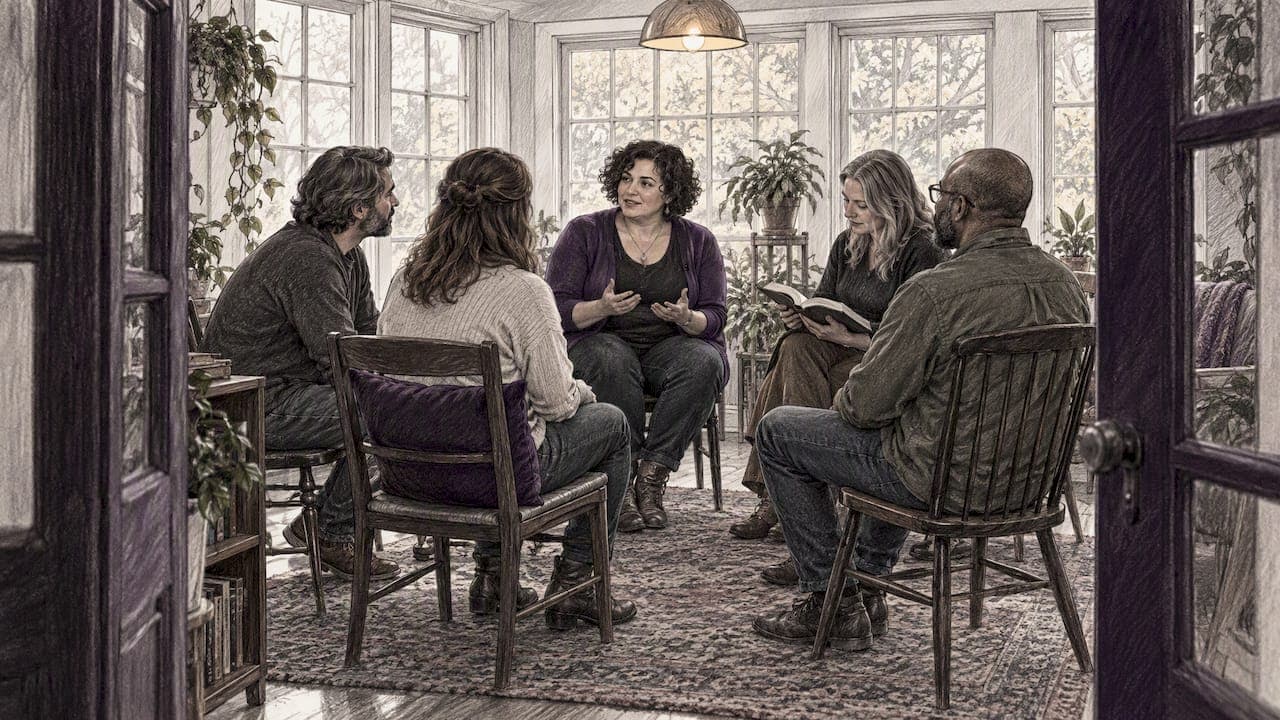
A private spiritual group is a small, closed circle where you share practice, questions or experiences with people you can trust. Some meet in person. Some meet online. Most admit new members by invitation, application or a short conversation. To find a good one, decide what you need, check who leads it, read the privacy rules, and attend once before you commit.
This guide walks you through each step. It covers the types of groups, the words they use for themselves, the safety questions to ask, what retreats cost, and how to keep your own practice private.
TL;DR
- Private spiritual groups range from peer-led meditation circles to invitation-only online communities and residential retreats.
- Belonging matters more than content. Choose a group where you feel safe being honest.
- Online groups have no standard safeguards. Check the leader, the rules and the privacy settings before you share anything personal.
- Attend one session first. Never pay a large deposit before you have met the group.
- If you want a private space for your own practice, you can keep your readings, journal and birth chart personal and share only when you choose.
Table of Contents
- What counts as a private spiritual group
- Why people choose a private group
- How to find a group
- Vet the leader and the safety rules
- Private circles online
- Moon circles and small gatherings
- Intimate retreats: what they cost
- Our perspective
- Keep part of your practice private
- Start your own circle
- When to leave a group
- FAQ
- Sources
What counts as a private spiritual group
The term covers many formats. What they share is a boundary. You cannot simply walk in, and what is said inside is not meant to leave.
Common formats:
- Discussion circles. A small group meets on a schedule to talk about spiritual questions. The Centers for Spiritual Living describe Spiritual Living Circles as small, discussion-based groups.
- Meditation and study groups. These sit together, then talk. Insight San Diego lists its groups as peer-led, which means laypeople facilitate and organize them.
- Support groups. These help people through doubt, loss, or a spiritual crisis. Peer-led formats are common here.
- Ceremony and breathwork circles. These are often entered through a personal introduction. My Spiritual Circles describes a private home for ceremonies, breathwork, retreats and quiet sittings where you come in through someone who already knows you.
- Retreats. These are multi-day gatherings with a small group, often with a teacher.
- Interest-based online communities. These form around a practice such as tarot, astrology or journaling.
Names you will see
Groups use different words depending on their tradition. According to the same Spiritual Living Circles page, you may see "Coven," "Fellowship," "Sangha" or "Satsang," and "Zazenkai" for Zen meditation gatherings. A sangha is not the same as a fellowship. If the name is unfamiliar, ask the organizer what the group does in a typical session.
Why people choose a private group
People rarely join for the teaching alone. Research summarized by ShareWellNow points to a nonjudgmental space where you can talk about spiritual change or doubt without pressure to fit one belief system. Many members say the most useful part is meeting others with similar experiences, which reduces isolation.
Community builders say the same. On My Spiritual Circles, the focus is on consistent, safe spaces where people can be themselves without friction from their mainstream social circles.
This is the real reason privacy matters. You may not want your family, coworkers or followers to see this part of your life. A private group gives you room to think out loud.
How to find a group
Follow these steps in order.
- Write down what you need. Pick one: practice (meditation, breathwork), conversation (discussion circle), support (a hard season) or friendship.
- Choose online or in person. Online is easier to join and easier to leave. In person builds trust faster.
- Search by type, not by label. Look for a meditation sitting group, a peer-led circle or a study group in your city. Local spiritual centers, meditation centers and community event pages often list them.
- Ask for an introduction. Many closed circles accept people through a current member. Tell a friend you are looking.
- Read the group's rules. Look for a written confidentiality statement, a code of conduct and a named leader.
- Attend once. Do not pay or share personal details until you have seen how the group runs a session.
- Review after three sessions. Ask yourself if you feel calmer, more honest and more welcome, or more pressured.
If you want a plan for building friendships over time, read our three month plan to build spiritual friendships in the U.S.
Vet the leader and the safety rules
This is the step most people skip.
A clinical setting is covered by privacy law and professional ethics. A spiritual group usually is not. Research on online spiritual care communities, published as a design paper, says anonymous online groups lack the standard safeguards of clinical care. It recommends that moderators and leaders be vetted by recognized organizations and that the community set clear boundaries. The retreat provider The Mission Within makes a similar point: informal online groups sit in a gray area without standard ethical codes or reporting requirements, so you should check the leadership yourself before you disclose anything sensitive.
Use this checklist before you share anything personal.
| Question | Good sign | Warning sign |
|---|---|---|
| Who leads the group? | A named person with a track record you can verify | No name, or only a nickname |
| What are the rules? | Written confidentiality and conduct rules | "We are all family, no rules needed" |
| Can you leave? | Easy exit, no questions asked | Guilt, pressure or penalties for leaving |
| How are decisions made? | Leader guides the practice only | Leader advises on money, marriage or family |
| What does it cost? | Clear, published fees | Surprise fees or required donations |
| Who sees your posts? | Only members, and you can check | Unclear visibility or public reposting |
The fourth row deserves attention. Reporting by The New York Times in 2020 described a tightly bound religious community whose members consult leaders on significant life decisions, including household budgets and marriage. Close communities can be healthy. They become a concern when a leader directs your personal choices.
If you are going through grief, trauma, depression or a crisis, a spiritual group can support you but does not replace a licensed therapist or doctor. Tell your clinician about the group, and contact one if your symptoms get worse. In the U.S., you can call or text 988 for the Suicide & Crisis Lifeline if you are in distress.
Moderation matters
A well-run group has someone who enforces the rules. If you plan to host a group, our guide to community moderation: roles, rules and tools explains what moderators do. For the wider picture, read what community wellbeing means for spiritual groups.
Private circles online
Online circles are the easiest way to start. They also carry the most privacy risk.
Do this before you join:
- Read how the platform treats your profile, posts and messages.
- Use a first name or a nickname if the group allows it.
- Turn off any setting that makes your posts visible to people outside the group.
- Do not share your address, workplace or health history in the first month.
- Ask whether sessions are recorded.
Birth data is personal too. If your group works with astrology, a birth date, time and place can identify you. Our article on private astrology groups and chart privacy explains what to check before you share a chart.
Moon circles and small gatherings
Not every group needs a platform. Some of the most lasting ones are four to eight friends who meet on a new or full moon. They share an intention, a short reading and a few minutes of silence. See how moon circles strengthen spiritual community life for formats you can copy.
Small size helps. Everyone speaks, and trust builds faster. If a group grows too big, the quiet members stop talking. Our article on why spiritual communities scale so differently explains why.
Intimate retreats: what they cost

A retreat is the deepest form of group practice. It is also the biggest financial commitment. According to figures reported by The Mission Within, single-day local retreats run about $300 to $600, residential multi-day retreats about $735 to $3,660, and therapeutic retreats with 24/7 clinical support about $6,500 to $7,500. Prices vary by provider, length and lodging.
Before you book:
- Ask about deposits. According to Mountain Stream Meditation, residential retreat providers often require a non-refundable deposit of around $300.
- Check the cancellation window. Refunds often shrink in the final one to two months before the start date.
- Ask about sliding-scale fees. Some retreats set tiered prices so that higher-paying guests subsidize reduced-rate guests.
- Confirm the format. Silent retreats differ from discussion retreats. Spirit Rock describes one retreat as silent except for teacher-led Q&A and small group meetings, for example.
- Check medical support. If you have a health condition, ask what happens in an emergency.
Try a one-day sitting first. If it suits you, move up to a weekend.
Our perspective
We build Tarosyn for people who want to practice on their own terms. Some of you want a community. Some of you want quiet. Many want both, at different times.
Here is what we have learned from that.
Privacy comes first. A reading, a journal entry or a birth chart is personal. You should decide who sees it. Tarosyn is built with privacy by design, so you can keep your practice personal or choose to share.
Memory helps depth. A group is valuable because it remembers you. It knows what you said last month. Our readings work the same way: they keep your history and your birth chart context, so each reading builds on the last.
Belonging beats content. You can find teachings anywhere. A group that welcomes you each week is rarer. Start small and keep it consistent.
Guidance should be steady, not predictive. We aim for reflective, emotionally aware readings rather than predictions. We think the same standard applies to a group leader. Good leaders ask questions. They do not tell you what will happen.
— Joseph Calitoy
Keep part of your practice private
You do not have to choose between a group and a solo practice. Many people do both: a weekly circle, plus a private daily routine.
Tarosyn gives you the private side. You can save readings, write journal entries, track your growth over time and check your daily horoscope. You can also browse public tarot readings from the community, or explore the spirituality topic, and share only if you want to.
Plans start with a free trial, then:
- Mystic monthly: $7.99 per month
- Annual circle: $59.99 per year
See the subscription plans and the subscription terms before you subscribe. Luna packs are also available on the Tarosyn home page.
Start your own circle
If you cannot find a group, start one. Keep it simple.
- Invite three to six people you already trust.
- Pick one format: meditate, pull cards, or discuss a single question.
- Set a fixed time, once a week or once a month.
- Write two rules: what is said stays in the group, and no one gives advice unless asked.
- Rotate who leads.
- Review after six weeks. Change what does not work.
To keep members engaged over time, read how to keep your online community active and engaged. For the idea behind shared practice, see our guide to collective consciousness. You can also read what members write in the community journal.
When to leave a group
Leave if any of these are true:
- You feel worse after most sessions.
- The leader asks you to pay more to reach a "higher" level without clear terms.
- You are told to cut ties with family or friends.
- Your private disclosures are repeated outside the group.
- You are discouraged from seeing a doctor or therapist.
You owe no explanation. Send a short message, mute the chat and step away. A good group lets you go.
FAQ
How do I find a private spiritual group near me?
Start with local meditation centers, spiritual centers and community event pages. Ask friends for an introduction, since many closed circles accept members that way. Attend one session before you commit.
What is a meditation group called?
The name depends on the tradition. You may see sangha, satsang, fellowship, circle or sitting group. Zazenkai refers to Zen meditation gatherings specifically.
Are online spiritual groups safe?
They can be, but they have no standard safeguards like clinical care does. Check who leads the group, read the rules and avoid sharing sensitive details early. If you are in crisis, contact a licensed professional or call or text 988.
How much does a spiritual retreat cost?
In the U.S., reported costs run about $300 to $600 for a local one-day retreat and about $735 to $3,660 for a residential multi-day retreat. Therapeutic retreats cost more. Ask about deposits and refunds before you book.
Sources
- My Spiritual Circles
- Spiritual Living Circles: spiritual discussion groups
- Insight San Diego: groups overview
- ShareWellNow: spirituality support groups
- On the Challenges of Implementing Online Spiritual Care Communities
- The Mission Within
- Mountain Stream Meditation
- The New York Times: People of Praise, 2020