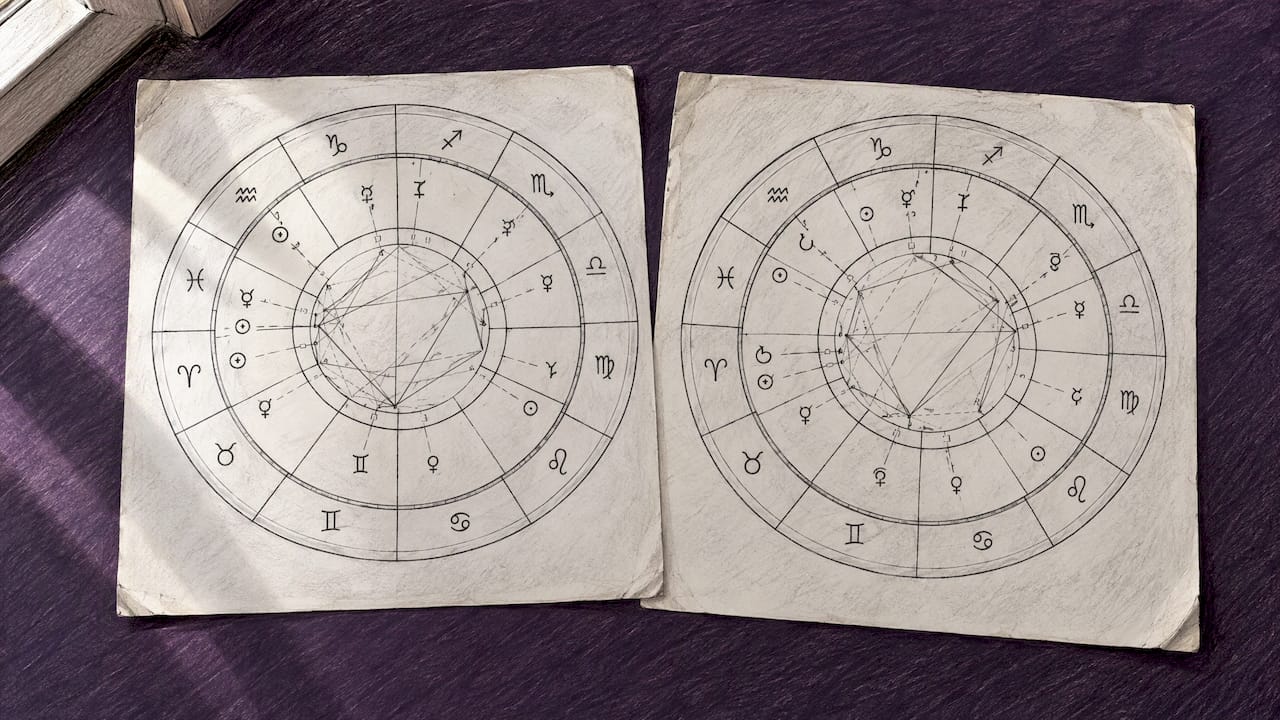
Your progressed Moon phase shows where you are in a cycle of about 29 to 30 years. You find it by measuring the distance between your progressed Moon and your progressed Sun. Every 45 degrees of that distance marks a new phase: New, Crescent, First Quarter, Gibbous, Full, Disseminating, Third Quarter and Balsamic. Each phase lasts roughly three to four years.
This guide explains what the phases mean, how to calculate yours and how to read it with the rest of your chart.
TL;DR
- The progressed lunation cycle is the Moon's monthly cycle stretched over about 29 to 30 years.
- Subtract the progressed Sun's position from the progressed Moon's position. Divide by 45 to find your phase.
- Each of the eight phases covers 45 degrees and lasts about three to four years.
- The progressed Moon's sign and house describe your mood and focus. The phase describes the stage of the cycle.
- Read the phase together with your natal chart, aspects and current transits. Do not read it alone.
Table of Contents
- What the progressed Moon is
- How long the progressed Moon cycle lasts
- The eight progressed Moon phases and their degree ranges
- How to find your progressed Moon phase
- Read the phase with the Moon's sign and house
- How the progressed phase differs from the daily Moon phase
- How to use your phase in practice
- Our perspective
- Track your phase in Tarosyn
- FAQ
- Sources
What the progressed Moon is
Secondary progression is a symbolic method. It uses a day-for-a-year formula: the planetary positions 10 days after your birth describe the influences active at age 10, as Astrology University explains. The progressed chart is a second chart that moves slowly alongside your birth chart.
In that chart, the Moon moves the fastest of all the planets. In a real day the Moon travels roughly 12 to 13 degrees. Under day-for-a-year symbolism, that distance is covered in one year. So your progressed Moon moves about one degree a month and stays in one zodiac sign for around two and a half years.
This is why the progressed Moon is a good timing marker. It changes sign and house often enough that you notice shifts in mood and focus. Cafe Astrology describes the progressed Moon's sign as the prevailing emotional attitude of a period. Its house shows the areas of life that come into focus.
If you have not built a progressed chart yet, start with our guide to calculating a progressed chart in four steps.
How long the progressed Moon cycle lasts
A real lunar cycle takes about 29.5 days, from one New Moon to the next. A progressed cycle takes about 29.5 years. Dane Rudhyar wrote about this in a 1959 article on progressed lunation charts. He explained that the cycle runs from one conjunction of the progressed Moon and progressed Sun to the next. Under day-for-a-year symbolism, a 29 to 30 day lunation becomes a cycle of roughly 29 to 30 years.
In practice:
- You enter your first progressed New Moon at some point in your life, depending on your birth date.
- You move through all eight phases in about 29 to 30 years.
- You then start a second cycle. Most people live through two full cycles and part of a third.
Your phase at birth is the first phase you experience. A person born close to a natal New Moon starts at the beginning of the cycle. A person born at a natal Full Moon starts halfway through it.
The eight progressed Moon phases and their degree ranges
The phase depends on how many degrees the progressed Moon is ahead of the progressed Sun. Cafe Astrology's lunar cycle page lists the first phases as New Moon at 0 to 45 degrees, Crescent at 45 to 90, First Quarter at 90 to 135, Gibbous at 135 to 180 and Full Moon at 180 to 225. The remaining three phases follow the same 45-degree steps.
| Phase | Distance from progressed Sun | Theme |
|---|---|---|
| New Moon | 0 to 45 degrees | A new chapter begins |
| Crescent | 45 to 90 degrees | Challenge, opportunity and adjustment |
| First Quarter | 90 to 135 degrees | Action and building |
| Gibbous | 135 to 180 degrees | Refining and fine-tuning |
| Full Moon | 180 to 225 degrees | Fruition and accomplishment |
| Disseminating | 225 to 270 degrees | Sharing what you learned |
| Third Quarter | 270 to 315 degrees | Dissatisfaction and letting go |
| Balsamic | 315 to 360 degrees | Withdrawal and reflection |
The themes follow the summary on Cafe Astrology. Some astrologers call the Third Quarter phase Last Quarter. It is the same 270 to 315 degree range.
The waxing half: New Moon to Full Moon
The first four phases build toward a peak. Symbolically, they stress initiation, resistance, action and development.

New Moon (0 to 45 degrees). A new chapter starts. Plans are not clear yet. You often act on instinct before you can explain why. Many astrologers treat this as a time to plant seeds and avoid judging results too early.
Crescent (45 to 90 degrees). The first pushback arrives. Old habits and outside expectations meet your new direction. This phase brings challenges, openings and adjustments. Stay with the direction you chose and adapt the details.
First Quarter (90 to 135 degrees). This is an active stage. You build, commit and make decisions. Things feel more urgent. Progress comes from steady effort and from handling the crises that appear along the way.
Gibbous (135 to 180 degrees). You refine. The structure exists, and now you improve it. You study, correct and prepare. Focus on quality and wait before you judge the outcome.
The waning half: Full Moon to Balsamic
The last four phases turn from building to sharing, release and rest.
Full Moon (180 to 225 degrees). Results become visible. This phase brings fruition and accomplishment. It also brings awareness of other people and of how your work affects them. For a simple way to mark this time, try our full moon release ritual.
Disseminating (225 to 270 degrees). You share what you learned. You teach, write, mentor or pass on your methods. Your experience becomes useful to others.
Third Quarter (270 to 315 degrees). Some of what you built no longer fits. Dissatisfaction shows up, and with it a need to let go. Review your commitments and decide what to keep.
Balsamic (315 to 360 degrees). This is the closing phase. It brings withdrawal and reflection. You rest, finish old business and prepare for the next New Moon. Many people feel quieter and more inward during these years.

How to find your progressed Moon phase
You need your birth date, birth time and birth place. The birth time matters because the Moon moves quickly. A few hours of error shifts the progressed Moon by a noticeable amount.
- Build your progressed chart. Choose a progressed date for the year you want to check. Use the day-for-a-year rule: add one day to your birth date for each year of age. The steps are in our progressed chart guide.
- Write down two positions. Note the zodiac longitude of the progressed Sun and of the progressed Moon. Convert each sign position to a number from 0 to 360. Aries 0 degrees is 0, Taurus 0 degrees is 30, Gemini 0 degrees is 60, and so on.
- Subtract. Take the progressed Moon's longitude and subtract the progressed Sun's. If the result is negative, add 360.
- Divide by 45. Round down. A result of 0 is New Moon, 1 is Crescent, 2 is First Quarter, and so on up to 7 for Balsamic.
- Check where you are inside the phase. The first half of a phase feels different from the last half. A person at 178 degrees is about to enter the Full Moon phase.
A worked example
This example uses made-up positions. Say a progressed Sun sits at 10 degrees Gemini, which is 70 degrees of the zodiac. The progressed Moon sits at 25 degrees Leo, which is 145 degrees.
145 minus 70 is 75 degrees. Divide 75 by 45 and you get 1.67. Round down to 1. This person is in the Crescent phase, near its end. They are about 15 degrees from First Quarter. At roughly one degree of separation per month, that change is around a year away. The progressed Moon gains on the progressed Sun at about 12 degrees a year, so the true time is slightly longer than a year. An ephemeris or chart tool will give the exact date.
When the phase changes
The progressed Moon gains on the progressed Sun at about 12 degrees a year. Each 45-degree phase therefore lasts a little under four years. Most charts show the phase change date. A good habit is to note the date, the sign and the house of each change.
Read the phase with the Moon's sign and house
The phase alone is a general theme. Cafe Astrology's practical view is that the progressed Moon works best when you read several layers together: sign, house, angles, aspects and transits. Use this order:
- Phase. What stage of the cycle are you in?
- Sign. What emotional tone does the progressed Moon carry now? Our moon sign meaning guide helps you read each sign.
- House. Which area of life gets your attention? If you are unsure about houses, read our birth chart houses guide.
- Aspects. Which natal planets does the progressed Moon touch? Our guide to reading chart angles by orb explains the method.
- Transits. What are the current planets doing? You can track astrology transits and compare them with your progressed Moon.
Here is an example of how the layers combine. A person in the Balsamic phase with the progressed Moon in the fourth house may feel a strong need to rest and to simplify home life. A person in the First Quarter phase with the progressed Moon in the tenth house may feel pushed to act on career decisions. The phase gives the stage. The house gives the setting.
How the progressed phase differs from the daily Moon phase
The daily Moon phase is what you see in the sky. It changes about every three to four days. It affects your mood tracking, your rituals and your timing for small tasks. Our guide to tracking your mood with the moon phases shows how. If you want to understand the physical cycle better, read this moon phase timing guide.
The progressed phase is symbolic and works over years. It is not what you see in the sky. Use the two together: the progressed phase for the big chapter and the daily phase for the small steps inside it.
The lunar return chart is a third Moon tool. It covers one month at a time and sits between the two.
How to use your phase in practice
Keep the process simple.
- Write the phase and its dates. Put them at the top of a journal page.
- List what began, grew or ended in the last year. Compare the list with the phase theme.
- Pick one action that fits the phase. In New Moon, start one small project. In Gibbous, improve something you already have. In Balsamic, remove one commitment.
- Review every six months. Note what changed. Look at the progressed Moon's sign and house again.
- Look back. Check the previous phase of your life. Many people find it easier to see the pattern in the past than in the present.
Use the phase as a reflection tool. It does not predict events. It gives you a frame for asking better questions about your own life.
For a wider reading practice, our birth chart self-analysis guide shows how to combine the natal chart with progressions and journaling.
Our perspective
We see the progressed Moon phase as one of the clearest ways to reflect on a long period of your life. A single reading answers a single question. A phase gives you a timeline.
That is why we build Tarosyn around memory. Our readings are designed to remember your history and bring your birth chart context into each session. You can save a reading, write a journal entry and look back months later at what you noted during a phase.
We aim for guidance that is emotionally intelligent and not predictive. A phase does not tell you what will happen. It gives you a question to take into your journal: what is beginning, what is ready to be refined, and what is ready to end?
Privacy is part of the design. You can keep your practice personal or share it with a friend circle in the community. The choice is yours.
Joseph Calitoy
Track your phase in Tarosyn
Tarosyn combines AI-powered tarot, astrology and numerology with journaling and a community. Save your readings, write notes on each phase and keep a record of your spiritual growth.
There are two plans. Mystic monthly costs $7.99 per month. Annual circle costs $59.99 per year. Choose your plan on the Tarosyn home page.
FAQ
What does the progressed Moon mean?
The progressed Moon is the Moon's position in your secondary progressed chart. Its sign shows the emotional tone of the current period. Its house shows the area of life that has your attention. It changes sign about every two and a half years.
How long does each progressed Moon phase last?
Each phase covers 45 degrees of distance between the progressed Moon and Sun. That takes a little under four years, since the progressed Moon gains about 12 degrees a year on the progressed Sun. The full cycle lasts about 29 to 30 years.
What is the secondary progressed Moon?
It is the Moon in a chart made with the day-for-a-year method. Each day after birth stands for one year of life. The Moon moves about 12 to 13 degrees a day, so it moves about that far in a symbolic year.
Do I need my birth time to find my phase?
Yes, for a reliable result. The Moon moves fast, and a few hours of error moves the progressed Moon by a few degrees. That can place you in the wrong half of a phase, or even in the wrong phase when you are near a boundary. Use a birth certificate time when you can.
Is the progressed New Moon the best time to start something?
Astrologers treat it as a time of new beginnings. It marks the start of a new life cycle of about 30 years. Use it as a prompt to reflect and set an intention. It is not a guarantee of any result.
Sources
- Secondary Progressions, Cafe Astrology
- Secondary Progressions: Lunar Cycle, Cafe Astrology
- Progressed Lunation Charts, Dane Rudhyar (1959)
- How to Use Progressions to Track Changes, Astrology University