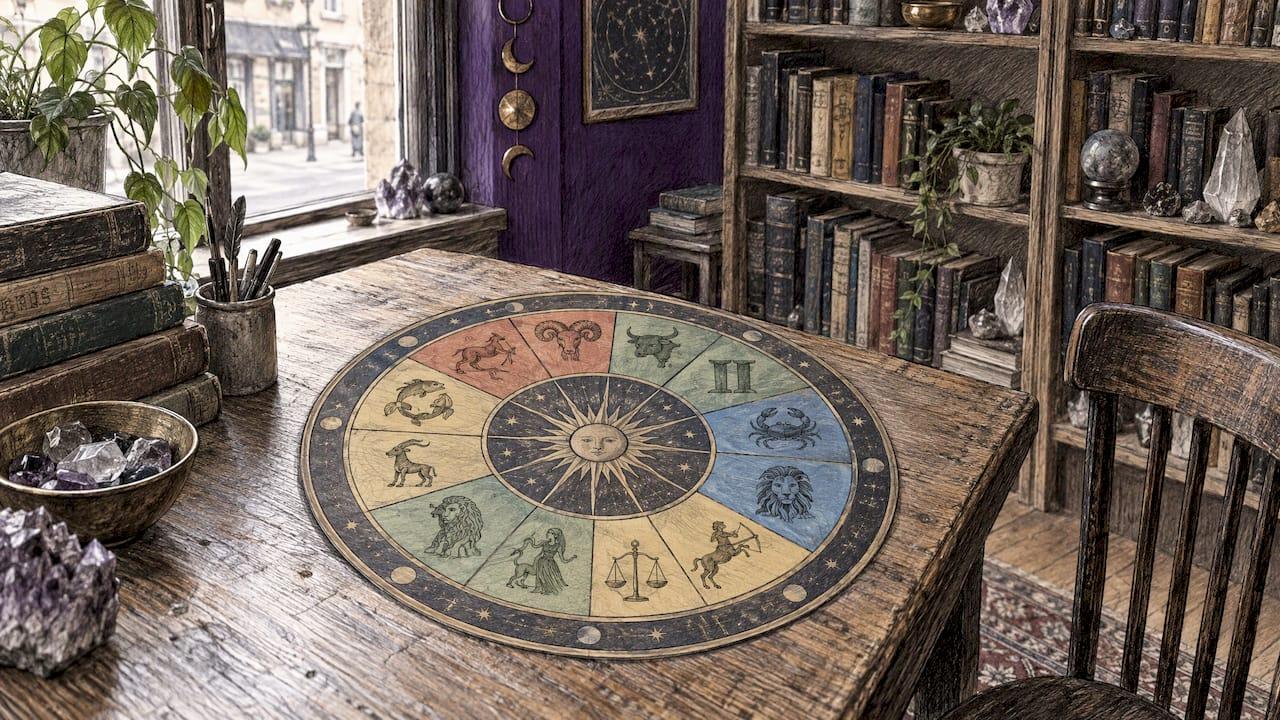
Western astrology has four elements: fire, earth, air and water. Each element groups three of the twelve zodiac signs. Fire is described as passionate, earth as practical, air as intellectual and water as emotional. Your Sun sign has one element. Your full birth chart has all four, in different amounts. This guide shows you each element, its signs, how modes change it, and how to find your dominant element.
TL;DR
- Fire: Aries, Leo, Sagittarius. Earth: Taurus, Virgo, Capricorn. Air: Gemini, Libra, Aquarius. Water: Cancer, Scorpio, Pisces.
- The element describes the broad energy of a sign. The mode (cardinal, fixed or mutable) describes how that energy is expressed.
- Your Sun sign is one placement. Your Moon, Rising sign and planets can sit in other elements.
- To find your dominant element, count the placements in each element. The highest count is dominant.
- Same-element pairs and fire with air or earth with water are the combinations most often called harmonious.
Table of Contents
- The four elements at a glance
- Why signs share an element
- Fire signs: Aries, Leo, Sagittarius
- Earth signs: Taurus, Virgo, Capricorn
- Air signs: Gemini, Libra, Aquarius
- Water signs: Cancer, Scorpio, Pisces
- Cardinal, fixed and mutable: the modes
- Sun sign element versus birth chart elements
- How to find your dominant element
- Element compatibility
- Elements in other astrology traditions
- Our perspective
- Explore your elements in Tarosyn
- FAQ
- Sources
The four elements at a glance
The zodiac has twelve signs. The elements repeat in a fixed order: fire, earth, air, water. Then the order starts again. The same pattern is used in Western and Vedic astrology.
Use this table to find your sign.
| Element | Signs | Core themes |
|---|---|---|
| Fire | Aries, Leo, Sagittarius | Passion, creativity, confidence, courage |
| Earth | Taurus, Virgo, Capricorn | Grounded, practical, stable |
| Air | Gemini, Libra, Aquarius | Intellect, independence, communication, social life |
| Water | Cancer, Scorpio, Pisces | Sensitive, intuitive, imaginative, nurturing |
The themes in the last column follow the summary of the four element groups from The Old Farmer's Almanac. Treat them as a starting vocabulary. They are not rules about any one person.
Why signs share an element
Signs of the same element sit four signs apart. In Western tropical astrology they are 120 degrees apart along the ecliptic and are said to be in trine. Astrologers call a group of three such signs a triplicity.
This geometry matters later. It is the reason same-element signs are read as supportive of each other. If you want to learn how angles between planets work, read our guide to astrology aspects.
Fire signs: Aries, Leo, Sagittarius
Fire signs act first. They start things, speak up and move fast. One astrologer quoted by USA Today calls fire the most energetic element.
- Aries starts projects and takes the lead.
- Leo wants to create, be seen and give warmth.
- Sagittarius looks for meaning, travel and new ideas.
Strengths: courage, enthusiasm, confidence. Common challenge: patience. Fire can move on before others are ready.
If you have a lot of fire in your chart, give your energy a task. Set a goal, pick a first step and begin.
Earth signs: Taurus, Virgo, Capricorn
Earth signs deal with what is real and useful. They plan, build and maintain. The same USA Today piece quotes an astrologer who describes earth signs as careful, slow and strategic, with a calm energy.
- Taurus values comfort, routine and steady results.
- Virgo values detail, service and improvement.
- Capricorn values structure, goals and long-term work.
Strengths: reliability, patience, a sense of what works. Common challenge: change. Earth can hold on to a plan after it stops working.
If you have a lot of earth, add one new thing each week. Change one habit at a time.
Air signs: Gemini, Libra, Aquarius
Air signs work with ideas and people. They are linked to thinking, writing and speaking.
- Gemini collects information and shares it.
- Libra looks for balance and fair exchange.
- Aquarius looks for new systems and group goals.
Strengths: curiosity, clear communication, a wide view. Common challenge: staying with feelings. Air can explain an emotion without feeling it.
If you have a lot of air, write things down. Journaling turns many thoughts into a few clear ones.
Water signs: Cancer, Scorpio, Pisces
Water signs respond to mood, memory and connection. The astrologer in the USA Today article describes them as highly sensitive, nurturing and resilient.
- Cancer protects, feeds and remembers.
- Scorpio looks beneath the surface and stays loyal.
- Pisces absorbs the mood of a room and imagines what is possible.
Strengths: empathy, intuition, emotional depth. Common challenge: boundaries. Water can take on feelings that belong to someone else.
If you have a lot of water, plan quiet time. Your Moon sign is a good place to look for what you need to recover.
Cardinal, fixed and mutable: the modes
The element is only half of a sign. Each sign also has a mode, also called a modality or quality. There are three: cardinal, fixed and mutable. The element gives the broad energy, and the mode changes how that energy is expressed.
- Cardinal signs start. They begin each season.
- Fixed signs sustain. They hold the middle of each season.
- Mutable signs adapt. They close each season and prepare for change.
Every sign is one element plus one mode. No two signs share both.
| Mode | Fire | Earth | Air | Water |
|---|---|---|---|---|
| Cardinal | Aries | Capricorn | Libra | Cancer |
| Fixed | Leo | Taurus | Aquarius | Scorpio |
| Mutable | Sagittarius | Virgo | Gemini | Pisces |
Here is how this changes a reading. Aries and Leo are both fire. Aries starts a fire. Leo keeps it burning. Sagittarius moves the fire to a new place. Use the same method for every element.
Sun sign element versus birth chart elements
Most people know only their Sun sign element. A birth chart is wider. It places the Moon, the Ascendant, the angles and every planet in a sign. Each of those signs has an element.
This means you can have a fire Sun and a chart that is mostly earth or water. A chart includes more than the Sun sign, and other placements may fall in different elements. If your Sun sign description does not fit you, check the rest of the chart before you decide it is wrong.
Two placements are worth checking first:
- Moon sign. It describes how you process feelings. Read the Moon sign guide.
- Rising sign. It describes how you come across at first meeting. Read how to find your Rising sign.
For a full walk-through of reading all placements, use the birth chart self-analysis guide.
How to find your dominant element
A dominant element is the element with the most placements in your chart. Follow these steps.
- Get your birth chart. You need your birth date, time and place.
- List the sign of each placement: Sun, Moon, Rising, Mercury, Venus, Mars, Jupiter, Saturn. Add Uranus, Neptune and Pluto if you want a wider count.
- Mark the element of each sign using the table above.
- Count each element.
- Note the highest count. That is your dominant element.
- Note the lowest count, including zero. That is your least represented element.
Some astrologers give extra weight to the Sun, Moon and Rising sign. This is a choice of method. Pick one method and use it each time so you can compare results.
A worked example: Sun in Leo (fire), Moon in Pisces (water), Rising Virgo (earth), Mercury in Virgo (earth), Venus in Cancer (water), Mars in Taurus (earth), Jupiter in Pisces (water), Saturn in Aries (fire). The count is fire 2, earth 3, air 0, water 3. This person has no air and a tie between earth and water. A tie is normal. Read both elements as strong.

What a dominant element means
A dominant element shows your default way of handling things. Fire acts. Earth builds. Air thinks. Water feels. It adds color to your chart. It does not replace any single placement.
What a missing element means
A missing or weak element is not a flaw. It marks a quality that may take more effort. In the example above, air is missing. That person can practice naming feelings in words, talking with friends and writing. If the count is close to even across all four, you may move between action, analysis, feeling and stability as the situation needs.
You can also balance a chart with daily habits. See balancing energy with astrology signs. If you practice yoga, the astrology guide for yoga practice matches poses to signs.
Element compatibility
Elements are the first filter astrologers use for compatibility. Two signs are compared by their elements, then by their planets and aspects.
The common rules:
| Pairing | Usual reading |
|---|---|
| Same element | Strong. Shared style and shared values. |
| Fire and air | Harmonious. Air feeds fire, and fire energizes air. |
| Earth and water | Harmonious. Earth gives water shape, and water feeds earth. |
| Fire and earth | Can work. Stability meets drive, but the pace differs. |
| Air and water | Can work. Thought meets feeling, so each partner must explain. |
| Fire and water | Needs effort. Action meets sensitivity. |
| Air and earth | Needs effort. Ideas meet practical needs. |
Traditional sources agree on the first three rows. Same-element signs form trines, and complementary elements form sextiles. Trines are read as supportive and sextiles as generally congenial. The last four rows are our reading of the same logic. They are general patterns, not predictions.
One astrologer says fire and earth can make an excellent combination for stability. The same source says two fire signs can be passionate and combustible, yet last if they survive each other's moods. So no pairing is closed to you.
An element match is a start. For a full reading, compare the Moon, Venus and Mars of both people. Our guide to planetary pairings for zodiac compatibility shows how. For an example of a fire and air pair, read Aries and Aquarius compatibility.
Elements in other astrology traditions
The four-element system is Western. Other traditions use different sets.
- Chinese astrology uses five elements: Wood, Fire, Earth, Metal and Water. They work in cycles that generate and control each other. There is no air.
- Vedic astrology uses the same four elements for the signs as Western astrology. It also names a fifth element, space or ether, which Western astrology does not use.
When you read about your element, check which system the writer uses. A Chinese Wood year and a Western fire Sun are separate things. Both can be used. Do not mix them in one reading.
Our perspective
We see elements as the quickest way to start reading a chart. A twelve-sign zodiac is a lot to hold. Four elements are easy to hold, and they give you a first question: where is my energy strongest, and where is it thin?
We built Tarosyn to keep the next step simple. Our readings are designed to remember your history and to use your birth chart context. That means a reading can look past your Sun sign and consider your whole chart.
We also think elements work best with reflection. Write down what you notice. Return to it after a week. Our journaling and growth tracking are made for that. Our approach is emotionally intelligent guidance, not fixed prediction.
Your practice can stay private or be shared with friends. You choose.
Joseph Calitoy
Explore your elements in Tarosyn
Tarosyn is an AI-powered app for tarot, astrology and numerology. It includes birth chart and daily horoscope readings, synastry compatibility, journaling and ritual guidance. You can save readings and track your growth over time.
The plans are Mystic monthly at $7.99 per month and Annual circle at $59.99 per year. Choose a plan on the Tarosyn home page. Enter your birth details, open your chart, and count your elements. You can also read about astrology and personality by zodiac sign first.
FAQ
What are the four elements in astrology?
The four elements are fire, earth, air and water. Each has three signs. Fire is Aries, Leo and Sagittarius. Earth is Taurus, Virgo and Capricorn. Air is Gemini, Libra and Aquarius. Water is Cancer, Scorpio and Pisces.
What is the difference between elements and modalities?
The element is the type of energy: fire, earth, air or water. The modality is how that energy moves: cardinal starts, fixed sustains, mutable adapts. Each sign has one of each. For example, Aries is cardinal fire and Virgo is mutable earth.
Which element is my birth chart?
Count the element of each planet and your Rising sign. The element with the highest count is dominant. Your Sun sign element is only one of those placements, so your dominant element may be different.
Which elements are compatible?
Same-element pairs, fire with air, and earth with water are usually called harmonious. Fire with water and air with earth ask for more effort. These are general patterns. Compare the full charts of both people for a complete reading.
Can a chart have no element at all?
Yes. A chart can have zero placements in one element. This is common when you count only the main planets. Read it as a quality that takes more conscious effort, not as a lack.
Sources
- Zodiac Elements: Fire, Earth, Air, and Water Signs, The Old Farmer's Almanac
- 12 Astrological Zodiac Signs, The Old Farmer's Almanac
- Zodiac elements explained, USA Today
- Astrology and the classical elements, Wikipedia
- Fire, earth, air and water signs: the zodiac elements, WhenStar
- Elemental Compatibility, Jove Spucchi
- The Astrological Elements: How Compatible Are Your Signs, Llewellyn Journal